Welsh · For Duolingo and SaySomethingIn learners who want to talk

The best AI apps to practice speaking Welsh

Updated November 15, 2026. We checked every other app on its own website, help pages and app store page. See the sources.

We built Teacher AI, so of course we’re biased. That’s why we link every claim we make about another app, and tell you plainly when another app suits you better.

Available oniPhone and iPadAndroidWeb app

An illustration of the conversation screen, rebuilt for this page with Welsh text.

The short answer

Welsh is harder than German for English speakers: 40th of the 67 languages in our ranking. Mostly because of the mutations, the verb-first sentences, and how hard it is to get real conversation, even in Wales. And very few AI speaking apps teach Welsh. Speak, Langua, Praktika, Babbel and Busuu don’t. Duolingo has a free Welsh course, but its pages don’t list AI conversation in Welsh.

Here’s our honest take. Pick Teacher AI if you want to get fluent, not just practice. You get lots of real conversation with Carys or Dafydd from Cardiff, who keep the conversation in Welsh, and every missed mutation fixed, with a Why?. Plus Welsh videos and stories at your level, and we track every word you learn. Pick SaySomethingIn for an audio course in North or South Welsh, and Talkpal for a cheaper AI chat.

Starting from zero? Teacher AI works best for Welsh from about A2. Learn the basics with Duolingo (free) or SaySomethingIn first.

  1. Best for getting fluent: input, speaking and trackingTeacher AITalk about anything, for as long as you like, with teachers from Wales, and every missed mutation fixed. Grow your Welsh with videos and stories at your level, and watch your active and passive words climb. Web, iPhone and Android, $149 a year.
  2. Best audio course, North or South WelshSaySomethingInFull courses in both North and South Welsh, done out loud. No AI conversation. £15 a month or £150 a year, with 7 days free.
  3. Cheaper, with open AI chatTalkpalWelsh is one of its 130+ languages, with chat, calls and roleplays. $119.99 a year, or 10 minutes a day for free. Its pages don’t say anything Welsh-specific.
  4. Best free startDuolingoA free Welsh course, with ads, and 608,000 learners. No AI conversation in Welsh listed.

A fluency system, built by polyglots

Teacher AI isn’t a chatbot with a language menu. It’s a fluency system, built by some of the most accomplished polyglots and language teachers around. People who learned many languages themselves, and know what actually gets you speaking.

  • Arieh Smith
    Arieh Smith
    Xiaoma · the world’s most viral polyglot
  • Lucas Bighetti
    Lucas Bighetti
    One of the world’s best polyglots · speaks 20+ languages
  • Olly Richards
    Olly Richards
    Author · 2M+ books sold · StoryLearning founder
  • Jan van der Aa
    Jan van der Aa
    Runs the leading network for online language entrepreneurs

“I’ve tried lots of this type of app. This is the best one. It feels like it’s created by someone who understands language learning.”

Jcalebmi, App Store review, October 2026

What you need to practice speaking Welsh

Welsh takes real work. In our ranking of 67 languages it’s the 40th hardest for English speakers, at 4,944 effort points. That’s harder than German (4,255) and about the same as Hindi (4,936), but a bit easier than its Celtic cousin Irish (5,364).

Some of it is friendly. Welsh uses Latin letters, the spelling is very regular, and lots of words came from Latin or English: pont, bridge, eglwys, church, tîm, team. What makes it hard is the way words change their first letter, sentences that start with the verb, and finding people who’ll actually talk to you in Welsh.

  • Words that change their first letterWelsh has mutations. Cardiff is Caerdydd. To Cardiff is i Gaerdydd. In Cardiff is yng Nghaerdydd. Same with a cat, cath: ei gath is his cat, ei chath is her cat, fy nghath is my cat. With ei, only the first letter tells you if it’s his or hers. You can learn the rules in an afternoon. Getting them right while you talk takes hundreds of conversations.
  • Ll, ch and friendsTwo sounds English doesn’t have. For ll, as in Llanelli, put your tongue where you’d say an l, and blow. Ch is the sound in Scottish “loch”: bach, small. And some letters work differently: dd is the th in “this”, a single f is a v, and w and y can be vowels, as in cwm, valley. The good news: once you know the rules, you can read any word out loud.
  • The verb comes first, and there’s no word for yesA Welsh sentence starts with the verb: Mae Dafydd yn byw yng Nghaerdydd, word for word “is Dafydd living in Cardiff”. And you don’t answer with one word for yes. You echo the verb. Wyt ti’n siarad Cymraeg? Do you speak Welsh? Ydw: I am, so yes. Oes car gyda ti? Have you got a car? Oes, there is. Picking the right one in a split second is pure practice.
  • North or South?It’s one language, but the north and south say some everyday things differently. Now is nawr in the south and rŵan in the north. Milk is llaeth or llefrith, and grandma is mam-gu or nain. Speakers understand each other fine. Pick one to speak, learn to understand the other, and pick a teacher who fits: Dafydd is from Cardiff, in the south.
  • Lots of Welsh you understandSpeaking activates the words you have. New words come from input: Welsh videos, podcasts and texts where you already understand most of it.
  • Lots of speaking timeA language this hard takes hours of talking. And in Wales, every Welsh speaker also speaks English. Lots of them switch to English as soon as they hear a learner, to be kind. So the hours have to come from somewhere.

A complete fluency system, not just a speaking app

Our speaking practice is the heart of Teacher AI. But speaking alone won’t make you fluent, and neither will input alone. You need both, and you need to see it working.

So Teacher AI is a complete fluency system. Input grows your Welsh. Speaking activates it. And we track every word along the way, to get you to real fluency as fast as we can.

  1. Step 1Input grows your vocabularyWatch Welsh YouTube videos and podcasts, and read stories written at your level. You always see how much you already understand, and every word you tap becomes a flashcard. How Watch and Read work.
  2. Step 2Speaking activates itKnowing a word isn’t the same as using it, with the right mutation, the verb up front and the right kind of yes. Talking with your teacher, for as long as you like, is how words move from “I know that one” to “I just said it”. Your teacher keeps the conversation in Welsh. Every mistake gets fixed, with a Why?.
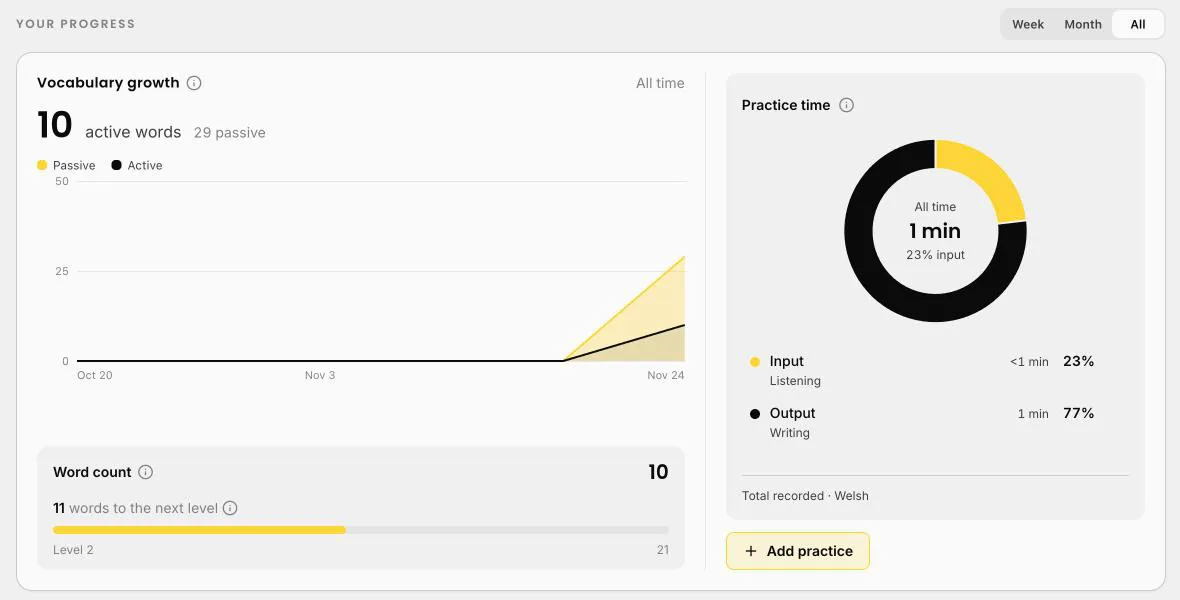
  3. Step 3We track every wordYour passive words are the ones you understand when you read or hear them. Your active words are the ones you’ve used yourself. You see both grow, how your time splits between input and output, and how many words to your next level.

Brand new to Welsh? Start somewhere else first. Teacher AI works best from about A2, once you can handle simple everyday sentences. Before that, you just don’t have enough words yet for open conversation. So learn the basics with Duolingo (free) or SaySomethingIn, which both teach Welsh from zero, and come back when you want to talk.

Teacher AI progress in Welsh after one chat and a short video: 10 active and 29 passive words, level 2, and practice time split into input and output
Your progress, in words10 Welsh words used, 29 understood, after one chat and a short video. You see your active and passive words grow, the words to your next level, and your practice time split into input and output.

What it looks like in Welsh

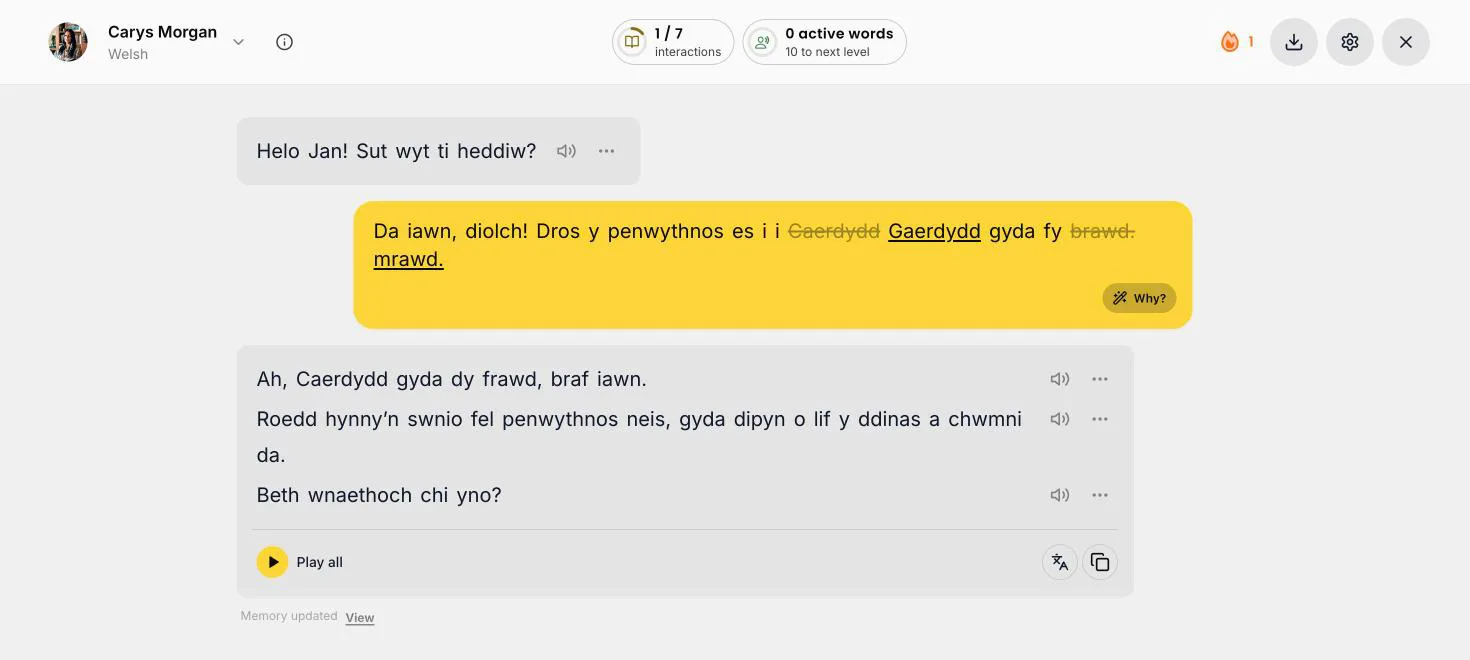
Here’s what a moment of practice looks like. You answer, your teacher replies, and if you made a mistake, your sentence gets fixed right there.

A card for every word you tap

Tap any word, in a conversation, a video or a story, and you get its card: what it means, what kind of word it is, and an example with a translation. Tap play to hear it.

hiraeth
a deep longing for home, or for a place or time you can’t go back to
NOUN
ExampleMae hiraeth arna i am Gymru. I miss Wales terribly.
Good to knowThere’s no one English word for it. Word for word, the example says “there’s hiraeth on me for Wales”, and Cymru mutates to Gymru after am.
cwtsh
a cuddle, a hug; a cosy little corner
NOUN
ExampleRho gwtsh i fi. Give me a cuddle.
Good to knowA South Wales favorite, and Welsh people use it in English too, spelled cwtch. The cupboard under the stairs can be a cwtch as well.
mam-gu
grandmother, grandma
NOUN
ExampleRoedd fy mam-gu yn siarad Cymraeg. My grandma spoke Welsh.
Good to knowThat’s the southern word. In the north, grandma is nain. Grandpa is tad-cu in the south and taid in the north.

An illustration of three word cards, rebuilt for this page. On the real card, the wording depends on the word. Below: real screenshots of the web app.

A Welsh conversation on Teacher AI with Carys: i Caerdydd corrected to i Gaerdydd, and fy brawd to fy mrawd
Corrected while you talkYou tell Carys you went to Cardiff with your brother at the weekend. I Caerdydd becomes i Gaerdydd, and fy brawd becomes fy mrawd. Then she asks what you did there.
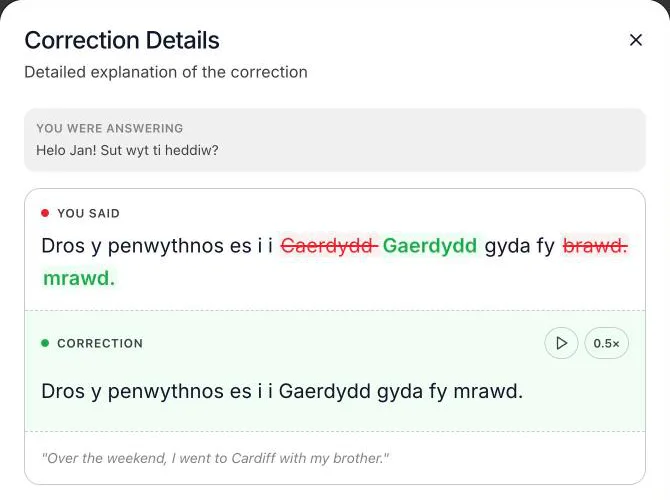
Teacher AI correction details for a Welsh sentence: Dros y penwythnos es i i Gaerdydd gyda fy mrawd, with a translation
Tap Why?Both mutations fixed: i Gaerdydd, to Cardiff, and fy mrawd, my brother. You see what you said, the fixed sentence, a translation and why, and you can save it as a flashcard.
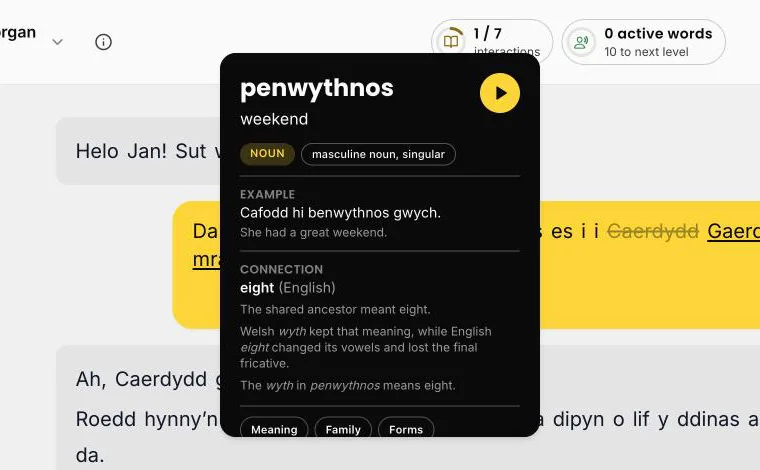
Teacher AI word card for penwythnos: weekend, a masculine noun, with an example and its link to the English word eight
Tap any wordTap penwythnos and you get weekend, an example, and a memory link: the wyth in it means eight, like English eight.
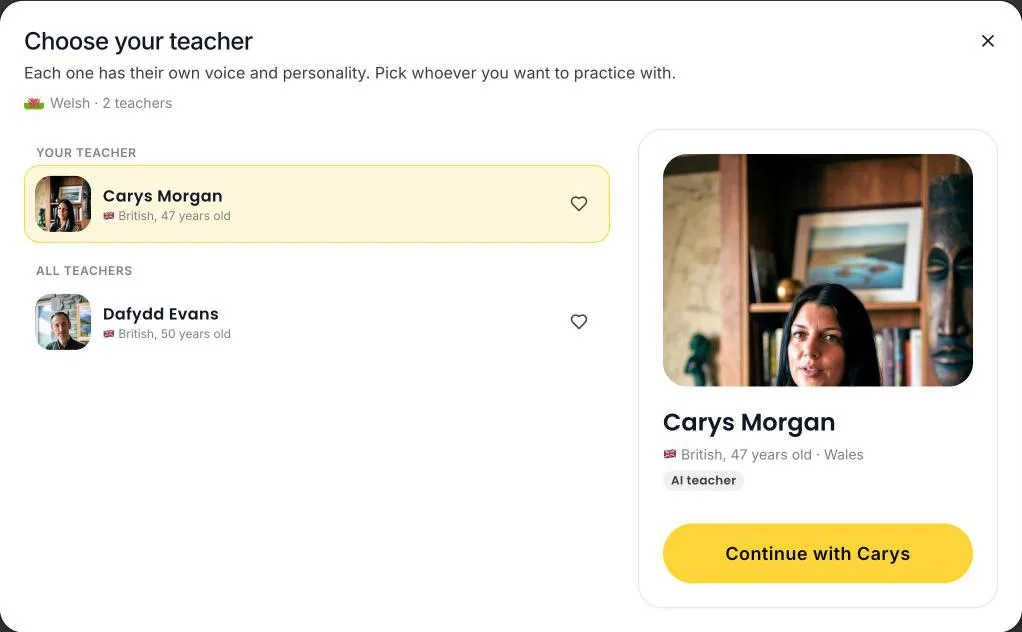
Teacher AI teacher picker for Welsh: Carys Morgan from Wales and Dafydd Evans
Two Welsh teachersCarys from Wales and Dafydd from Cardiff, each with their own voice. Your chat history stays when you switch.

Meet your Welsh teachers

Two teachers, both from Wales: Carys, and Dafydd from Cardiff. Each has their own voice. Pick the one you like, and switch whenever you want.

Teachers from Wales

  • Carys Morgan
    Carys Morgan
    Wales · British
  • Dafydd Evans
    Dafydd Evans
    Cardiff · British

Input: Welsh to watch and read, at your level

Here’s the input side up close. New words come from lots of Welsh you hear and read, where you already understand most of it. Living outside Wales? This is how you get Welsh around you every day.

Watch and Read are on the web app for now. Words you read along with, without tapping, count toward your passive words. Every word you tap lands in your flashcards. And when you’re done, you talk about it with your teacher.

  • Any YouTube videoPaste a link to a Welsh YouTube video, or an Apple Podcasts episode. We turn it into a page you read along with, new words in yellow. No subtitles? On a paid plan we transcribe it for you, within a monthly allowance.
  • Stories written for youRead writes Welsh texts at your level, from A1 to Native, about anything you like, and suggests ideas from what you talk about with your teacher.
  • How much you know, before you startTeacher AI keeps a list of every Welsh word you’ve met: the ones you use when you talk, the ones you read or hear, the ones you tap. It checks every word of a video or text against that list and shows you the share you already know.
  • The 80% rulePick videos and texts where you know 80% or more of the words. Then your brain fills in the rest from context. Under 70% is too much for now. 90% and up is easy and fun.
  • Then talk about itOne tap on Talk about this starts a conversation about what you just watched or read. Retelling it is how new words become words you can say.
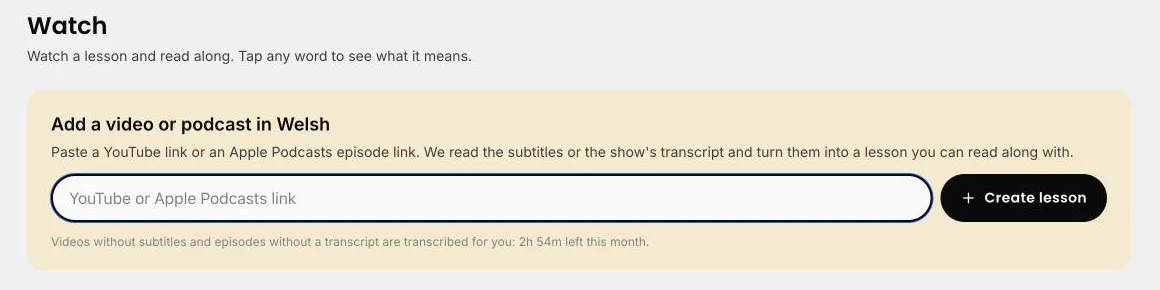
Teacher AI Watch in Welsh: paste a YouTube or Apple Podcasts link to make a lesson
Paste any Welsh videoPaste a link to a Welsh YouTube video or podcast and it becomes a lesson. No subtitles? On a paid plan we transcribe it, within a monthly allowance.
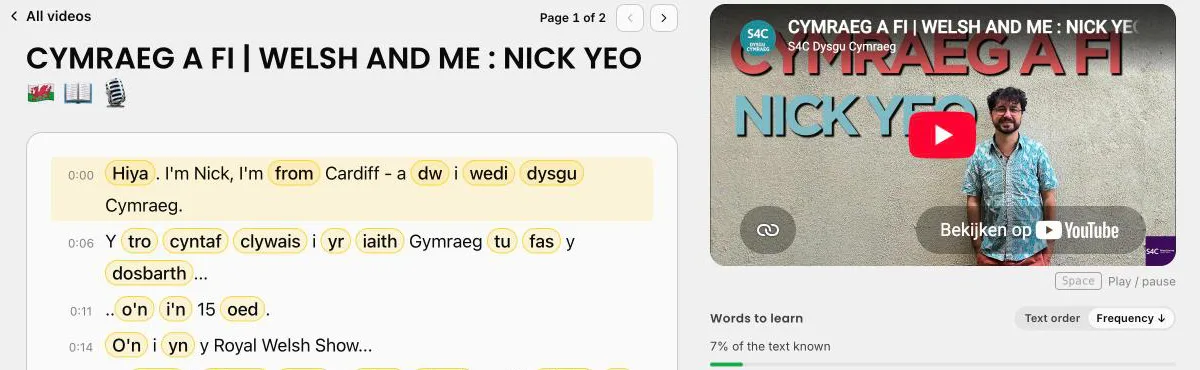
An S4C Dysgu Cymraeg video, Cymraeg a fi with Nick Yeo, as a Teacher AI lesson: the Welsh transcript with new words marked and 7% of the text known
Any video becomes a lessonNick from Cardiff on learning Welsh, from S4C’s Dysgu Cymraeg, as a lesson. The transcript follows the video, new words in yellow, and you see how much of the text you already know.
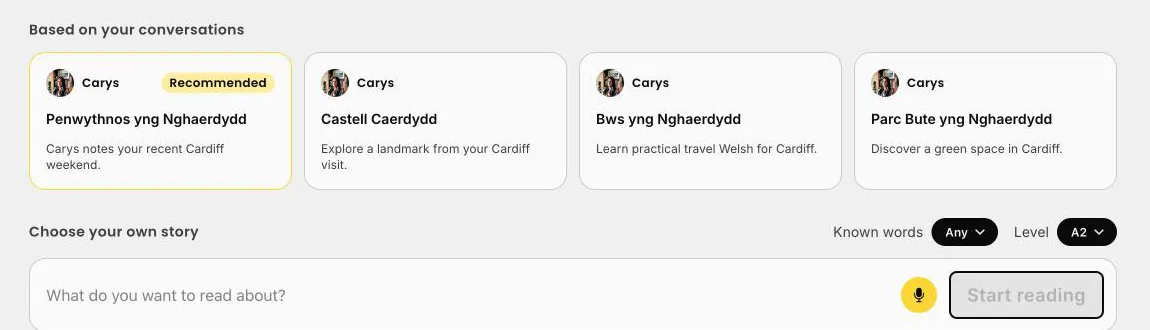
Teacher AI Read in Welsh: reading ideas about a weekend in Cardiff, Cardiff Castle, the buses in Cardiff and Bute Park
Ideas from your conversationsYou told Carys about your weekend in Cardiff. So Read suggests your weekend there, Cardiff Castle, getting around by bus and Bute Park.
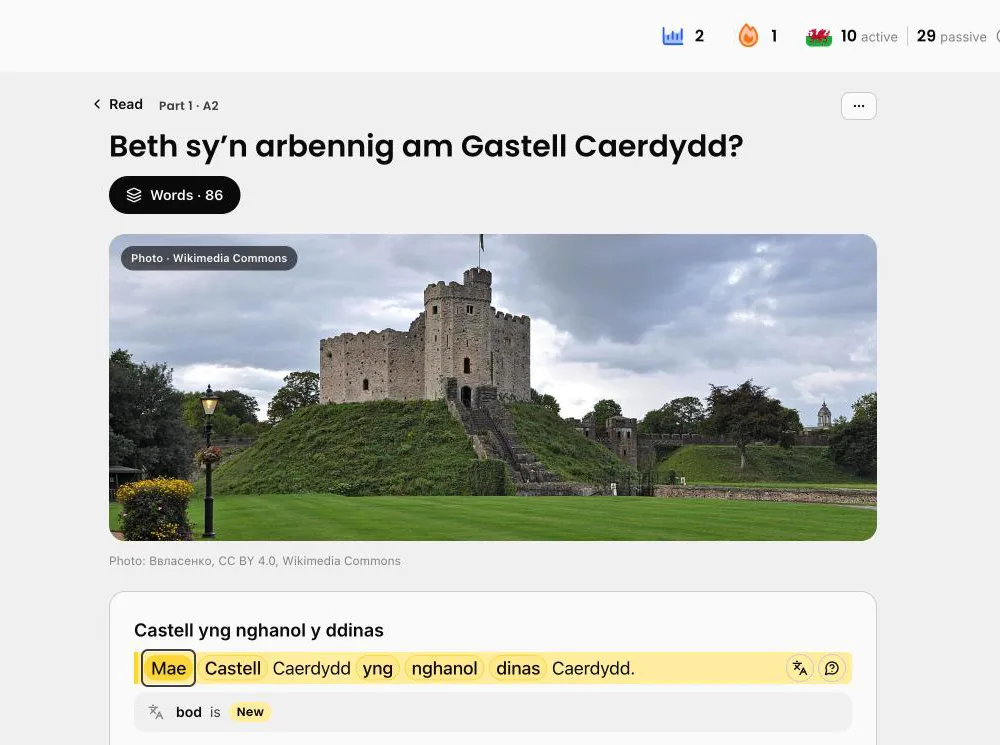
A Welsh story on Teacher AI at A2: Beth sy’n arbennig am Gastell Caerdydd?, with a photo of Cardiff Castle and new words marked
A story at your levelBeth sy’n arbennig am Gastell Caerdydd?, what’s special about Cardiff Castle?, at A2, with a photo of the castle. New words are in yellow, and one tap shows what a word means.

Teacher AI or Duolingo?

Lots of people start Welsh on Duolingo: 608,000 learners, it says. Good! So here’s how the two compare for speaking, with every Duolingo fact from Duolingo’s own pages.

Duolingo
Teacher AI
What it’s built for
Short lessons and exercises, as a daily game.
Conversation, plus Welsh to watch and read at your level, with every word you learn tracked.
Open conversation
Not for Welsh. Duolingo’s help center lists AI Video Call and Roleplay for other languages, not Welsh.
Unlimited on a paid plan, by voice or text, or hands-free in a call.
Corrections
Exercises are checked right or wrong. Explain My Answer isn’t listed for Welsh.
During the conversation: your own sentence is fixed, missed mutations included, and Why? explains each fix.
Teachers
Duolingo’s own characters.
Two from Wales, each with their own voice: Carys, and Dafydd from Cardiff.
Starting from zero
Yes. The course starts at the beginning, for free.
No. For Welsh, Teacher AI works best from about A2.
Where it works
iPhone, Android and web. Video Call and Roleplay only in the app.
iPhone, Android and web, conversations included.
Price (US)
Every course is free, with ads. Super Duolingo: $9.99 to $119.99 on the US App Store.
Start free on the website. Unlimited conversation: $149 a year on the web.

Duolingo is a good free way to learn your first Welsh words, and you can keep your streak. Once you reach about A2 and want to talk, that’s what Teacher AI is built for. Lots of people use both.

The apps side by side

FeatureTeacher AISaySomethingInTalkpalDuolingo
Teaches this languageYes, from about A2, with 2 teachers from Wales, one from Cardiff.Yes, full courses in both North and South Welsh.Yes, one of its 130+ languages. Its Welsh page doesn’t name levels.Yes, a free course from English. Its top level isn’t stated.
Open conversationUnlimited on a paid plan, by voice or text, or hands-free in a call. Free plan: one conversation.No AI conversation. An audio course you do out loud. Its community runs spoken practice sessions.Chat, calls, roleplays and debates. Unlimited on Premium.No for Welsh. Video Call and Roleplay aren’t listed for Welsh.
CorrectionsDuring the conversation: your message is marked up, and Why? explains each fix.Not on what you say yourself: you hear the right answer and compare.Feedback after each reply, and a tool that explains any sentence.Exercises are checked right or wrong. Explain My Answer isn’t listed for Welsh.
Pronunciation helpReplay your recording next to a native speaker saying the same line. No pronunciation score.You copy the voices in the lessons. No pronunciation score on its pages.Says it gives feedback on pronunciation, intonation and rhythm. Its Sentence Mode score is for selected languages, and doesn’t say if Welsh is one.Speaking exercises. No pronunciation score on its pages.
Reading aid for the scriptNot needed: Latin letters, plus the little roof, to bach: â, ê, î, ô, û, ŵ, ŷ. Type them on your keyboard, or just speak.Not needed: the course is about speaking.Not needed.Not needed.
Where it worksWeb, iOS and AndroidiPhone, Android and the web.Web, iOS and AndroidiOS, Android and web. Video Call and Roleplay: app only.
Price (US)Web: $149/year, $99/6 months, $25/month. App: $179, $119, $29.£15/month or £150/year for all its languages (website). $12 or $15 a month on the US App Store.$119.99/year or $19.99/month. On the web, $149.99 for 24 months.Super Duolingo: $9.99 to $119.99 on the US App Store, which doesn’t say which is monthly or yearly.
Free optionStart free on the website, no credit card.7 days free on its website. Its App Store page says free access up to the start of Orange Belt.10 minutes a day, free. 14-day trial, no payment up front.Every course is free, with ads.

Scroll the table sideways to see every app.

The apps, one by one

Teacher AI

Best for getting fluent: input, speaking and tracking
Speaking
Unlimited on a paid plan. Pick a conversation starter at your level, talk about anything in Free Talk, try a roleplay, or switch to hands-free and just talk. Your teacher stays in Welsh.
Teachers
Two for Welsh: Carys, and Dafydd from Cardiff.
Corrections
Your own sentence is fixed while you talk: a missed mutation after i or fy, like i Caerdydd for i Gaerdydd. Tap Why? for the explanation.
Progress
Your active and passive words, your practice time split into input and output, and 100 levels with the matching CEFR level.
Watch and Read
Turn a Welsh YouTube video or podcast into a lesson (no subtitles? we transcribe it on a paid plan), and read stories at your level. Both show the share of words you already know. On the web app.
Not so good
Not for complete beginners: for Welsh, it works best from about A2, so learn the basics with Duolingo or SaySomethingIn first. Only two Welsh teachers so far. And there’s no pronunciation score.

SaySomethingIn

Best audio course, North or South Welsh
Course
Full Welsh courses in both North and South Welsh, its FAQ says. SaySomethingIn started with Welsh in 2009, and says tens of thousands of learners have started there.
Speaking
High intensity speaking exercises: an audio course you do out loud (“out loud is the course”). It teaches mutations by having you say them over and over, not with rules. Its community runs spoken practice sessions.
Not so good
No AI conversation, and nothing that corrects the sentences you make up yourself. And the course is about speaking, not reading or writing.
Price
£15 a month or £150 a year on its website, for all its languages, with 7 days free.

Talkpal

Cheaper, with open AI chat
Welsh
One of its 130+ languages, with its own Learn Welsh page. Chat, Call Mode, roleplays and debates with an AI tutor. Unlimited on Premium, 10 minutes a day for free.
Not stated
Anything Welsh-specific, like the mutations or North and South Welsh. And whether its pronunciation score (Sentence Mode, “available for selected languages”) covers Welsh.
Price
$119.99 a year or $19.99 a month on the US App Store, with a 14-day trial.

Duolingo

Best free start
Course
A free Welsh course for English speakers, with 608,000 learners. Its pages don’t say up to which level, or whether it’s North or South Welsh.
Speaking
Speaking exercises for free. But Duolingo’s help center lists neither AI Video Call nor Roleplay for Welsh, and Explain My Answer isn’t listed for Welsh either.
Not so good
No open conversation in Welsh listed. Duolingo says nine of its courses now go up to B2, and Welsh isn’t one of them.

Where another app might suit you better

Live in Wales, or want a class with a human tutor? Learn Welsh, the National Centre for Learning Welsh, runs courses with a tutor at every level, from Entry for people with no Welsh, in a classroom or in a virtual classroom online. There’s a free online taster course, and courses are free if you’re 16 to 25, or work in education.

Want an app for the mutations? blas., a Celtic languages app with Welsh, Irish and Scottish Gaelic among its six languages, has drills on consonant mutations and speech recognition for pronunciation. Its App Store page doesn’t mention AI conversation. $99.99 a year.

And if you’re looking at Speak, Langua, Praktika, Babbel, Busuu, Pimsleur, Jumpspeak, Ling or Mondly: none of them teaches Welsh. Memrise has no official Welsh course page either.

Try Teacher AI for free →No credit card needed

Questions people ask

What’s the best app to practice speaking Welsh?

For getting fluent, Teacher AI: talk about anything for as long as you like, with Carys or Dafydd from Cardiff, and a Why? on every correction. Plus Welsh videos and stories at your level, and every word you learn tracked. For an audio course in North or South Welsh, SaySomethingIn. For a cheaper AI chat, Talkpal.

Is Welsh hard to learn?

Harder than German, easier than Irish. In our ranking of 67 languages, Welsh is the 40th hardest for English speakers, at 4,944 effort points. The spelling is the quick part: once you know the rules, you can read any word out loud. The mutations, the verb-first sentences and the many kinds of yes are what take practice, out loud.

Should I learn North or South Welsh?

Pick the one your family speaks, or the one where you live or want to live. They’re one language, and speakers from the north and south understand each other. The differences are mostly some everyday words, like nawr and rŵan for now, and a few ways of saying things. On Teacher AI, Dafydd is from Cardiff, in the south. SaySomethingIn has full courses in both.

Do I need to learn the mutations before I talk?

No. Nobody learns the tables first and talks later. A handful do most of the work: the soft mutation after i, to, and dy, your, and the nasal one after fy, my. You pick them up by using them and having the wrong ones fixed. That’s what your teacher does, with a Why? on each fix.

Why do Welsh speakers switch to English when I try?

Mostly to be kind. Every Welsh speaker also speaks English, so when they hear a learner, many switch to help you out. Say Dw i’n dysgu Cymraeg, I’m learning Welsh, and ask them to stay in Welsh. The more fluent you sound, the less they switch, and lots of practice with a teacher who keeps talking Welsh is how you get there.

I’ve done Duolingo or SaySomethingIn. What now?

Talk. Duolingo and SaySomethingIn are great ways to learn your first Welsh words. But neither lets you hold an open conversation with an AI in Welsh. Once you can handle simple everyday sentences, Teacher AI is where you practice saying your own sentences, about anything, with every mistake explained. Lots of people keep their streak going too.

Does Speak teach Welsh?

No. Speak teaches English speakers Spanish, French, Korean, Japanese, Italian and Chinese. Langua, Praktika, Babbel and Busuu don’t teach Welsh either.

Can a complete beginner use Teacher AI for Welsh?

Not really. For Welsh, Teacher AI works best from about A2, once you can handle simple everyday sentences. Before that, you just don’t have enough words yet for open conversation. Starting from zero? Learn the basics with Duolingo or SaySomethingIn first, then come here to talk. (Spanish and French are different: they have a beginner track from zero.)

Is Teacher AI only for speaking?

No. It’s a complete fluency system. Speaking is how you activate your Welsh. On the web app you also grow it: turn a Welsh YouTube video or podcast into a lesson, and read stories at your level. And Teacher AI tracks the words you understand and the words you use, so you see your progress in real numbers.

Is Teacher AI better than Duolingo for speaking Welsh?

For speaking, yes. Teacher AI is built around conversation, unlimited on a paid plan, on the web and on your phone. Duolingo’s Welsh course is free, but its help center lists neither Video Call nor Roleplay for Welsh. Lots of people use both: Duolingo for the basics and a daily habit, Teacher AI for the conversations.

Sources, checked November 15, 2026

Head-to-head comparisons

Teacher AI vs Talkpal · Teacher AI vs Duolingo. All comparisons.

Other languages

SpanishSpain and Latin AmericaFrenchFrance, Belgium and SwitzerlandMandarin ChineseSimplified or Traditional, with pinyinCantoneseHong Kong, with JyutpingThaiWith spaces between words, and Paiboon+ or IPAJapaneseWith furigana or romaji, and a kanji countDutchThe Netherlands and Flanders, with Flemish voicesBrazilian PortugueseWith Brazilian teachers and well-known polyglotsItalianWith Italian teachers from Podcast Italiano and Vaporetto ItalianoGermanWith German and Austrian teachers, from Lingster Academy to Herr AntrimEuropean PortugueseWith teachers from Lisbon, Porto, Coimbra and Faro, and Portuguese With LeoEnglishWith American and British teachers, from Espresso English to English Like A NativeKoreanWith teachers from Seoul and Busan, and every dropped 요 fixedRussianWith the stress marked above every wordTurkishWith Can from Turkishle, and every ending fixed as you talkArabicWith teachers from Cairo, Amman and Jeddah, and a straight answer on MSA or dialectPolishWith teachers from Warsaw, and every case ending fixedSwedishPitch accent, en or ett, and nobody switching to EnglishIndonesianWith teachers from Bali and Bandung, for the Indonesian people actually speakHindiWith teachers from Delhi, Jaipur and Mumbai, and every missing ने fixedRomanianWith teachers from Bucharest and Transylvania, and every ending explainedCatalanFor when Barcelona keeps answering you in SpanishVietnameseWith teachers from Hanoi and Sapa, and every tone, classifier and pronoun fixedUkrainianWith two teachers from Lviv, and every case fixed as you talkGreekWith teachers from Crete and Thessaloniki, and every gender and ending explainedHebrewFor Hebrew without the vowels, with two teachers from Tel AvivNorwegianBokmål in the app, dialect on TV, and two melodiesDanishThe soft d, the stød, and Danes who switch to EnglishCzechWith Klara and Lukáš from Brno, and a Why? on every case endingFinnishFifteen cases, long vowels, and Finnish as it’s really spokenAfrikaansFor the South African in your life, and for Dutch speakersArmenianEastern Armenian with teachers from Yerevan and Gyumri, for the diaspora tooAzerbaijaniFor Baku, for family, and for Turkish speakersBelarusianFor families, heritage learners and the diasporaBulgarianWhere “the” goes on the end, and a nod means noCebuanoFor Bisaya families, and for life in Cebu, Davao and DumagueteCroatianFor the coast, the in-laws, and talking with bakaEstonianFor e-residents, Tallinn’s tech scene, and Finnish speakersGalicianFor Galicia, the Camino, and the family back homeGeorgianFor life in Tbilisi, the supra, and your Georgian in-lawsHungarianFor life in Budapest, your Hungarian family, and every -ban and -benIcelandicFor when Reykjavík keeps answering you in EnglishIrishFor bringing your school Irish back to life, with Aoife from Dublin and Seán from GalwayJavaneseFor the in-laws, and for life in Yogyakarta, Solo or SurabayaKazakhFor when Almaty keeps answering you in RussianKyrgyzFor when Bishkek answers you in RussianLatvianWith teachers from Riga, and every long vowel and case ending fixedLingalaWith a teacher from Kinshasa, for family, rumba and the French in betweenLithuanianWith teachers from Vilnius, and every case ending fixedLuxembourgishFor when everyone in Luxembourg switches to French, and for the SproochentestMacedonianThree ways to say “the”, and the stress always in the same placeMalayFor living in Malaysia, with teachers from Penang, lah and allSerbianTwo alphabets, seven cases, and teachers from SerbiaSlovakFor your Slovak family, life in Bratislava, and Czech speakersSlovenianFor your partner’s family, life in Ljubljana, and the dualSwahiliWith teachers from Tanzania and Nairobi, and every ki- and vi- fixedTagalogFor partners, families and heritage learners, with po, opo and plenty of Taglish

The best way to find out is to talk

Pick a teacher and have a real conversation in Welsh. Then decide.

No credit card needed

Available oniPhone and iPadAndroidWeb app