Hungarian · For life in Budapest, your Hungarian family, and every -ban and -ben

The best AI apps to practice speaking Hungarian

Updated November 15, 2026. We checked every other app on its own website, help pages and app store page. See the sources.

We built Teacher AI, so of course we’re biased. That’s why we link every claim we make about another app, and tell you plainly when another app suits you better.

Available oniPhone and iPadAndroidWeb app

An illustration of the conversation screen, rebuilt for this page with Hungarian text.

The short answer

Hungarian is more than twice as hard as Spanish for English speakers: 12th of the 67 languages in our ranking, and the hardest official EU language in it. Not because of the letters, but because of the endings, the two ways to say every verb, and words that look nothing like English. And few AI speaking apps teach it. Speak, Langua and Praktika don’t. Talkpal has open AI chat in Hungarian, and Jumpspeak has role-plays with its AI Tutor, without a full course. Duolingo, Ling and Pimsleur have courses, but no AI conversation in Hungarian.

Here’s our honest take. Pick Teacher AI if you want to get fluent, not just practice: for life in Budapest, for your partner’s family, or to finally speak the Hungarian you grew up hearing. You get lots of real conversation with Katalin from Budapest or István from Debrecen, and a Why? on every correction, from -ban or -ben to látok or látom. Plus Hungarian videos and stories at your level, and we track every word you learn. Pick Talkpal for open AI chat at a lower price.

Starting from zero? Teacher AI works best for Hungarian from about A2. Learn the basics with Duolingo (free) or Pimsleur first.

  1. Best for getting fluent: input, speaking and trackingTeacher AITalk about anything, for as long as you like, with teachers from Budapest and Debrecen, and every ending explained. Grow your Hungarian with videos and stories at your level, and watch your active and passive words climb. Web, iPhone and Android, $149 a year.
  2. Cheaper, with open AI chatTalkpalHungarian is one of its 130+ languages, with chat, calls and roleplays. $119.99 a year, or 10 minutes a day for free. Its pages don’t say if its pronunciation score covers Hungarian.
  3. AI role-plays on your phoneJumpspeakRole-played chats with its AI Tutor, and feedback after each one. No full Hungarian course. Premium caps AI time at 7 minutes a day. $79 a year.
  4. Game-style lessons with a speaking gameLingLessons, dialogue games and a speaking game that checks your voice. $89.99 a year, with a free plan.
  5. Best free startDuolingoA free Hungarian course, with ads, and about 579,000 learners. No AI conversation in Hungarian listed.

A fluency system, built by polyglots

Teacher AI isn’t a chatbot with a language menu. It’s a fluency system, built by some of the most accomplished polyglots and language teachers around. People who learned many languages themselves, and know what actually gets you speaking.

  • Arieh Smith
    Arieh Smith
    Xiaoma · the world’s most viral polyglot
  • Lucas Bighetti
    Lucas Bighetti
    One of the world’s best polyglots · speaks 20+ languages
  • Olly Richards
    Olly Richards
    Author · 2M+ books sold · StoryLearning founder
  • Jan van der Aa
    Jan van der Aa
    Runs the leading network for online language entrepreneurs

“I’ve tried lots of this type of app. This is the best one. It feels like it’s created by someone who understands language learning.”

Jcalebmi, App Store review, October 2026

What you need to practice speaking Hungarian

Hungarian takes work. In our ranking of 67 languages it’s the 12th hardest for English speakers, at 6,819 effort points. That’s more than twice what Spanish takes (2,941), and more than Turkish (6,521), Polish (6,329) or its far-off cousin Finnish (5,759). No other official EU language in our ranking comes higher.

Some of it is easy. Hungarian uses Latin letters, the spelling is regular, the stress is always on the first syllable, and there’s no gender: ő means he and she. Learn that s sounds like “sh” and sz like “s”, and you can read most words aloud. What makes it hard is the rest: almost no words look like English (window is ablak, thank you is köszönöm), and you build every sentence from endings, on the fly.

  • Endings instead of prepositionsWhere English says “in”, “from” or “to”, Hungarian adds an ending, and there are around 18 of these cases, depending on how you count. Ház is a house: a házban, in the house, a házból, out of it, a házba, into it, a háznál, at it. And vowel harmony picks the vowel: a házban, but a kertben, in the garden. Endings stack, too: a házaimban, in my houses. Towns pick their own: you live Budapesten, but Debrecenben.
  • Two ways to say every verbHungarian verbs change with the object. Látok egy kutyát: I see a dog. Látom a kutyát: I see the dog. Same verb, a different ending, because “the dog” is definite. And “I … you” has its own ending: szeretlek, I love you, hívlak, I’ll call you. You choose the right form every time you say a verb with an object.
  • Long and short soundsAn accent on a vowel makes it long, and that changes the word. Kor is age, kór is disease. Öt is five, őt is him or her. Double consonants count too: megy, goes, and meggy, a sour cherry. You learn to hear and hold the length by saying it, over and over.
  • Te, maga or ön?How you say “you” changes the verb. A friend gets te: Hogy vagy?, how are you? Your partner’s parents may get ön or maga, with the verb in the third person: Hogy van? Children, and plenty of adults, greet older people with csókolom, and ask with tetszik: Hogy tetszik lenni? Getting this right is half of sounding polite in a Hungarian family.
  • Lots of Hungarian you understandSpeaking activates the words you have. New words come from input: Hungarian videos, podcasts and texts where you already understand most of it. With so few words that look like English, that’s where most of your vocabulary will come from.
  • Lots of speaking timeA language this hard takes hours of talking. A few minutes a day won’t get you there.

A complete fluency system, not just a speaking app

Our speaking practice is the heart of Teacher AI. But speaking alone won’t make you fluent, and neither will input alone. You need both, and you need to see it working.

So Teacher AI is a complete fluency system. Input grows your Hungarian. Speaking activates it. And we track every word along the way, to get you to real fluency as fast as we can.

  1. Step 1Input grows your vocabularyWatch Hungarian YouTube videos and podcasts, and read stories written at your level. You always see how much you already understand, and every word you tap becomes a flashcard. How Watch and Read work.
  2. Step 2Speaking activates itKnowing a word isn’t the same as using it, with the right ending, the right vowel and the right form of the verb. Talking with your teacher, for as long as you like, is how words move from “I know that one” to “I just said it”. Every mistake gets fixed, with a Why?.
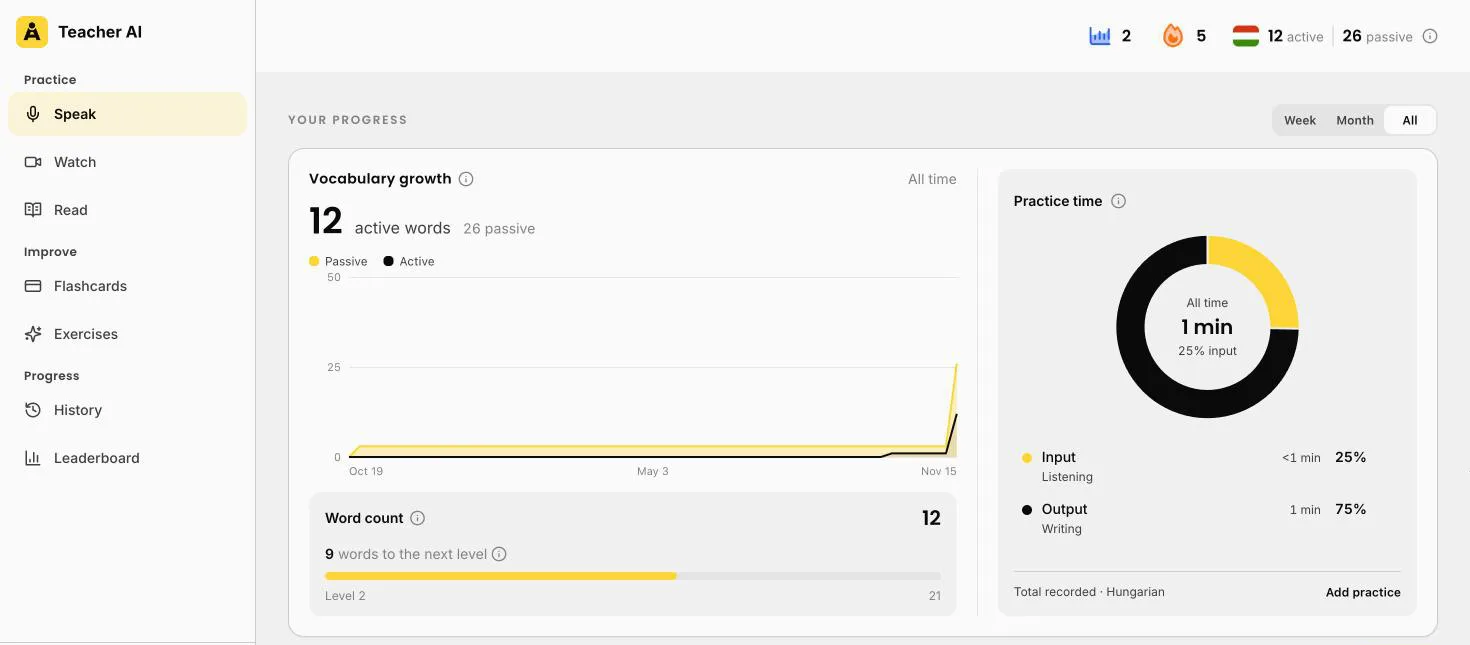
  3. Step 3We track every wordYour passive words are the ones you understand when you read or hear them. Your active words are the ones you’ve used yourself. You see both grow, how your time splits between input and output, and how many words to your next level.

Brand new to Hungarian? Start somewhere else first. Teacher AI works best from about A2, once you can handle simple everyday sentences. Before that, you just don’t have enough words yet for open conversation. So learn the basics with Duolingo (free) or Pimsleur, which both teach Hungarian from zero, and come back when you want to talk.

Teacher AI progress in Hungarian after a chat and a video: 12 active and 26 passive words, level 2, and practice time split into input and output
Your progress, in words12 Hungarian words used, 26 understood. You see your active and passive words grow, the words to your next level, and your practice time split into input and output.

What it looks like in Hungarian

Here’s what a moment of practice looks like. You answer, your teacher replies, and if you made a mistake, your sentence gets fixed right there.

A card for every word you tap

Tap any word, in a conversation, a video or a story, and you get its card: what it means, what kind of word it is, and an example with a translation. Tap play to hear it.

csókolom
hello (polite, to an older person)
PHRASE
ExampleCsókolom, Marika néni! Hello, Auntie Marika!
Good to knowLiterally “I kiss it”, short for kezét csókolom, I kiss your hand. Kids say it to adults, and lots of people still say it to older women. Your partner’s grandmother will notice.
puszi
a kiss on the cheek; love (at the end of a message)
NOUN
ExampleHolnap hívlak. Puszi! I’ll call you tomorrow. Love!
Good to knowFriends and family greet each other with two puszi, and sign off texts with it. Hívlak is the “I … you” form of hív, to call.
kocsi
car
NOUN
ExampleKocsival megyünk a Balatonra. We’re driving to Lake Balaton.
Good to knowEnglish “coach” comes from it: a kocsi was a cart from Kocs, a village in Hungary.

An illustration of three word cards, rebuilt for this page. On the real card, the wording depends on the word. Below: real screenshots of the web app.

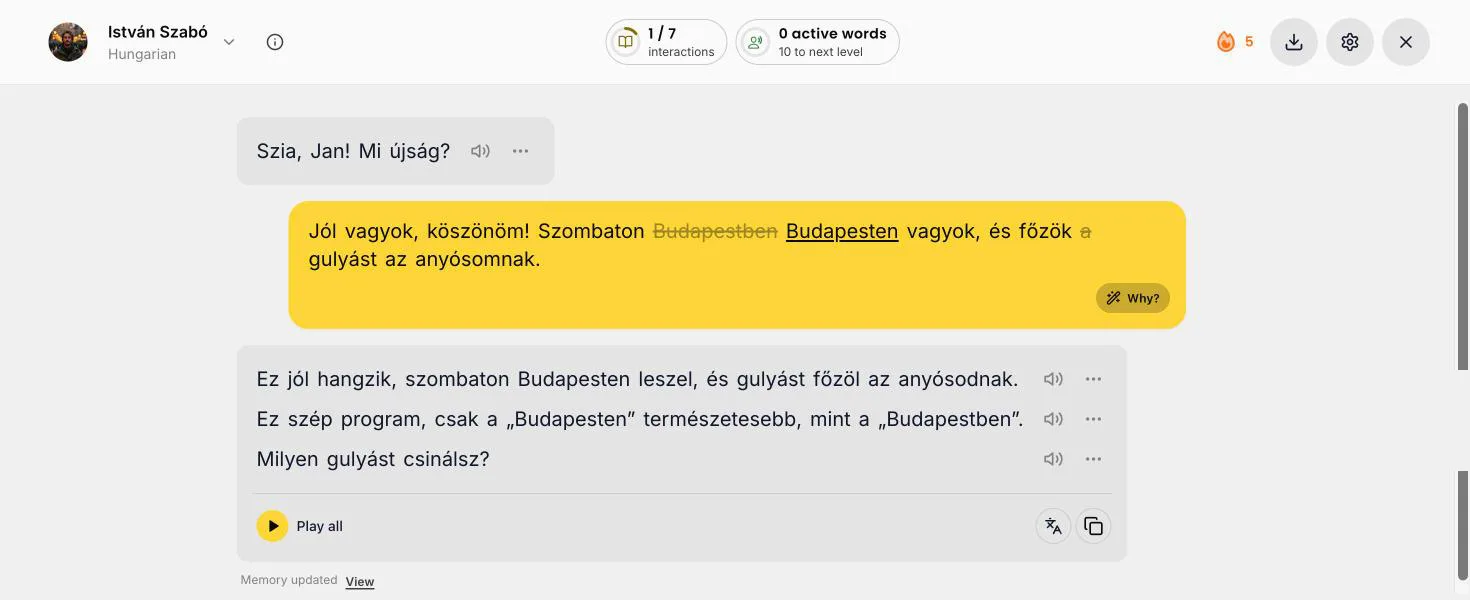
A Hungarian conversation on Teacher AI with István: Budapestben corrected to Budapesten
Corrected while you talkYou tell István you’re cooking goulash for your mother-in-law in Budapest. Budapestben becomes Budapesten, and he points it out again in his reply. Above the text box: á, é and í.
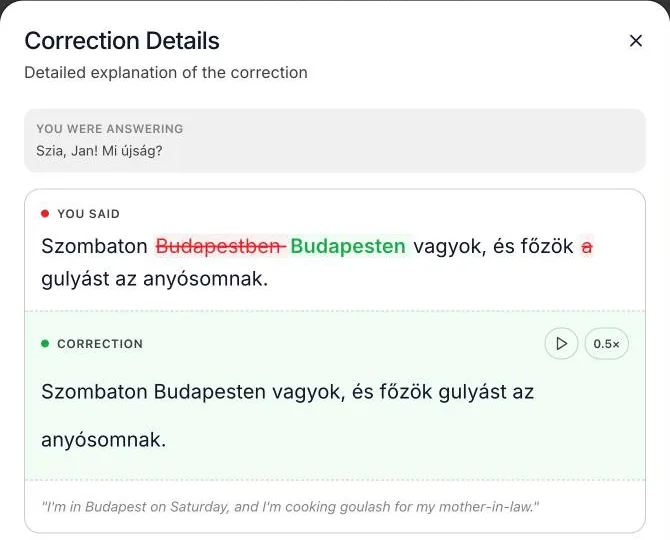
Teacher AI correction details for a Hungarian sentence: Szombaton Budapesten vagyok, with the fixed sentence and a translation
Tap Why?Budapest takes -en, not -ben: Budapesten, in Budapest. You see what you said, the fixed sentence, a translation and why, and you can save it as a flashcard.
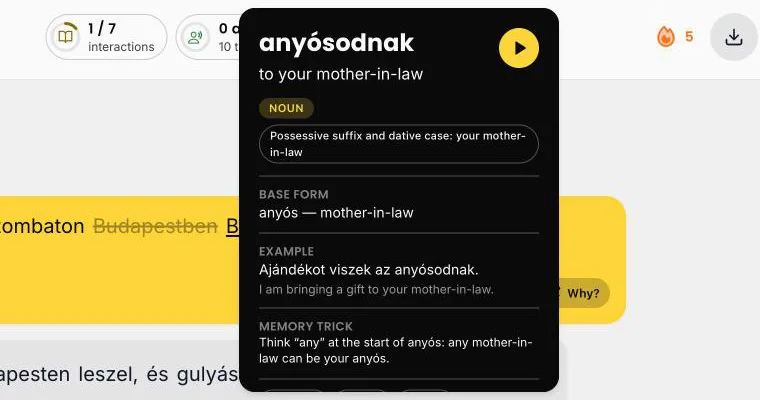
Teacher AI word card for anyósodnak: to your mother-in-law, with the suffixes explained, the base form anyós, an example and a memory trick
Tap any wordTap anyósodnak and you get to your mother-in-law, what its endings do, the base form anyós, an example and a memory trick.
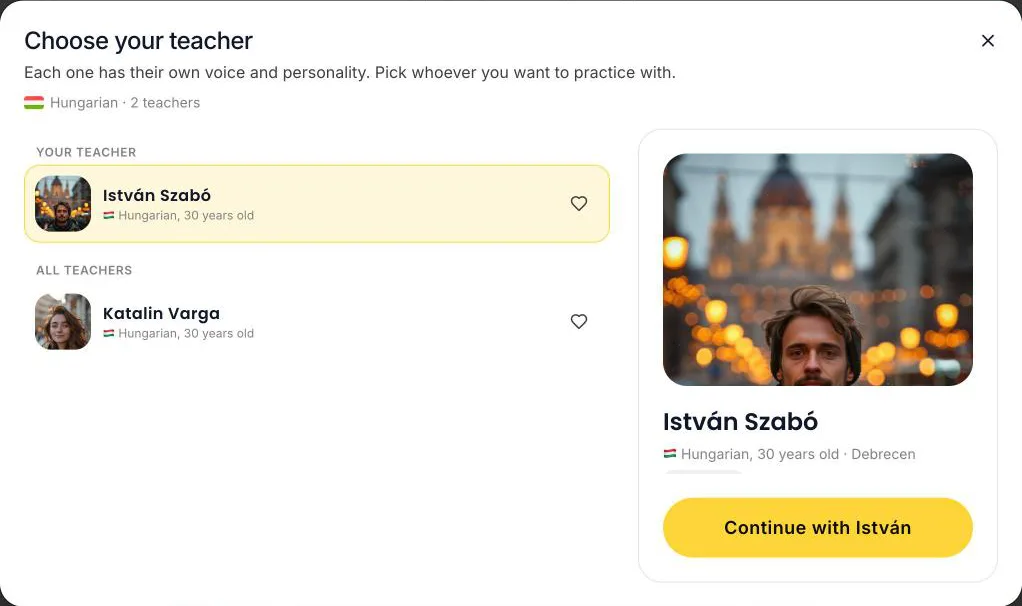
Teacher AI teacher picker for Hungarian: István Szabó from Debrecen and Katalin Varga
Two Hungarian teachersIstván from Debrecen and Katalin from Budapest, each with their own voice. Your chat history stays when you switch.

Meet your Hungarian teachers

Two teachers, both from Hungary: Katalin from Budapest, and István from Debrecen, Hungary’s second city, out in the east. Each has their own voice. Pick the one you like, and switch whenever you want.

  • István Szabó
    István Szabó
    Debrecen · Hungarian
  • Katalin Varga
    Katalin Varga
    Budapest · Hungarian

Input: Hungarian to watch and read, at your level

Here’s the input side up close. New words come from lots of Hungarian you hear and read, where you already understand most of it.

Watch and Read are on the web app for now. Words you read along with, without tapping, count toward your passive words. Every word you tap lands in your flashcards. And when you’re done, you talk about it with your teacher.

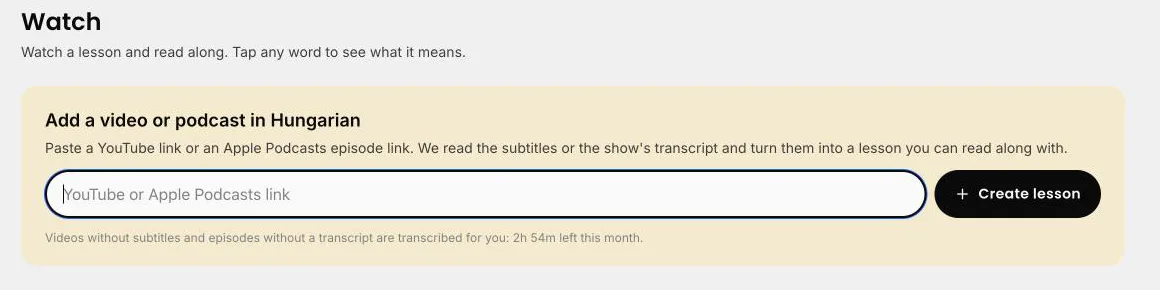
  • Any YouTube videoPaste a link to a Hungarian YouTube video, or an Apple Podcasts episode. We turn it into a page you read along with, new words in yellow. No subtitles? On a paid plan we transcribe it for you, within a monthly allowance.
  • Stories written for youRead writes Hungarian texts at your level, from A1 to Native, about anything you like, and suggests ideas from what you talk about with your teacher.
  • How much you know, before you startTeacher AI keeps a list of every Hungarian word you’ve met: the ones you use when you talk, the ones you read or hear, the ones you tap. It checks every word of a video or text against that list and shows you the share you already know.
  • The 80% rulePick videos and texts where you know 80% or more of the words. Then your brain fills in the rest from context. Under 70% is too much for now. 90% and up is easy and fun.
  • Then talk about itOne tap on Talk about this starts a conversation about what you just watched or read. Retelling it is how new words become words you can say.
Teacher AI Watch in Hungarian: paste a YouTube or Apple Podcasts link to make a lesson
Paste any Hungarian videoPaste a link to a Hungarian YouTube video or podcast and it becomes a lesson. No subtitles? On a paid plan we transcribe it, within a monthly allowance.
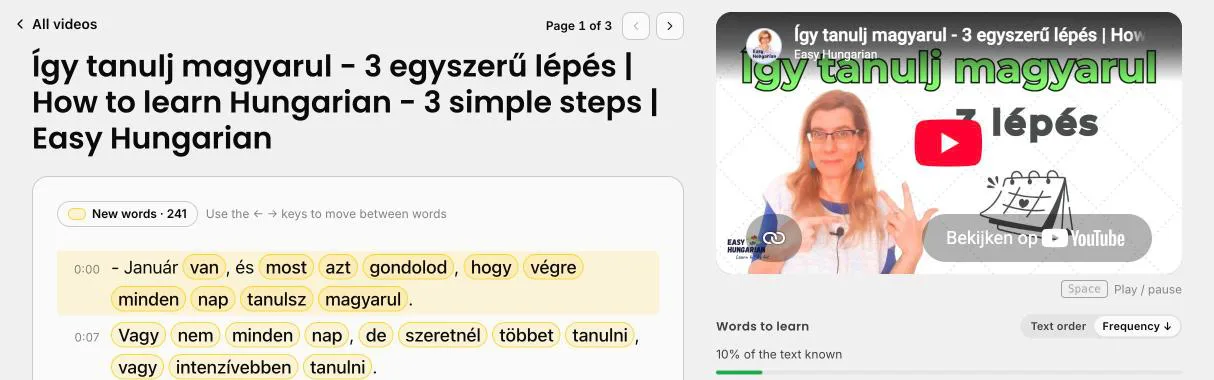
An Easy Hungarian video, How to learn Hungarian in 3 simple steps, as a Teacher AI lesson: the Hungarian transcript with new words marked
Any video becomes a lessonPetra from Easy Hungarian on how to learn Hungarian in three steps, as a lesson. The transcript follows the video, new words in yellow, and one tap starts a conversation about it with István.
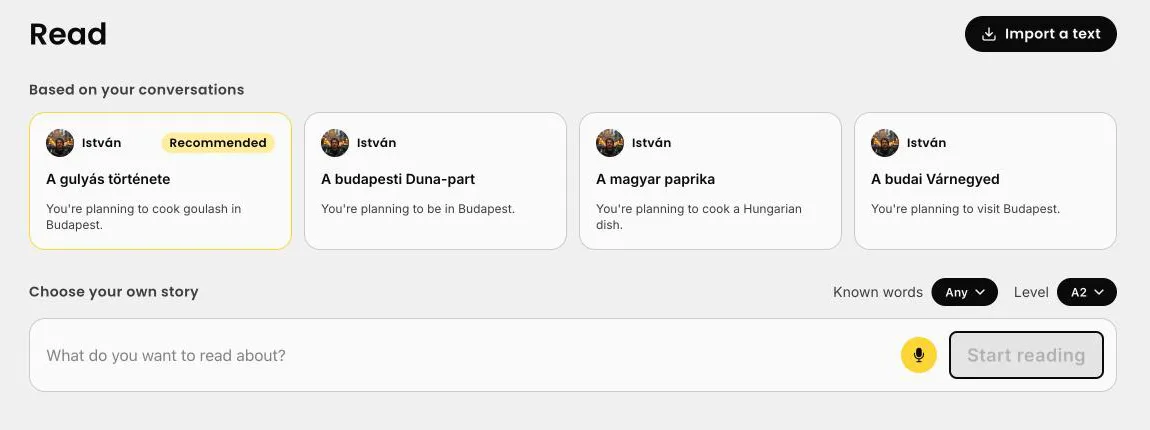
Teacher AI Read in Hungarian: reading ideas about the history of goulash, the Danube in Budapest, Hungarian paprika and the Buda Castle District
Ideas from your conversationsYou told István about cooking goulash in Budapest. So Read suggests the history of goulash, Hungarian paprika, the Danube embankment and the Buda Castle District.
A Hungarian story on Teacher AI at A2: Hogyan lett híres a gulyás?, with levels A1 to Native, a photo of goulash and new words marked
A story at your levelHogyan lett híres a gulyás?, how did goulash get famous?, at A2. Did you know a gulyás was first a herdsman? New words are in yellow, and Words to learn starts with the most common ones.

Teacher AI or Duolingo?

Lots of people start Hungarian on Duolingo: about 579,000 learners, it says. Good! So here’s how the two compare for speaking, with every Duolingo fact from Duolingo’s own pages.

Duolingo
Teacher AI
What it’s built for
Short lessons and exercises, as a daily game. Its pages don’t say what level the Hungarian course reaches.
Conversation, plus Hungarian to watch and read at your level, with every word you learn tracked.
Open conversation
Not for Hungarian. Duolingo’s help center lists AI Video Call and Roleplay for other languages, not Hungarian.
Unlimited on a paid plan, by voice or text, or hands-free in a call.
Corrections
Exercises are checked right or wrong. Explain My Answer isn’t listed for Hungarian.
During the conversation: your own sentence is fixed, and Why? explains each fix, case endings and verb forms included.
Teachers
Duolingo’s own characters.
Two from Hungary, each with their own voice: Katalin from Budapest and István from Debrecen.
Starting from zero
Yes. The course starts at the beginning, for free.
No. For Hungarian, Teacher AI works best from about A2.
Where it works
iPhone, Android and web. Video Call and Roleplay only in the app.
iPhone, Android and web, conversations included.
Price (US)
Every course is free, with ads. Super Duolingo: $9.99 to $119.99 on the US App Store.
Start free on the website. Unlimited conversation: $149 a year on the web.

Duolingo is a good free way to learn your first Hungarian words, and you can keep your streak. Once you reach about A2 and want to talk, that’s what Teacher AI is built for. Lots of people use both.

The apps side by side

FeatureTeacher AITalkpalJumpspeakLingDuolingo
Teaches this languageYes, from about A2, with 2 teachers, from Budapest and Debrecen.Yes, one of its 130+ languages.AI Tutor only. No full course for Hungarian.Yes, a Hungarian course.Yes, a free course from English. Its pages don’t say what level it reaches.
Open conversationUnlimited on a paid plan, by voice or text, or hands-free in a call. Free plan: one conversation.Chat, Call Mode and roleplays. Unlimited on Premium.Role-played chats with its AI Tutor. Premium: 7 minutes a day, 60 a month.Dialogue games. Its AI Tutor covers Thai only.Not for Hungarian. AI Video Call and Roleplay don’t list it.
CorrectionsDuring the conversation: your message is marked up, and Why? explains each fix.Feedback after each reply.Written feedback on grammar, vocabulary and speaking after each conversation.Its speaking game checks your answers with speech recognition.Right or wrong checks in exercises. Explain My Answer doesn’t list Hungarian.
Pronunciation helpReplay your recording next to a native speaker saying the same line. No pronunciation score.Says it gives feedback on pronunciation, intonation and rhythm. Its Sentence Mode score is for selected languages, and doesn’t say if Hungarian is one.Speech feedback, its pages say. They don’t say if it covers Hungarian.Google’s voice recognition in a speaking game. No score on its own pages.Speaking exercises. No pronunciation score on its pages.
Reading aid for the scriptNot needed: Latin letters, plus á, é, í, ó, ö, ő, ú, ü and ű. In text mode, a row with á, é and í sits above the text box. For the rest, add a Hungarian keyboard, or just speak.Not needed.Not needed.Not needed.Not needed.
Where it worksWeb, iOS and AndroidWeb, iOS and AndroidiPhone and Android only. Not on a computer.iOS, Android and web.iOS, Android and web.
Price (US)Web: $149/year, $99/6 months, $25/month. App: $179, $119, $29.$119.99/year or $19.99/month. On the web, $149.99 for 24 months.$79/year or $69 for 3 months (its pricing page).$89.99/year, $64.99/6 months, $16.99/month (website).Super Duolingo: $9.99 to $119.99 on the US App Store, which doesn’t say which is monthly or yearly.
Free optionStart free on the website, no credit card.10 minutes a day, free. 14-day trial, no payment up front.No free plan stated. A 100-day money-back guarantee on its website.A free plan with limited lessons, and a 7-day trial.Every course is free, with ads.

Scroll the table sideways to see every app.

The apps, one by one

Teacher AI

Best for getting fluent: input, speaking and tracking
Speaking
Unlimited on a paid plan. Pick a conversation starter at your level, talk about anything in Free Talk, try a roleplay, or switch to hands-free and just talk.
Teachers
Two for Hungarian: Katalin from Budapest and István from Debrecen.
Corrections
Your own sentence is fixed while you talk, and Why? explains it: -ban where you needed -ben, Budapestben for Budapesten, látok where you needed látom.
Progress
Your active and passive words, your practice time split into input and output, and 100 levels with the matching CEFR level.
Watch and Read
Turn a Hungarian YouTube video or podcast into a lesson (no subtitles? we transcribe it on a paid plan), and read stories at your level. Both show the share of words you already know. On the web app.
Not so good
Not for complete beginners: for Hungarian, it works best from about A2, so learn the basics with Duolingo or Pimsleur first. Only two Hungarian teachers so far. And there’s no pronunciation score.

Talkpal

Cheaper, with open AI chat
Hungarian
One of its 130+ languages, with its own Learn Hungarian page. Chat, Call Mode and roleplays with an AI tutor. Unlimited on Premium, 10 minutes a day for free.
Pronunciation
Its Hungarian page names gy, ny and ty as sounds to practice, and says it gives feedback on pronunciation, intonation and rhythm. Its scored Sentence Mode is “available for selected languages”, without a list.
Price
$119.99 a year or $19.99 a month on the US App Store, with a 14-day trial.

Jumpspeak

AI role-plays on your phone
Hungarian
AI Tutor only. Jumpspeak has no full course for Hungarian, just role-played conversations with its AI Tutor.
Feedback
After each conversation, written feedback on your grammar, vocabulary and speaking.
Limits
Premium: 7 minutes a day and 60 a month of AI conversation. Premium AI lifts the caps, and its pages don’t give that price.
Price
$79 a year on its pricing page. iPhone and Android only, not on a computer.

Ling

Game-style lessons with a speaking game
Course
Hungarian lessons built by native speakers, with a dialog feature, its Hungarian page says.
Conversation
Dialogue games. Its Ling AI Tutor only covers Thai so far.
Pronunciation
A speaking game checks you with Google’s voice recognition, on Android, iPhone and the web. No score on its own pages.
Price
$89.99 a year, $64.99 for 6 months or $16.99 a month. A free plan with limited lessons.

Duolingo

Best free start
Course
A free Hungarian course for English speakers, with about 579,000 learners. Its pages don’t say up to which level.
Speaking
Speaking exercises for free. But Duolingo’s help center lists neither AI Video Call nor Roleplay for Hungarian, and Explain My Answer isn’t listed for Hungarian either.
Not so good
No open conversation in Hungarian listed. Duolingo says nine of its courses now go up to B2, and Hungarian isn’t one of them.

Where another app might suit you better

Want a structured audio course? Pimsleur teaches standard Hungarian, with one level so far: a good way to start from zero. Its AI Conversation Coach covers Japanese, Latin American Spanish and French, not Hungarian.

Mondly teaches Hungarian too, but its chatbot has you repeat sentences the app gives you. That’s practice, not open conversation.

And if you’re looking at Speak, Langua, Praktika, Babbel or Busuu: none of them teaches Hungarian to English speakers. Memrise has no official Hungarian course either.

Try Teacher AI for free →No credit card needed

Questions people ask

What’s the best app to practice speaking Hungarian?

For getting fluent, Teacher AI: talk about anything for as long as you like, with Katalin from Budapest or István from Debrecen, and a Why? on every correction. Plus Hungarian videos and stories at your level, and every word you learn tracked. For open AI chat at a lower price, Talkpal. For a free start, Duolingo.

Is Hungarian hard to learn?

For English speakers, yes. In our ranking of 67 languages, Hungarian is the 12th hardest, at 6,819 effort points: more than twice Spanish, and the hardest official EU language in the ranking. Reading and pronunciation are the quick part, at 131 points each. Most of the effort is vocabulary (2,641 points), because so few words look like English, and real-time processing (2,305): building endings and choosing verb forms while you talk. That takes practice, out loud.

Do I need to learn all 18 cases before I talk?

No. Nobody learns the tables first and talks later. A handful does most of the work: -ban/-ben, in, -ba/-be, into, -ból/-ből, out of, -n for on (and for most Hungarian towns), and -t for the object. You pick them up by using them, and having the wrong ones fixed. That’s what your teacher does, with a Why? on each fix.

Látok or látom: how do I know which one?

If the object is definite, use the definite form: látom a kutyát, I see the dog, látom Pétert, I see Péter. If it’s indefinite or there’s no object, use the other one: látok egy kutyát, I see a dog, látok, I can see. Rules help, but what makes it automatic is saying it hundreds of times and being corrected when you pick the wrong one.

Is Hungarian word order free?

Freer than English, but not random. The word right before the verb is the focus. Anna ment moziba: it was Anna who went to the cinema. Moziba ment Anna: the cinema is where Anna went. And verb prefixes move: Anna elment, Anna left, but Anna nem ment el, Anna didn’t leave. You get a feel for it by hearing lots of Hungarian, and by talking.

Should I say te, maga or ön to my partner’s parents?

Start polite, with the verb in the third person (Hogy van?), and let them offer te. Many Hungarian families switch to te quickly. Ön is the formal one you hear in shops and offices. Maga is polite too, but in some tones it can sound distant, so listen to how your family uses it. With older relatives, csókolom and tetszik (Hogy tetszik lenni?) are safe. You can ask your teacher to talk to you formally, to practice.

I understand Hungarian from my family, but I can’t speak it. Will Teacher AI help?

Yes, that’s exactly the gap it’s built for. Lots of people who grew up with Hungarian parents or grandparents understand far more than they can say: a big passive vocabulary, and a small active one. Talking with your teacher turns passive words into active ones, and Teacher AI shows you both numbers, so you can watch the gap close.

Does Speak teach Hungarian?

No. Speak teaches English speakers Spanish, French, Korean, Japanese, Italian and Chinese. Langua and Praktika don’t teach Hungarian either.

Can a complete beginner use Teacher AI for Hungarian?

Not really. For Hungarian, Teacher AI works best from about A2, once you can handle simple everyday sentences. Before that, you just don’t have enough words yet for open conversation. Starting from zero? Learn the basics with Duolingo (free) or Pimsleur first, then come here to talk. (Spanish and French are different: they have a beginner track from zero.)

Is Teacher AI only for speaking?

No. It’s a complete fluency system. Speaking is how you activate your Hungarian. On the web app you also grow it: turn a Hungarian YouTube video or podcast into a lesson, and read stories at your level. And Teacher AI tracks the words you understand and the words you use, so you see your progress in real numbers.

Is Teacher AI better than Duolingo for speaking Hungarian?

For speaking, yes. Teacher AI is built around conversation, unlimited on a paid plan, on the web and on your phone. Duolingo’s Hungarian course is free, but its help center lists neither Video Call nor Roleplay for Hungarian. Lots of people use both: Duolingo for the basics and a daily habit, Teacher AI for the conversations.

Sources, checked November 15, 2026

Head-to-head comparisons

Teacher AI vs Talkpal · Teacher AI vs Jumpspeak · Teacher AI vs Duolingo. All comparisons.

Other languages

SpanishSpain and Latin AmericaFrenchFrance, Belgium and SwitzerlandMandarin ChineseSimplified or Traditional, with pinyinCantoneseHong Kong, with JyutpingThaiWith spaces between words, and Paiboon+ or IPAJapaneseWith furigana or romaji, and a kanji countDutchThe Netherlands and Flanders, with Flemish voicesBrazilian PortugueseWith Brazilian teachers and well-known polyglotsItalianWith Italian teachers from Podcast Italiano and Vaporetto ItalianoGermanWith German and Austrian teachers, from Lingster Academy to Herr AntrimEuropean PortugueseWith teachers from Lisbon, Porto, Coimbra and Faro, and Portuguese With LeoEnglishWith American and British teachers, from Espresso English to English Like A NativeKoreanWith teachers from Seoul and Busan, and every dropped 요 fixedRussianWith the stress marked above every wordTurkishWith Can from Turkishle, and every ending fixed as you talkArabicWith teachers from Cairo, Amman and Jeddah, and a straight answer on MSA or dialectPolishWith teachers from Warsaw, and every case ending fixedSwedishPitch accent, en or ett, and nobody switching to EnglishIndonesianWith teachers from Bali and Bandung, for the Indonesian people actually speakHindiWith teachers from Delhi, Jaipur and Mumbai, and every missing ने fixedRomanianWith teachers from Bucharest and Transylvania, and every ending explainedCatalanFor when Barcelona keeps answering you in SpanishVietnameseWith teachers from Hanoi and Sapa, and every tone, classifier and pronoun fixedUkrainianWith two teachers from Lviv, and every case fixed as you talkGreekWith teachers from Crete and Thessaloniki, and every gender and ending explainedHebrewFor Hebrew without the vowels, with two teachers from Tel AvivNorwegianBokmål in the app, dialect on TV, and two melodiesDanishThe soft d, the stød, and Danes who switch to EnglishCzechWith Klara and Lukáš from Brno, and a Why? on every case endingFinnishFifteen cases, long vowels, and Finnish as it’s really spokenBulgarianWhere “the” goes on the end, and a nod means noCroatianFor the coast, the in-laws, and talking with bakaMalayFor living in Malaysia, with teachers from Penang, lah and allSerbianTwo alphabets, seven cases, and teachers from SerbiaSwahiliWith teachers from Tanzania and Nairobi, and every ki- and vi- fixedTagalogFor partners, families and heritage learners, with po, opo and plenty of Taglish

The best way to find out is to talk

Pick a teacher and have a real conversation in Hungarian. Then decide.

No credit card needed

Available oniPhone and iPadAndroidWeb app