Serbian · Two alphabets, seven cases, and teachers from Serbia
The best AI apps to practice speaking Serbian
Updated November 15, 2026. We checked every other app on its own website, help pages and app store page. See the sources.
We built Teacher AI, so of course we’re biased. That’s why we link every claim we make about another app, and tell you plainly when another app suits you better.
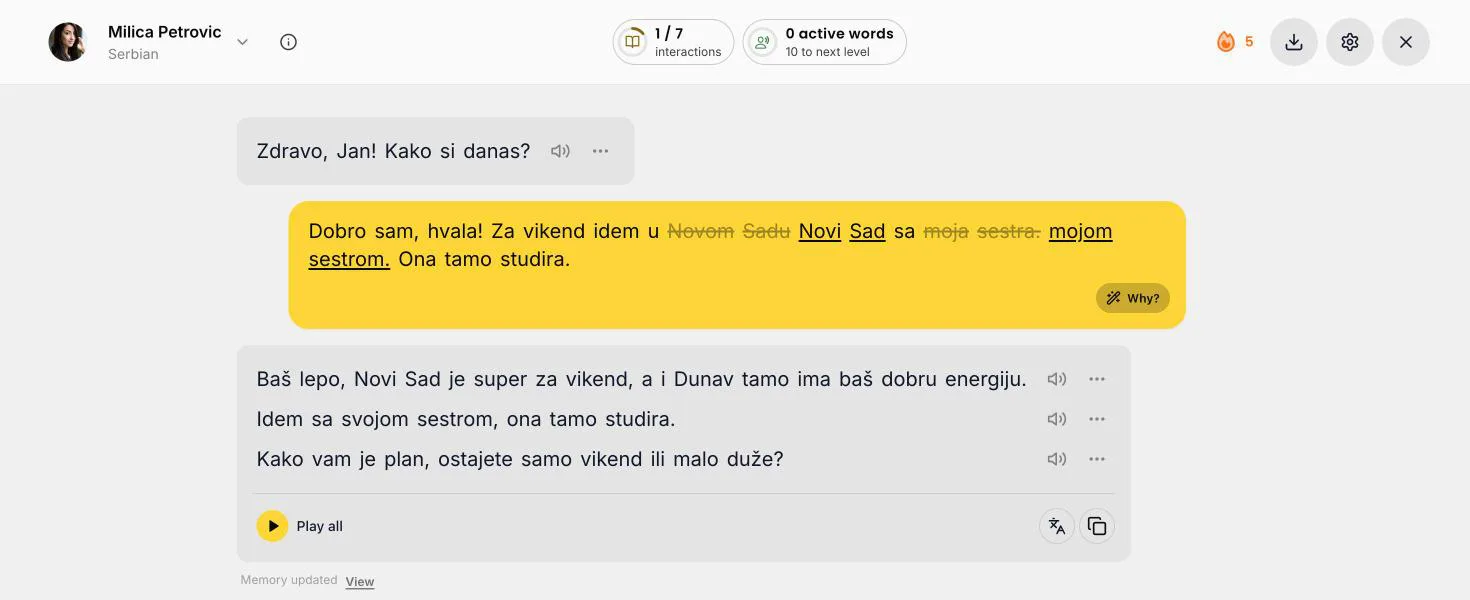
Šta planiraš za vikend?What are you up to at the weekend?
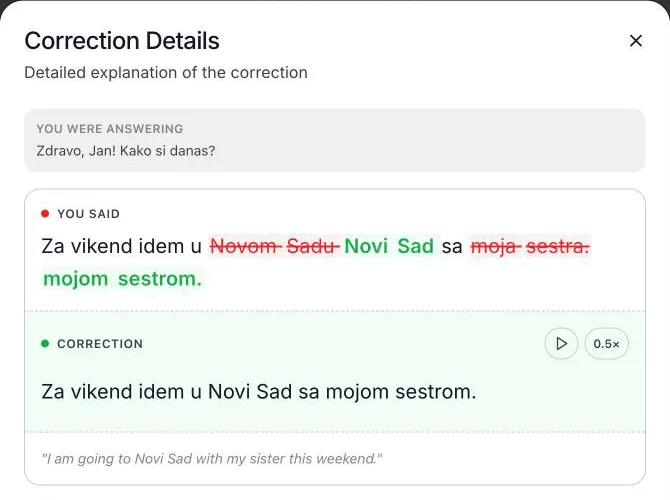
Idem u Novom Sadu Novi Sad sa moja sestra mojom sestrom.I’m going to Novi Sad with my sister.
2 small fixesWhy?
Why?With u, it depends on whether you’re moving. You go u Novi Sad, in the accusative, but you are u Novom Sadu, in the locative. And after sa, with, both words take the instrumental: sa mojom sestrom.
An illustration of the conversation screen, rebuilt for this page with Serbian text.
The short answer
Serbian sits in the middle of our difficulty ranking for English speakers: ranked together with Croatian, Bosnian and Montenegrin as Serbo-Croatian, it’s 45th of 67, a bit harder than German. But very few AI speaking apps teach it. Speak, Langua, Praktika, Babbel and Busuu don’t, and Duolingo has no Serbian course for English speakers. Talkpal has open AI chat in Serbian. Ling has a course.
Here’s our honest take. Pick Teacher AI if you want to get fluent, not just practice. You get lots of real conversation with Nikola from Belgrade or Milica, and a Why? on every correction, from a case ending to the wrong verb of a pair. Plus Serbian videos and stories at your level, and we track every word you learn. Pick Talkpal for a cheaper AI chat, and Ling for a step-by-step course.
Starting from zero? Teacher AI works best for Serbian from about A2. Learn the alphabets and the basics with Ling first.
Best for getting fluent: input, speaking and trackingTeacher AITalk about anything, for as long as you like, with two teachers from Serbia, and every case ending explained. Grow your Serbian with videos and stories at your level, and watch your active and passive words climb. Web, iPhone and Android, $149 a year.
Cheaper, with open AI chatTalkpalSerbian is one of its 130+ languages, with chat, calls and roleplays. $119.99 a year, or 10 minutes a day for free. Its pages don’t say if its pronunciation score covers Serbian.
A step-by-step Serbian courseLingA Serbian course that teaches both scripts side by side, with dialogues, and speaking lessons on Android and the web, not on iPhone. $89.99 a year, and the first 2 units are free.
A fluency system, built by polyglots
Teacher AI isn’t a chatbot with a language menu. It’s a fluency system, built by some of the most accomplished polyglots and language teachers around. People who learned many languages themselves, and know what actually gets you speaking.
Arieh Smith
Xiaoma · the world’s most viral polyglot
Lucas Bighetti
One of the world’s best polyglots · speaks 20+ languages
Olly Richards
Author · 2M+ books sold · StoryLearning founder
Jan van der Aa
Runs the leading network for online language entrepreneurs
“I’ve tried lots of this type of app. This is the best one. It feels like it’s created by someone who understands language learning.”
Jcalebmi, App Store review, October 2026
What you need to practice speaking Serbian
Serbian sits in the middle. Our ranking of 67 languages puts Serbian, Croatian, Bosnian and Montenegrin together, as Serbo-Croatian, and it’s the 45th hardest for English speakers, at 4,660 effort points. That’s about 1.6 times what Spanish takes (2,941), a bit more than German (4,255), and well under Russian (6,067) or Polish (6,329).
The alphabets look like the hard part. They aren’t, for long: Serbian is spelled the way it sounds. What makes Serbian hard is the endings and the verbs, at full speed, in a real conversation.
Two alphabets, and Serbs read bothSerbian uses two alphabets, Cyrillic and Latin, and Serbs read both. Cyrillic is the official one, and in Belgrade you see both on the street, often side by side: Хвала and Hvala, thank you. The good news: they match letter for letter, and each letter is one sound. Watch out for letters that look English but aren’t: in Cyrillic, Р is r, Н is n, С is s and В is v, so ресторан is restoran. Most people can sound out words in both after a week or two.
Seven casesNouns change their ending with their job in the sentence. You live u Beogradu, in Belgrade, come iz Beograda, from Belgrade, and go u Beograd, to Belgrade. The vocative is for talking to someone: Milica becomes Milice!, and a friend, drug, becomes druže!. Even numbers change the noun: jedna kafa, one coffee, dve kafe, two, pet kafa, five. Knowing the tables is one thing. Getting the ending right while you talk takes practice.
Verbs come in pairsMost verbs have two forms. Juče sam čitao knjigu: yesterday I was reading the book. Juče sam pročitao knjigu: I finished it. Kupovati and kupiti, to buy, work the same way. You pick one every time you talk about the past or the future. And in Serbia, people like da plus a verb where English has “to”: Hoću da idem, I want to go.
How Serbia soundsSerbian has a pitch accent: a stressed vowel can be long or short, and its pitch can rise or fall. You’re understood without it, but it’s what makes you sound like Belgrade, not a textbook. One rule helps right away: in a longer word, the stress almost never falls on the last syllable. Beograd is BE-o-grad, Srbija is SR-bi-ja. And in Serbia it’s mleko, milk, reka, river, and lepo, nice. In Croatia, Bosnia and Montenegro you hear mlijeko, rijeka and lijepo.
Lots of Serbian you understandSpeaking activates the words you have. New words come from input: Serbian videos, podcasts and texts where you already understand most of it.
Lots of speaking timeA language in the middle of our ranking still takes hundreds of hours, and lots of them should be spent talking. A few minutes a day won’t get you there.
A complete fluency system, not just a speaking app
Our speaking practice is the heart of Teacher AI. But speaking alone won’t make you fluent, and neither will input alone. You need both, and you need to see it working.
So Teacher AI is a complete fluency system. Input grows your Serbian. Speaking activates it. And we track every word along the way, to get you to real fluency as fast as we can.
Step 1Input grows your vocabularyWatch Serbian YouTube videos and podcasts, and read stories written at your level. You always see how much you already understand, and every word you tap becomes a flashcard. How Watch and Read work.
Step 2Speaking activates itKnowing a word isn’t the same as using it, with the right case ending and the right verb of the pair. Talking with your teacher, for as long as you like, is how words move from “I know that one” to “I just said it”. Every mistake gets fixed, with a Why?.
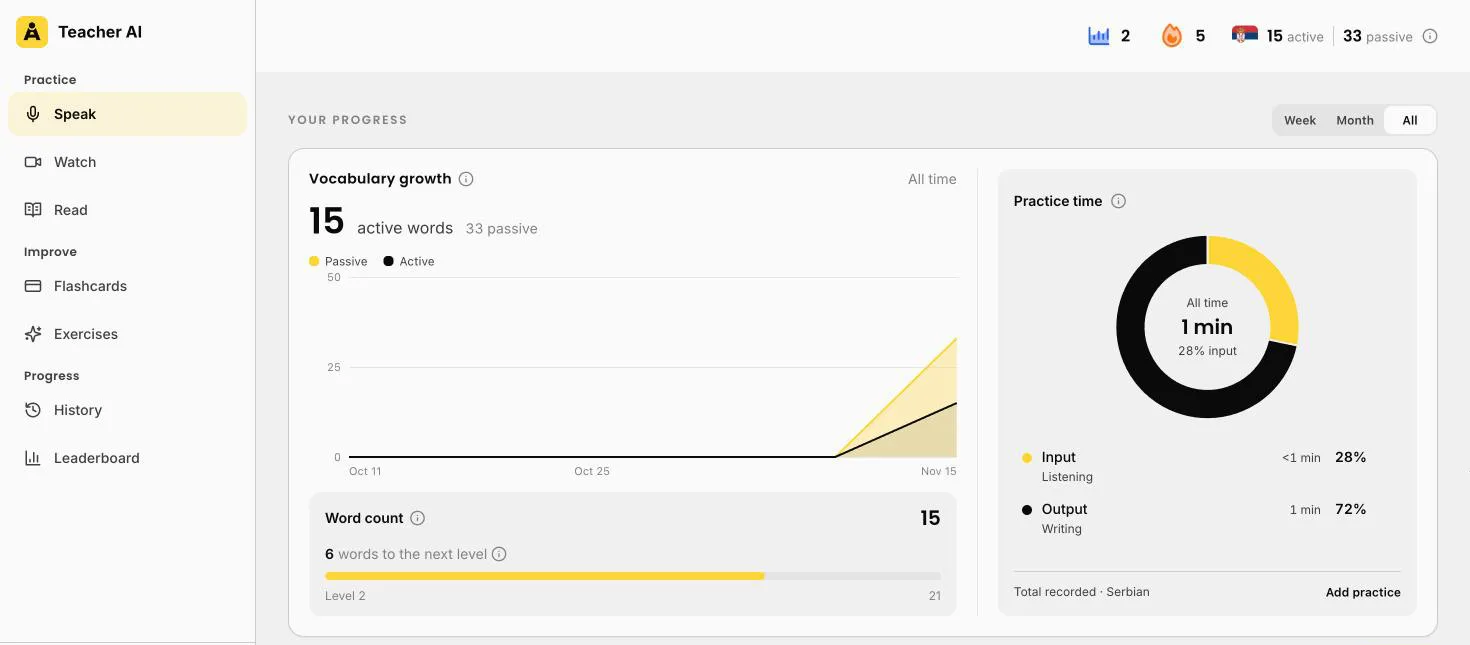
Step 3We track every wordYour passive words are the ones you understand when you read or hear them. Your active words are the ones you’ve used yourself. You see both grow, how your time splits between input and output, and how many words to your next level.
Brand new to Serbian? Start somewhere else first. Teacher AI works best from about A2, once you can handle simple everyday sentences. Before that, you just don’t have enough words yet for open conversation. Duolingo doesn’t teach Serbian, so learn the alphabets and the basics with the Ling app, which teaches both scripts side by side, and come back when you want to talk.
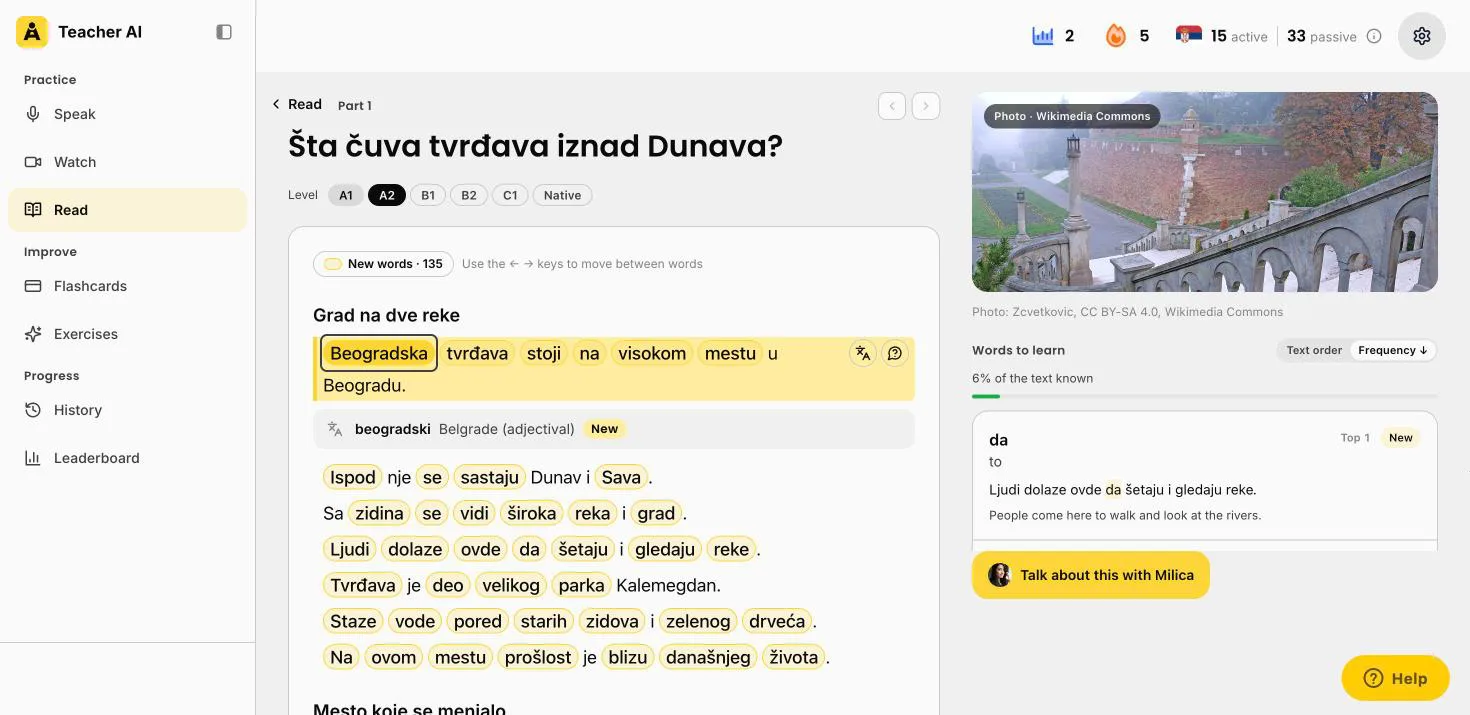
Your progress, in wordsDay one in Serbian: 15 words used, 33 understood. You see your active and passive words grow, the words to your next level, and your practice time split into input and output.
What it looks like in Serbian
Here’s what a moment of practice looks like. You answer, your teacher replies, and if you made a mistake, your sentence gets fixed right there.
A card for every word you tap
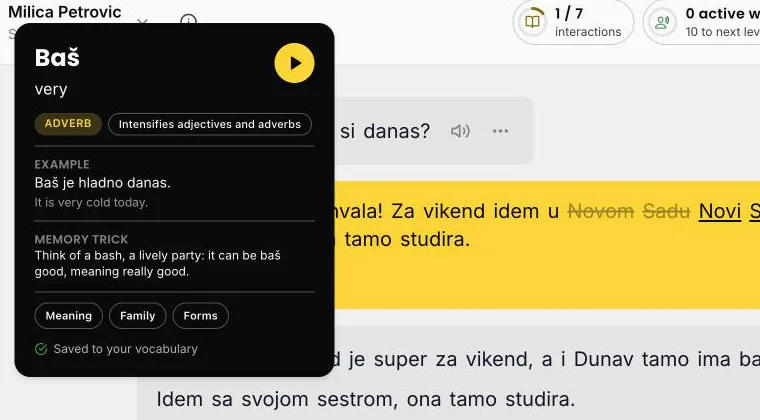
Tap any word, in a conversation, a video or a story, and you get its card: what it means, what kind of word it is, and an example with a translation. Its family and its forms are one tap away. Tap play to hear it.
inat
spite, stubborn defiance
NOUN
ExampleUradio je to iz inata. He did it out of spite.
Good to knowThere’s no one English word for it: doing something just because someone said you couldn’t, even when it costs you.
simpatičan
likeable, nice
ADJECTIVE
ExampleTvoj brat je baš simpatičan. Your brother is really nice.
Good to knowA false friend. “Sympathetic” is saosećajan.
baš
really, exactly, just
PARTICLE
ExampleBaš lepo! How lovely!
Good to knowOne of the words you hear most in Serbia. Baš tako: exactly.
An illustration of three word cards, rebuilt for this page. On the real card, the wording depends on the word. Below: real screenshots of the web app.
Corrected while you talkYou tell Milica you’re going to Novi Sad with your sister. u Novom Sadu becomes u Novi Sad, and sa moja sestra becomes sa mojom sestrom. Teacher AI writes Serbian in Latin letters.Tap Why?You see what you said, the fixed sentence and a translation, and why: after sa, with, both words take the instrumental. You can save it as a flashcard.Tap any wordTap baš and you get very, what it does, an example, Baš je hladno danas, and a memory trick.Two Serbian teachersMilica and Nikola, each with their own voice. Your chat history stays when you switch.
Meet your Serbian teachers
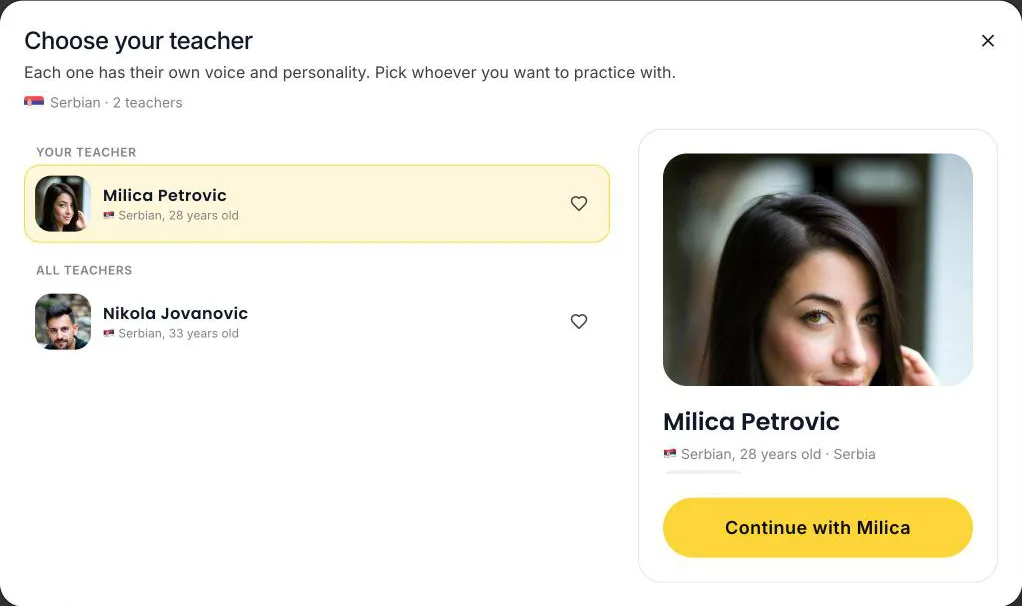
Two teachers, both from Serbia: Nikola from Belgrade, and Milica. Each has their own voice. Pick the one you like. And when you greet Milica, use the vocative: Zdravo, Milice!
Milica Petrovic
Serbia · Serbian
Nikola Jovanovic
Belgrade · Serbian
Input: Serbian to watch and read, at your level
Here’s the input side up close. New words come from lots of Serbian you hear and read, where you already understand most of it.
Watch and Read are on the web app for now. Words you read along with, without tapping, count toward your passive words. Every word you tap lands in your flashcards. And when you’re done, you talk about it with your teacher.
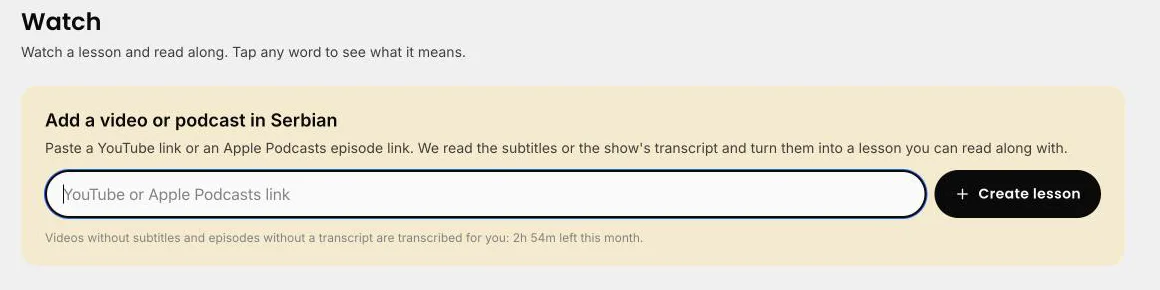
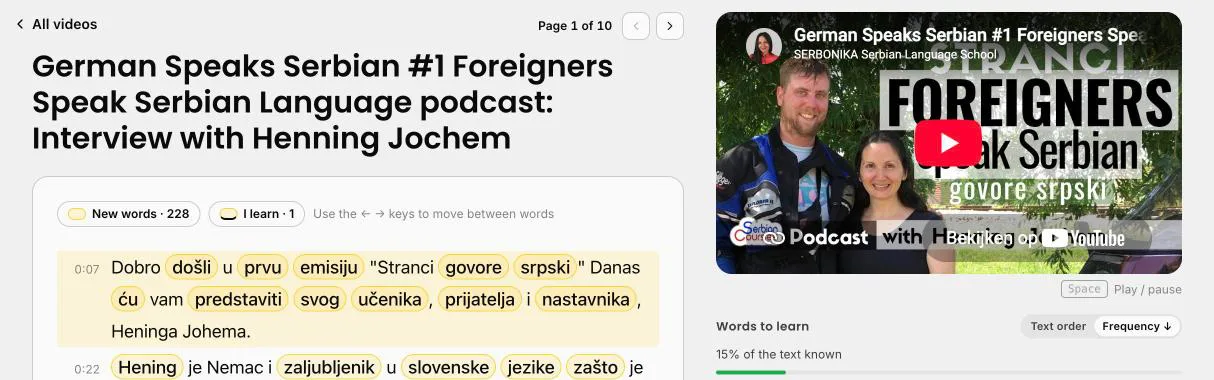
Any YouTube videoPaste a link to a Serbian YouTube video, or an Apple Podcasts episode. We turn it into a page you read along with, new words in yellow. No subtitles? On a paid plan we transcribe it for you, within a monthly allowance.
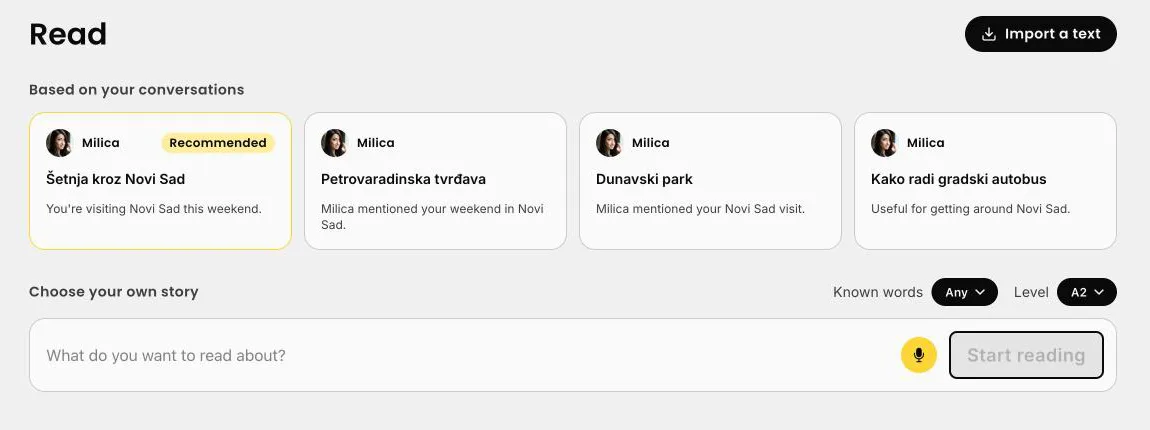
Stories written for youRead writes Serbian texts at your level, from A1 to Native, about anything you like, and suggests ideas from what you talk about with your teacher.
How much you know, before you startTeacher AI keeps a list of every Serbian word you’ve met: the ones you use when you talk, the ones you read or hear, the ones you tap. It checks every word of a video or text against that list and shows you the share you already know.
The 80% rulePick videos and texts where you know 80% or more of the words. Then your brain fills in the rest from context. Under 70% is too much for now. 90% and up is easy and fun.
Then talk about itOne tap on Talk about this starts a conversation about what you just watched or read. Retelling it is how new words become words you can say.
Paste any Serbian videoPaste a link to a Serbian YouTube video or podcast and it becomes a lesson. No subtitles? On a paid plan we transcribe it, within a monthly allowance.Any video becomes a lessonA Serbonika podcast with Henning, a German who learned Serbian, as a lesson. The transcript follows the video, new words in yellow, and one tap starts a conversation about it with Milica.Ideas from your conversationsYou told Milica you’re spending the weekend in Novi Sad. So Read suggests a walk through the city, Petrovaradin Fortress, the Danube park and how the city bus works.A story at your levelŠta čuva tvrđava iznad Dunava?, what does the fortress above the Danube guard?, at A2, about Belgrade’s Kalemegdan, where the Sava meets the Danube. New words are in yellow, and Words to learn starts with the most common ones.
Teacher AI or Duolingo?
Lots of people look for Serbian on Duolingo first. It isn’t there. Duolingo’s list of courses for English speakers has no Serbian, and no Croatian either. Here’s how the two compare, from Duolingo’s own pages.
Duolingo
Teacher AI
Teaches Serbian
No. There’s no Serbian course for English speakers.
Yes, from about A2. Your teacher can explain in English, or switch to your own language.
Open conversation
No Serbian course, so no Video Call or Roleplay in Serbian.
Unlimited on a paid plan, by voice or text, or hands-free in a call.
Teachers
Duolingo’s own characters, in its other courses.
Two from Serbia, each with their own voice: Nikola from Belgrade, and Milica.
Starting from zero
Not in Serbian.
No. For Serbian, Teacher AI works best from about A2. Start with Ling.
Where it works
iPhone, Android and web. Video Call and Roleplay only in the app.
iPhone, Android and web, conversations included.
Price (US)
Every course is free, with ads. Super Duolingo: $9.99 to $119.99 on the US App Store.
Start free on the website. Unlimited conversation: $149 a year on the web.
Love your Duolingo streak? Keep it, in another language. For Serbian, learn the alphabets and the basics with Ling. Once you reach about A2 and want to talk, that’s what Teacher AI is built for.
The apps side by side
Feature
Teacher AI
Talkpal
Ling
Duolingo
Teaches this language
Yes, from about A2, with 2 teachers, both from Serbia.
Yes, one of its 130+ languages.
Yes, a Serbian course, from the basics to advanced topics.
No course for English speakers.
Open conversation
Unlimited on a paid plan, by voice or text, or hands-free in a call. Free plan: one conversation.
Chat, audio-only Call Mode and roleplays. Unlimited on Premium.
Dialogues and role-play scenarios in the app. Its AI Tutor is Thai only.
No Serbian course, so no Video Call or Roleplay in Serbian.
Corrections
During the conversation: your message is marked up, and Why? explains each fix.
Feedback after each reply, and a tool that explains any sentence.
Its speaking lessons check your answers with speech recognition.
No Serbian course.
Pronunciation help
Replay your recording next to a native speaker saying the same line. No pronunciation score.
Says it gives feedback on pronunciation, intonation and rhythm. Its Sentence Mode score is for selected languages, and doesn’t say if Serbian is one.
Google’s voice recognition in speaking lessons, on Android and the web, not on iPhone. No score on its own pages.
No Serbian course.
Reading aid for the script
Serbian uses two alphabets, Cyrillic and Latin, and Serbs read both. Teacher AI writes Serbian in Latin letters. For č, ć, š, ž and đ, add a Serbian keyboard, or just speak. Learn Cyrillic too: it matches Latin letter for letter.
Its Serbian page suggests starting with the Latin alphabet. A Romanization feature for non-Latin scripts, system not named.
Super Duolingo: $9.99 to $119.99 on the US App Store, which doesn’t say which is monthly or yearly.
Free option
Start free on the website, no credit card.
10 minutes a day, free. 14-day trial, no payment up front.
The first 2 units. 7-day trial on the yearly plan only.
Every course is free, with ads.
Scroll the table sideways to see every app.
The apps, one by one
Teacher AI
Best for getting fluent: input, speaking and tracking
Speaking
Unlimited on a paid plan. Pick a conversation starter at your level, talk about anything in Free Talk, try a roleplay, or switch to hands-free and just talk.
Teachers
Two for Serbian: Nikola from Belgrade, and Milica, both from Serbia.
Corrections
Your own sentence is fixed while you talk, and Why? explains it: u Novi Sad or u Novom Sadu, the instrumental after sa, a name that needs the vocative, the wrong verb of a pair.
Progress
Your active and passive words, your practice time split into input and output, and 100 levels with the matching CEFR level.
Watch and Read
Turn a Serbian YouTube video or podcast into a lesson (no subtitles? we transcribe it on a paid plan), and read stories at your level. Both show the share of words you already know. On the web app.
Not so good
Not for complete beginners: for Serbian, it works best from about A2, so learn the alphabets and the basics with Ling first. Only two teachers so far. And there’s no pronunciation score.
Talkpal
Cheaper, with open AI chat
Serbian
One of its 130+ languages, with its own Learn Serbian page. Chat with an AI tutor, audio-only Call Mode and roleplays.
Strengths
Its Serbian page says its speech recognition gives feedback on pronunciation, intonation and rhythm. On the web and on your phone. 10 minutes a day for free.
Alphabets
Its Serbian page says Serbian uses both alphabets, and suggests beginners start with Latin.
Not stated
Anything about cases or the pitch accent, which levels it covers, and whether its pronunciation score (Sentence Mode, “available for selected languages”) covers Serbian.
Price
$119.99 a year or $19.99 a month on the US App Store, with a 14-day trial.
Ling
A step-by-step Serbian course
Course
A Serbian course, from pronunciation and greetings up to advanced topics. It teaches both scripts side by side, its Serbian page says.
Speaking
Dialogues and role-play scenarios, and speaking lessons that check you with Google’s voice recognition, on Android and the web. Not on iPhone, its help center says. Its AI Tutor covers Thai only.
Price
$89.99 a year or $16.99 a month on its website. The first 2 units are free.
Duolingo
No Serbian course
Course
Duolingo has no Serbian course for English speakers. Its list of courses for English speakers has no Croatian either.
Speaking
No Serbian course, so no Video Call, Roleplay or speaking exercises in Serbian.
Not so good
If you want Serbian, it isn’t an option. Keep your streak in another language if you like.
Where another app might suit you better
Want an app made only for Serbian? Erla: Learn Serbian with AI has a written chat with an AI teacher and spoken conversations, at Beginner, Intermediate or Advanced, with corrections and hints. It’s small: 4 ratings on the US App Store. $59.99 a year or $12.99 a month.
Looking at Langua or Pimsleur? Both teach Croatian, a close relative, but not Serbian. Memrise has no official Serbian course, and Mondly doesn’t list Serbian.
And if you’re looking at Speak, Praktika, Babbel or Busuu: none of them teaches Serbian.
For getting fluent, Teacher AI: talk about anything for as long as you like, with Nikola from Belgrade or Milica, and a Why? on every correction. Plus Serbian videos and stories at your level, and every word you learn tracked. Very few AI speaking apps teach Serbian at all. Talkpal does, and it’s cheaper. For a step-by-step course, Ling.
Is Serbian hard to learn?
It’s in the middle. Our ranking of 67 languages puts Serbian, Croatian, Bosnian and Montenegrin together, as Serbo-Croatian: the 45th hardest for English speakers, at 4,660 effort points. That’s about 1.6 times Spanish, a bit more than German, and less than Russian or Polish. The alphabets are the easy part. The seven cases, the verb pairs and the pitch accent take practice, out loud.
Should I learn Cyrillic or Latin?
Both, sooner or later. Serbian uses two alphabets, Cyrillic and Latin, and Serbs read both. Cyrillic is the official one, and in Serbia you see both on signs, menus and in messages. They match letter for letter, so once you know one, the other takes days, not months. Most people can sound out words after a week or two. Teacher AI writes Serbian in Latin letters, so you can start talking right away.
Is Serbian the same as Croatian?
Close enough that Serbs, Croats, Bosnians and Montenegrins talk to each other without trouble, which is why our ranking counts them as one language. But you hear the differences. In Serbia it’s mleko, milk, and hleb, bread. In Croatia it’s mlijeko and kruh. A train is voz in Serbia and vlak in Croatia, and “what” is šta or što. Croatian is written in Latin only. Going to Croatia? Teacher AI has Croatian too, with Ivana from Dubrovnik and Marko from Split.
Can I learn Serbian on Duolingo?
No. Duolingo’s list of courses for English speakers has no Serbian, and no Croatian either. To learn Serbian from zero, try Ling. To practice speaking it, Teacher AI or Talkpal.
Do Speak, Langua or Praktika teach Serbian?
No. Speak’s courses for English speakers, Langua’s 23 languages and Praktika’s 14 don’t include Serbian. Langua teaches Croatian. Babbel and Busuu don’t teach Serbian either.
Can a complete beginner use Teacher AI for Serbian?
Not really. For Serbian, Teacher AI works best from about A2, once you can handle simple everyday sentences. Before that, you just don’t have enough words yet for open conversation. Starting from zero? Learn the alphabets and the basics with the Ling app first, then come here to talk. (Spanish and French are different: they have a beginner track from zero.)
Is Teacher AI only for speaking?
No. It’s a complete fluency system. Speaking is how you activate your Serbian. On the web app you also grow it: turn a Serbian YouTube video or podcast into a lesson, and read stories at your level. And Teacher AI tracks the words you understand and the words you use, so you see your progress in real numbers.
Is Teacher AI better than Duolingo for speaking Serbian?
Duolingo doesn’t teach Serbian to English speakers, so there’s nothing to compare there. Teacher AI is built around conversation, unlimited on a paid plan, on the web and on your phone. If you love your Duolingo streak, keep it for another language, and practice Serbian here.