German · With German and Austrian teachers, from Lingster Academy to Herr Antrim

The best AI apps to practice speaking German

Updated November 15, 2026. We checked every other app on its own website, help pages and app store page. See the sources.

We built Teacher AI, so of course we’re biased. That’s why we link every claim we make about another app, and tell you plainly when another app suits you better.

Available oniPhone and iPadAndroidWeb app

An illustration of the conversation screen, rebuilt for this page with German text.

The short answer

German is harder than Spanish or French for English speakers, mostly because of the grammar you need at full speed: articles, cases and word order. Lots of AI apps teach it: Langua, Praktika, Talkpal, Jumpspeak, Duolingo, Babbel and Busuu all have AI conversation in German. Speak doesn’t teach German.

Here’s our honest take. Pick Teacher AI if you want to get fluent, not just practice. You get lots of real conversation, corrected as you go, with 14 teachers: Germans, two Austrians with Austrian voices, and German teachers like Julia from Lingster Academy and Herr Antrim. Plus German videos and stories at your level, and we track every word you learn. Pick Babbel for a step-by-step course, Langua for open AI chat on the web too, and Talkpal for the lowest price.

Starting from zero? Teacher AI works best for German from about A2. Learn the basics with Duolingo, Babbel or Pimsleur first.

  1. Best for getting fluent: input, speaking and trackingTeacher AITalk about anything, for as long as you like, corrected as you go, with German and Austrian teachers, some from YouTube channels you may already watch. Grow your German with videos and stories at your level, and watch your active and passive words climb. Web, iPhone and Android, $149 a year.
  2. Best step-by-step courseBabbelGerman up to B2, with topics up to C1, from a Berlin company. Its AI partner Babbel Speak covers German, in beta, in the phone app. $107.99 a year for all its languages.
  3. Open AI chat, on the web tooLanguaChat and calls, and its blog says you can pick Austrian or Swiss German. $149.99 a year, or 3 minutes of calls a day for free. Its pronunciation score doesn’t cover German.
  4. Best for video calls with an avatarPraktikaGerman from A0 to C2, with lifelike AI tutors. Phone only.
  5. Best price, with a free daily planTalkpalChat, calls and roleplays in German. $119.99 a year, or 10 minutes a day for free.
  6. Best free startDuolingoA free course up to B2, with ads. AI Video Call and Roleplay cover German, on a paid plan, in the app.

A fluency system, built by polyglots

Teacher AI isn’t a chatbot with a language menu. It’s a fluency system, built by some of the most accomplished polyglots and language teachers around. People who learned many languages themselves, and know what actually gets you speaking.

  • Arieh Smith
    Arieh Smith
    Xiaoma · the world’s most viral polyglot
  • Lucas Bighetti
    Lucas Bighetti
    One of the world’s best polyglots · speaks 20+ languages
  • Olly Richards
    Olly Richards
    Author · 2M+ books sold · StoryLearning founder
  • Jan van der Aa
    Jan van der Aa
    Runs the leading network for online language entrepreneurs

“I’ve tried lots of this type of app. This is the best one. It feels like it’s created by someone who understands language learning.”

Jcalebmi, App Store review, October 2026

What you need to practice speaking German

German is a step up from Spanish or French. In our ranking of 67 languages it’s the 52nd hardest for English speakers, at 4,255 effort points. That’s harder than Dutch (3,422) and Italian (3,244), but far easier than Russian (6,067) or Japanese.

Lots of words are close to English: Haus, Wasser, Freund. What makes German hard is the grammar you have to use at full speed, in a real conversation.

  • Der, die, dasEvery noun has a gender, and you can rarely guess it: der Löffel, the spoon, die Gabel, the fork, das Messer, the knife. Even das Mädchen, the girl, is neuter. So you learn each word with its article.
  • Four cases“The” and “my” change with their job in the sentence. Ich sehe den Mann, I see the man. Ich gebe dem Mann, I give the man. Mit always takes the dative: mit meinen Freunden. Knowing the table is easy. Getting it right while you talk takes practice.
  • The verb goes where?In a main sentence, the verb comes second: Gestern bin ich, not Gestern ich bin. After weil or dass, it goes to the very end. And some verbs split in two: Ich rufe dich morgen an.
  • Germany, Austria or SwitzerlandIt’s one written language, but you hear the difference. In Austria, January is Jänner and a tomato is a Paradeiser, and people say Servus. So pick a teacher who sounds like where you’re going.
  • Lots of German you understandSpeaking activates the words you have. New words come from input: videos, podcasts and texts where you already understand most of it.
  • Lots of speaking timeGerman takes more hours than the easiest languages, and most of them should be spent talking. A few minutes a day won’t get you there.

A complete fluency system, not just a speaking app

Our speaking practice is the heart of Teacher AI. But speaking alone won’t make you fluent, and neither will input alone. You need both, and you need to see it working.

So Teacher AI is a complete fluency system. Input grows your German. Speaking activates it. And we track every word along the way, to get you to real fluency as fast as we can.

  1. Step 1Input grows your vocabularyWatch German YouTube videos and podcasts, and read stories written at your level. You always see how much you already understand, and every word you tap becomes a flashcard, with its article. How Watch and Read work.
  2. Step 2Speaking activates itKnowing a word isn’t the same as using it, with the right article, the right case and the verb in the right place. Talking with your teacher, for as long as you like, is how words move from “I know that one” to “I just said it”. Every mistake gets fixed, with a Why?.
  3. Step 3We track every wordYour passive words are the ones you understand when you read or hear them. Your active words are the ones you’ve used yourself. You see both grow, how your time splits between input and output, and how many words to your next level.

Brand new to German? Start somewhere else first. Teacher AI works best from about A2, once you can handle simple everyday sentences. Before that, you just don’t have enough words yet for open conversation. So learn the basics with a course like Duolingo (free), Babbel or Pimsleur, and come back when you want to talk.

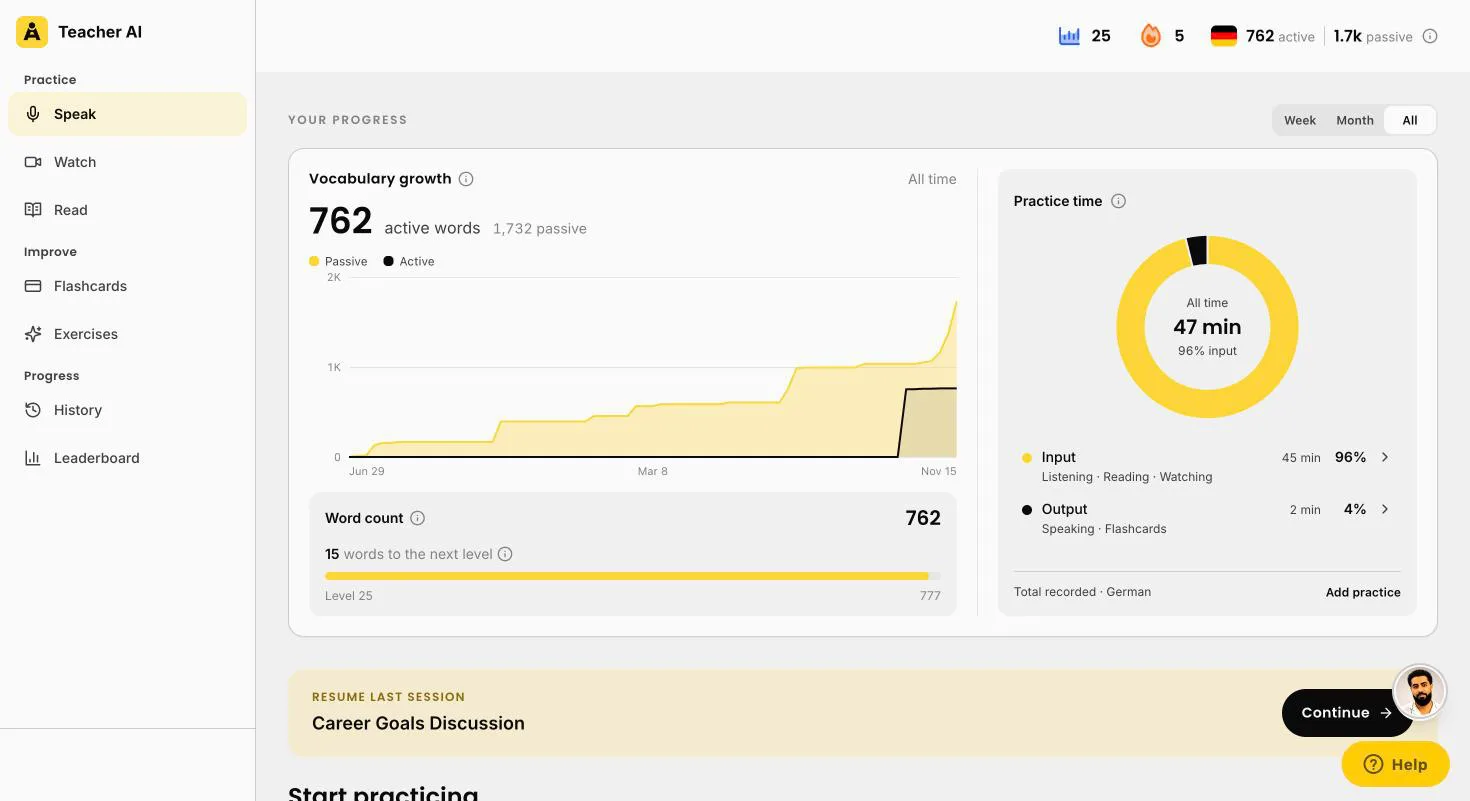
Teacher AI progress in German: 762 active and 1,732 passive words over time, level 25, and practice time split into input and output
Your progress, in wordsYour active and passive words over time, the words to your next level, and your practice time split into input (listening, reading, watching) and output (speaking, writing, flashcards).

What it looks like in German

Here’s what a moment of practice looks like. You answer, your teacher replies, and if you made a mistake, your sentence gets fixed right there.

A card for every word you tap

Tap any word, in a conversation, a video or a story, and you get its card: what it means, its article and plural, its forms, and an example with a translation. Tap play to hear it.

doch
yes (after a no), after all
PARTICLE
ExampleDu kommst nicht mit? Doch! You’re not coming? Yes, I am!
Good to knowThe “yes” you use to contradict a negative question. Ja would sound wrong here.
der Feierabend
the end of the working day
NOUN
ExampleEndlich Feierabend! Finally done for the day!
Good to knowThere’s no one English word for it: the moment work is over and your free evening starts.
das Gift
poison
NOUN
ExampleZucker ist Gift für die Zähne. Sugar is poison for your teeth.
Good to knowA false friend. A present is ein Geschenk.

An illustration of three word cards, rebuilt for this page. On the real card, the wording depends on the word. Below: real screenshots of the web app.

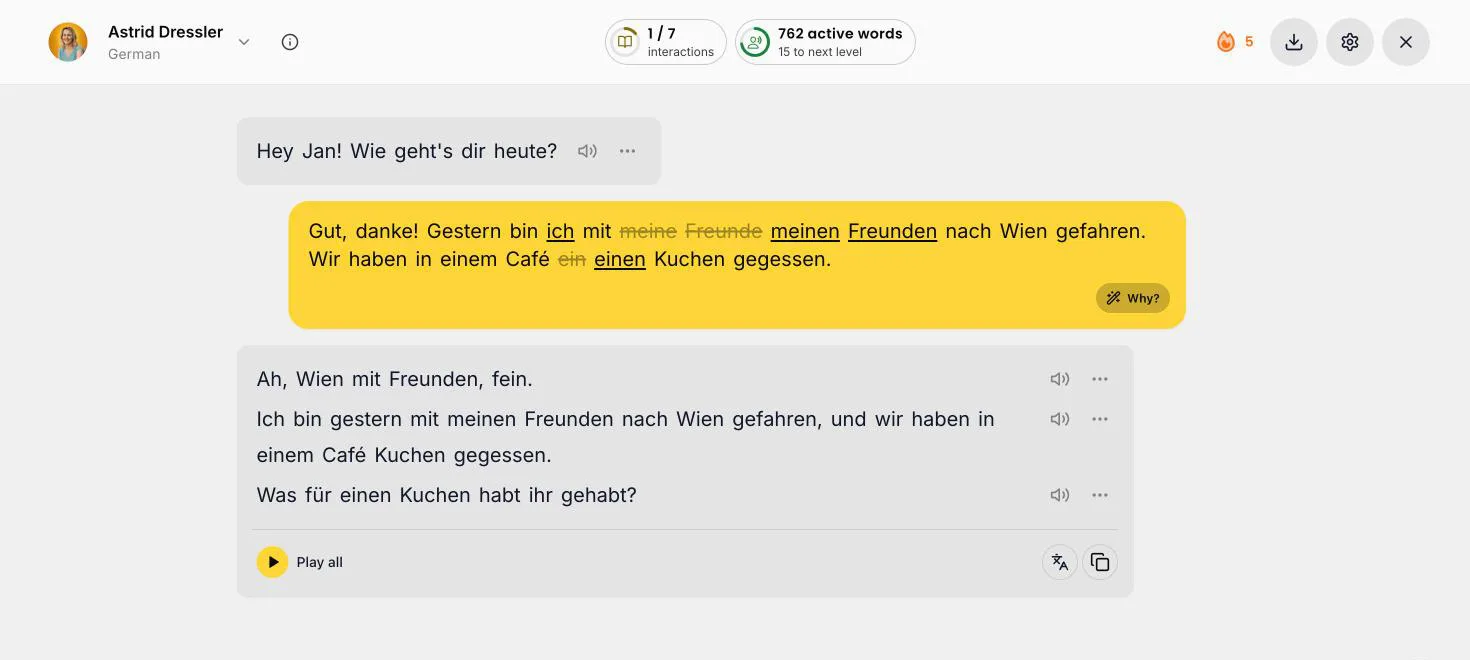
A German conversation on Teacher AI with Astrid: Gestern ich bin corrected to Gestern bin ich, meine Freunde to meinen Freunden, and ein Kuchen to einen Kuchen
Corrected while you talkYou tell Astrid about a trip to Vienna. Gestern ich bin becomes Gestern bin ich, mit meine Freunde becomes mit meinen Freunden, and ein Kuchen becomes einen Kuchen.
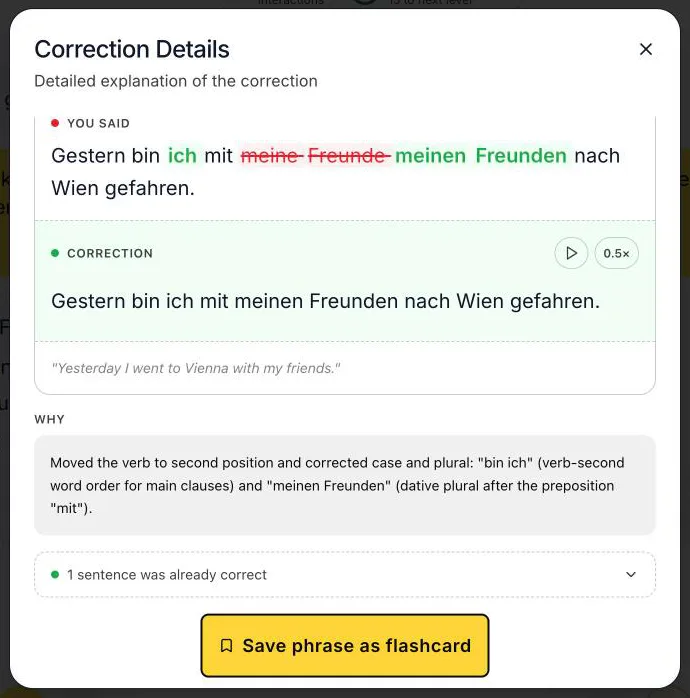
Teacher AI correction details for a German sentence: verb second, and the dative plural after mit, with a translation and why
Tap Why?The verb goes second, and mit takes the dative: meinen Freunden. You see what you said, the fixed sentence, a translation and why, and you can save it as a flashcard.
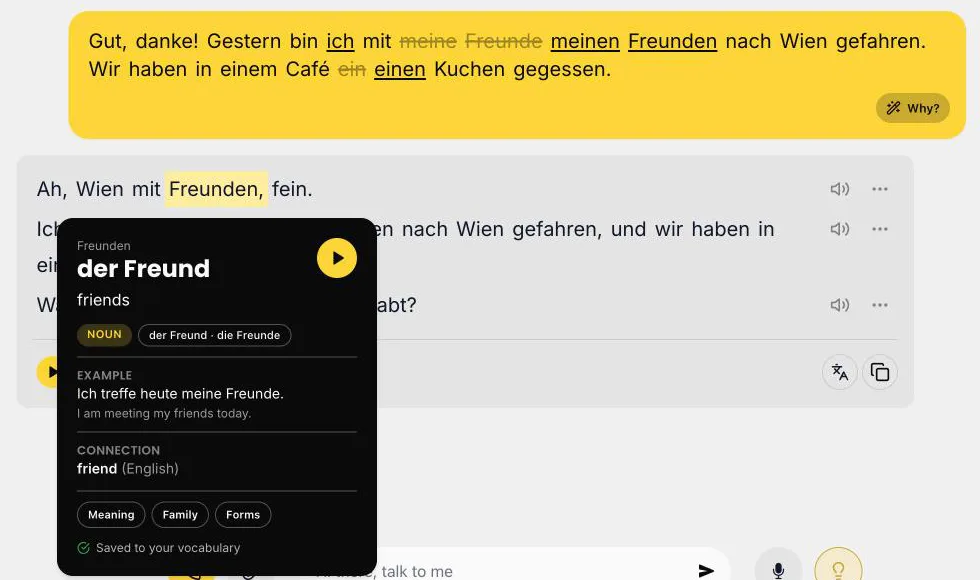
Teacher AI word card for Freunden: der Freund, friends, a noun, with its plural die Freunde and an example
Tap any wordTap Freunden and you get der Freund: the article, the plural, an example with a translation, and the link to English friend.
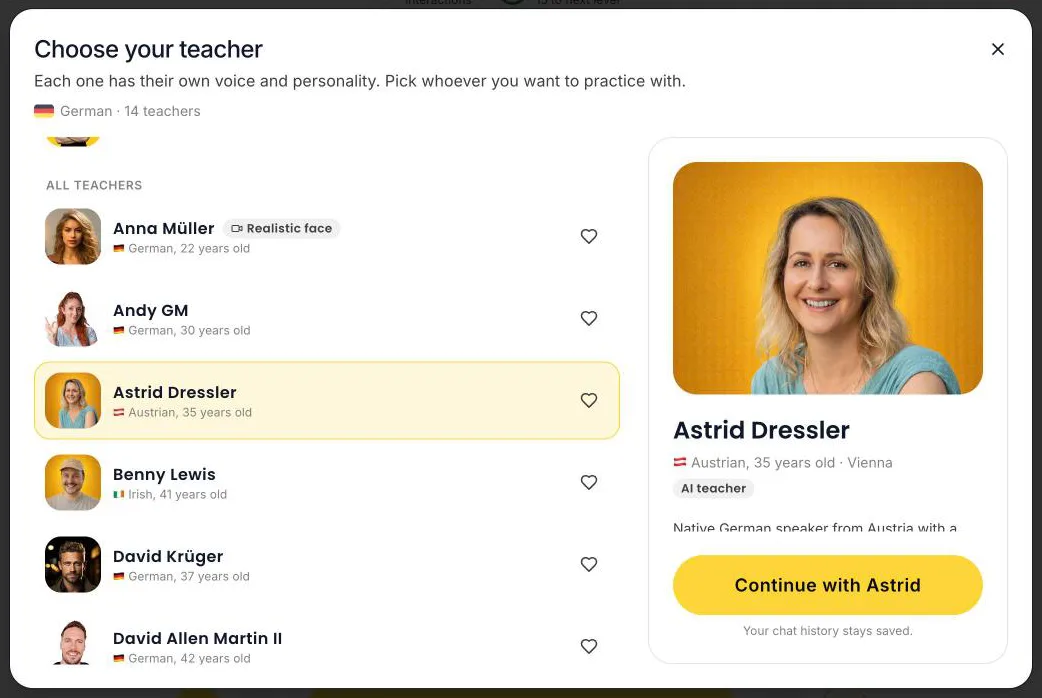
Teacher AI teacher picker for German: Astrid Dressler from Vienna, Austrian, with Anna Müller, Andy GM, Benny Lewis, David Krüger and David Allen Martin II
Fourteen teachers, each with their own voiceAstrid from Vienna speaks with an Austrian accent. Above her: Anna, with a realistic face, and Andy from AndyGM Academy.

Meet your German teachers

Fourteen teachers. Germans from Berlin, Düsseldorf, Stuttgart and Rostock, and two Austrians with Austrian voices: Astrid from Vienna and Mia from Salzburg. Anna from Berlin has a realistic face, so you see her speak as you chat.

And German teachers you might know: Julia from Lingster Academy, Levi from Learn German with Herr Antrim, Astrid from the podcast Deutsch aus Österreich, Flemming from Natural. Fluent. German, David from LinguaThor, Andy from AndyGM Academy and Muryel from Alemão com Muryel. Plus language people you might know: Benny Lewis from Fluent in 3 Months, and our co-founders Olly Richards and Xiaoma. They learned many languages themselves, so they know where you’ll get stuck.

Austrian teachers, with Austrian voices

  • Astrid Dressler
    Astrid Dressler
    Vienna · Austrian
  • Mia Schneider
    Mia Schneider
    Salzburg · Austrian

Teachers from Germany, and well-known polyglots

  • Andy GM
    Andy GM
    Berlin · German
  • Anna Müller
    Anna Müller
    Berlin · German
  • Benny Lewis
    Benny Lewis
    Travels the world · Irish
    Fluent in 3 Months
  • David Krüger
    David Krüger
    Düsseldorf · German
  • David Allen Martin II
    David Allen Martin II
    San Diego · German

  • Flemming Goldbecher
    Flemming Goldbecher
    Rostock · German
  • Julia Brodt
    Julia Brodt
    Stuttgart · German
    Lingster Academy
  • Leon Schmidt
    Leon Schmidt
    Stuttgart · German
  • Levi Antrim
    Levi Antrim
    Illinois, USA · American
    Learn German with Herr Antrim
  • Muryel Ovidio
    Muryel Ovidio
    Curitiba · Brazilian
    Alemão com Muryel
  • Olly Richards
    Olly Richards
    Devon · British

    StoryLearning
  • Xiaoma
    Xiaoma
    New York City · American
    Xiaomanyc

Input: German to watch and read, at your level

Here’s the input side up close. New words come from lots of German you hear and read, where you already understand most of it.

Watch and Read are on the web app for now. Words you read along with, without tapping, count toward your passive words. Every word you tap lands in your flashcards. And when you’re done, you talk about it with your teacher.

  • Any YouTube videoPaste a link to a German YouTube video, or an Apple Podcasts episode. We turn it into a page you read along with, new words in yellow. No subtitles? On a paid plan we transcribe it for you, within a monthly allowance.
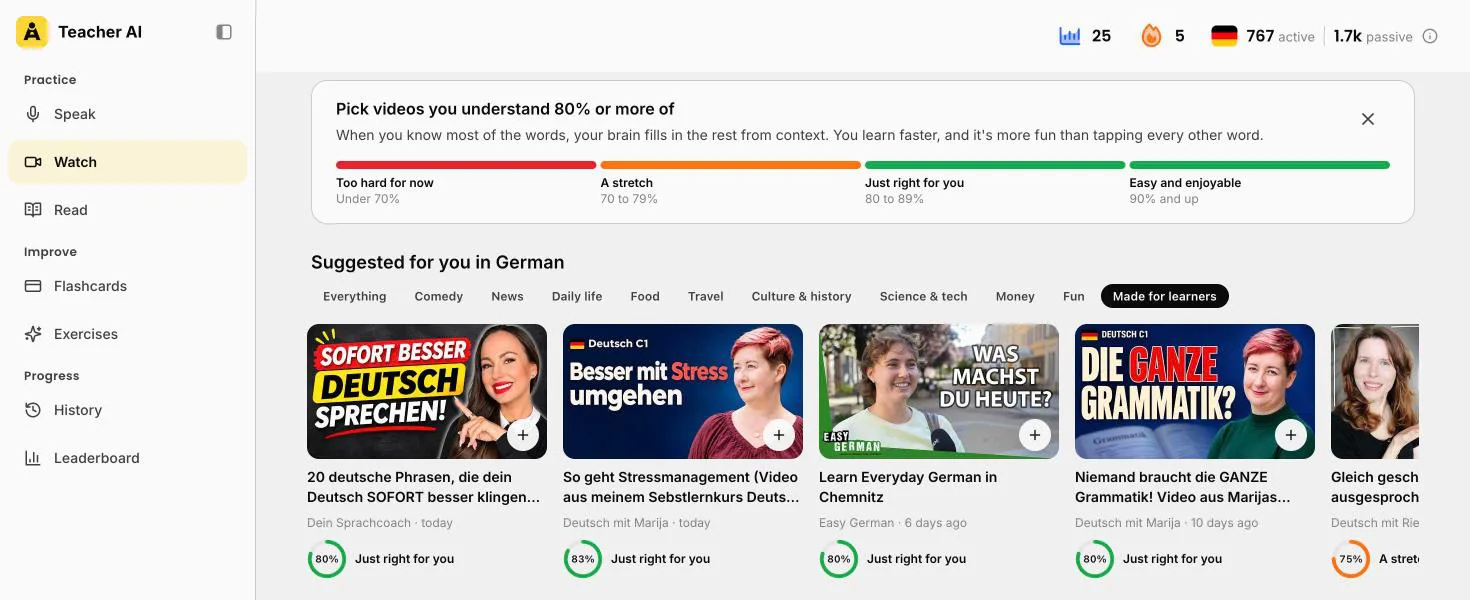
  • Suggested for youWatch suggests videos by topic, from channels made for learners, like Easy German, Dein Sprachcoach and Deutsch mit Marija, to comedy, food and the news. Each one shows the share of words you’d understand.
  • Stories written for youRead writes German texts at your level, from A1 to Native, about anything you like, and suggests ideas from what you talk about with your teacher. There’s today’s news, too.
  • How much you know, before you startTeacher AI keeps a list of every German word you’ve met: the ones you use when you talk, the ones you read or hear, the ones you tap. It checks every word of a video or text against that list and shows you the share you already know.
  • The 80% rulePick videos and texts where you know 80% or more of the words. Then your brain fills in the rest from context. Under 70% is too much for now. 90% and up is easy and fun.
  • Then talk about itOne tap on Talk about this starts a conversation about what you just watched or read. Retelling it is how new words become words you can say.
Teacher AI Watch: videos made for learners of German, from Dein Sprachcoach, Deutsch mit Marija and Easy German, each with the share the learner would understand
Videos picked for youMade for learners: Dein Sprachcoach, Deutsch mit Marija, Easy German and Deutsch mit Rieke. 80% to 83% known: just right for this learner.
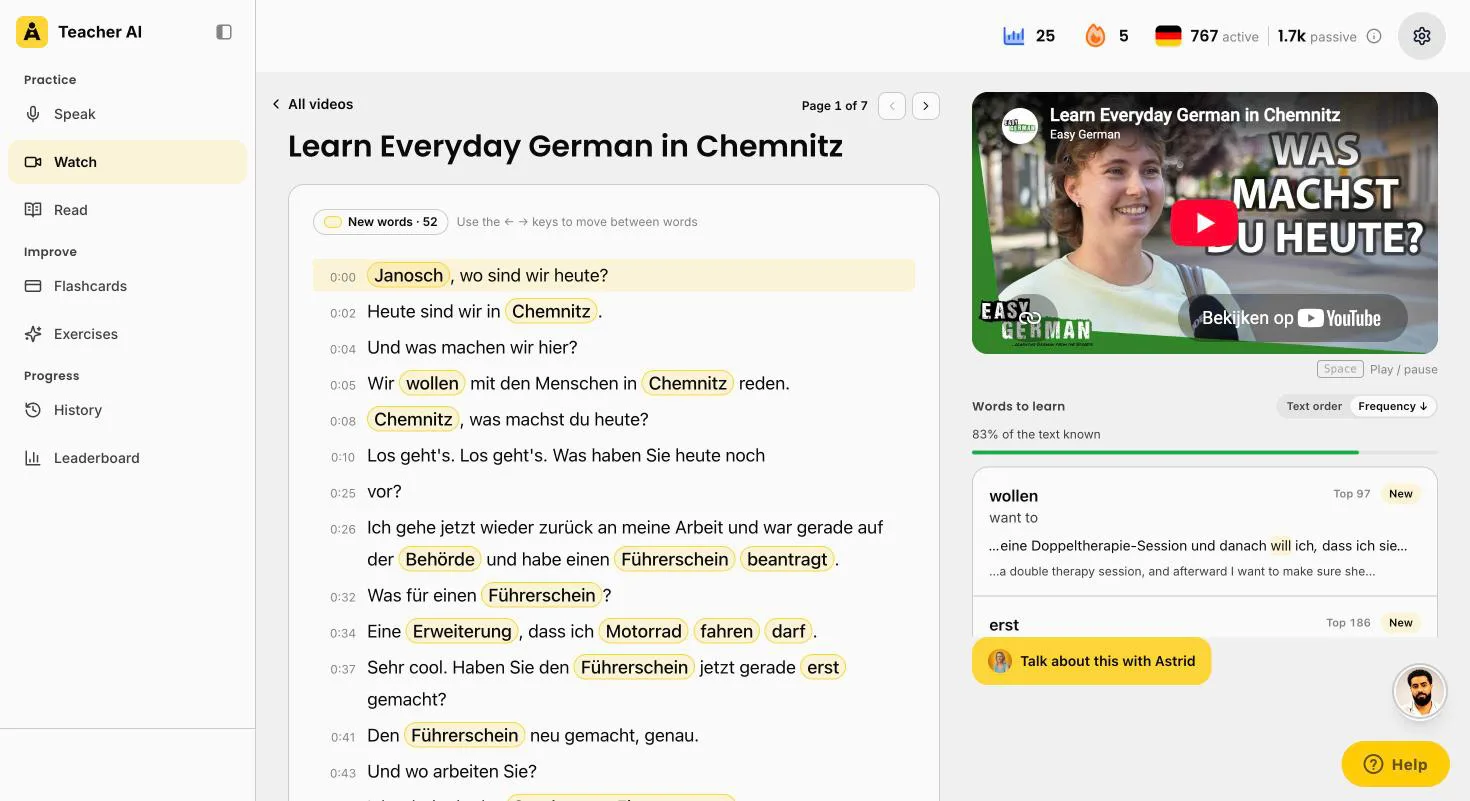
An Easy German video as a Teacher AI lesson: the German transcript with 52 new words marked, 83% of the text known, and Words to learn
Any video becomes a lessonLearn Everyday German in Chemnitz, from Easy German, as a lesson. The transcript follows the video, new words in yellow, and one tap starts a conversation about it with Astrid.
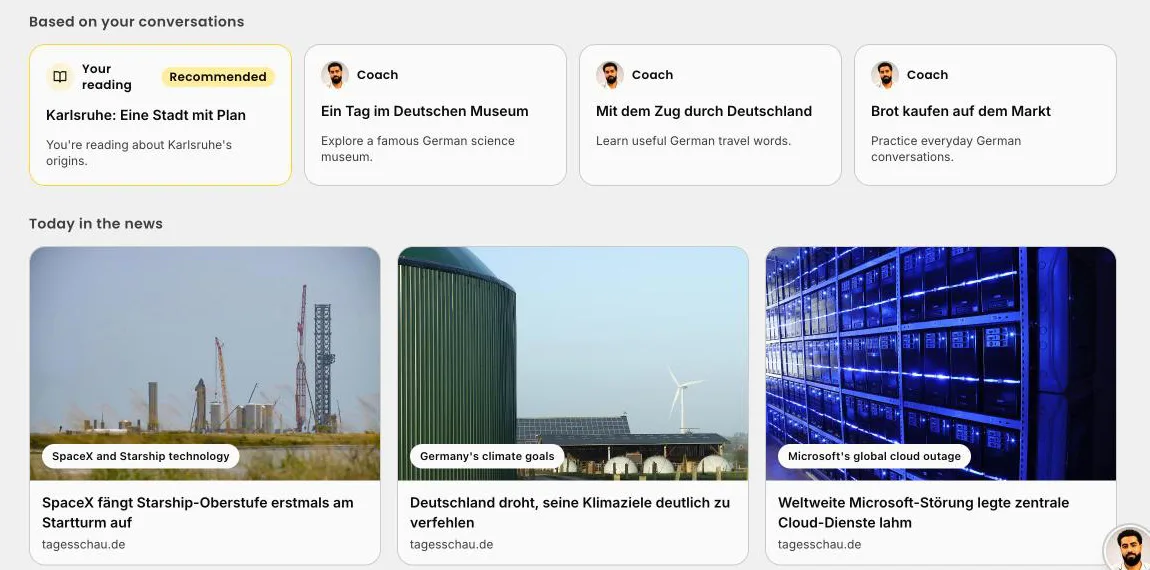
Teacher AI Read in German: reading ideas about Karlsruhe, the Deutsches Museum, a train trip and the market, and today’s news from tagesschau.de
Ideas from your conversationsKeep reading about Karlsruhe, or try a day at the Deutsches Museum, a train trip through Germany or buying bread at the market. Below: today’s German news.
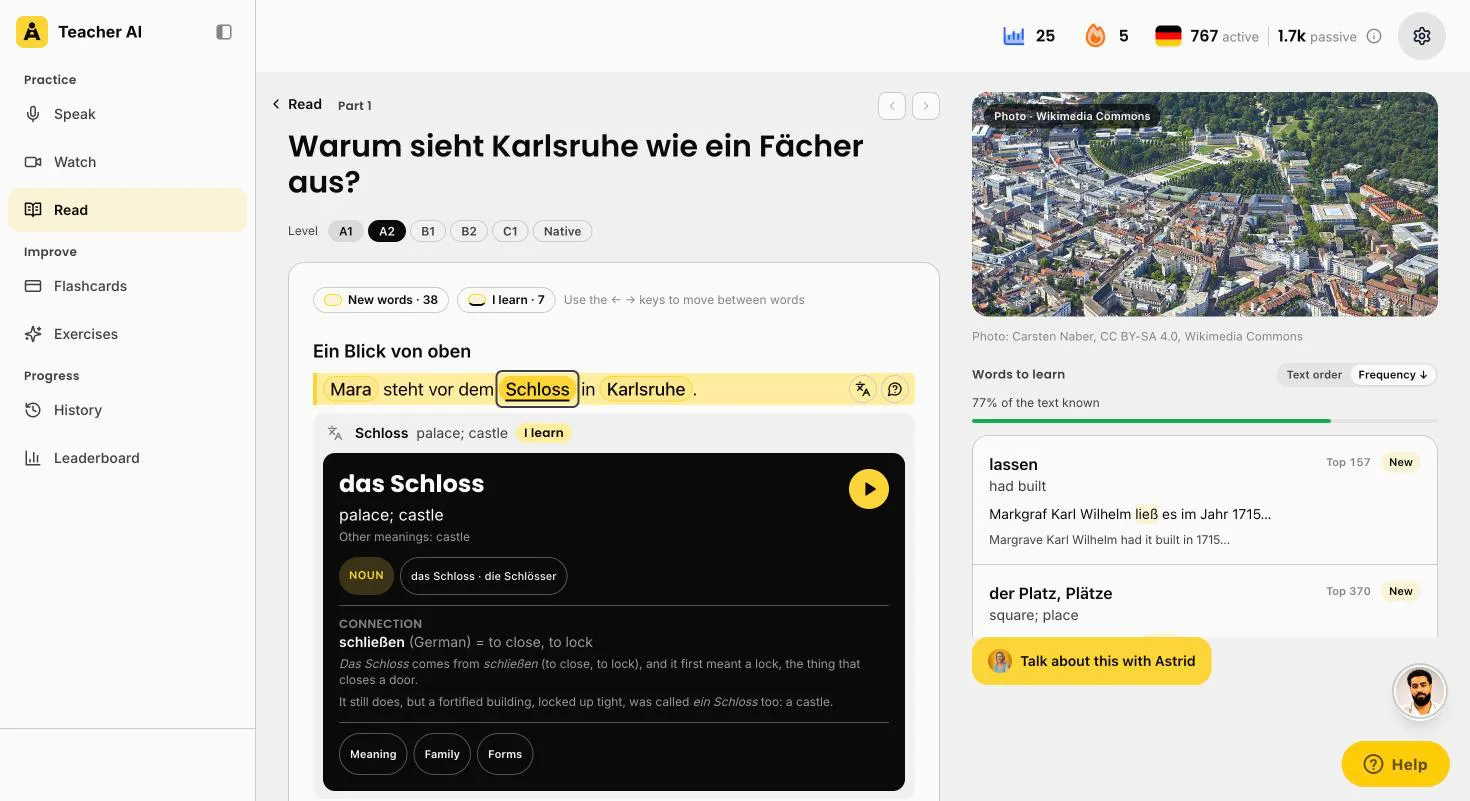
A German story on Teacher AI at A2: Warum sieht Karlsruhe wie ein Fächer aus?, with levels A1 to Native, new words marked, a word card for das Schloss and 77% of the text known
A story at your levelWarum sieht Karlsruhe wie ein Fächer aus?, why Karlsruhe looks like a fan, at A2 with a photo. Tap Schloss and you get das Schloss, with its plural and where the word comes from.

Teacher AI or Duolingo?

Lots of people start German on Duolingo. Good! So here’s how the two compare for speaking, with every Duolingo fact from Duolingo’s own pages.

Duolingo
Teacher AI
What it’s built for
Short lessons and exercises, as a daily game. Up to B2.
Conversation, plus German to watch and read at your level, with every word you learn tracked.
Open conversation
AI Video Call with Lily, and Roleplay with set scenarios. Both paid, and only in the app. Video Call is moving from Max into Super by the end of 2026, Duolingo says.
Unlimited on a paid plan, by voice or text, or hands-free in a call.
Corrections
Explain My Answer explains your mistakes in exercises, German included, now for free.
During the conversation: your own sentence is fixed, and Why? explains each fix.
Teachers
Duolingo’s own characters, like Lily in Video Call.
Fourteen, with their own voices: Germans, two Austrians, and German teachers like Julia from Lingster Academy and Herr Antrim.
Starting from zero
Yes. The course starts at the beginning, for free.
No. For German, Teacher AI works best from about A2.
Where it works
iPhone, Android and web. Video Call and Roleplay only in the app.
iPhone, Android and web, conversations included.
Price (US)
Every course is free, with ads. Super Duolingo: $9.99 to $119.99 on the US App Store.
Start free on the website. Unlimited conversation: $149 a year on the web.

Want a free daily habit? Duolingo is great at that, and you can keep it. Want to actually speak? That’s what Teacher AI is built for. Lots of people use both: Duolingo for the habit, Teacher AI for the conversations.

The apps side by side

FeatureTeacher AILanguaBabbelPraktikaTalkpalDuolingo
Teaches this languageYes, from about A2, with 14 teachers, two of them Austrian.Yes, with a guided course for A1 and A2. Its blog says you can pick Swiss or Austrian German.Yes, up to B2, with extra topics up to C1.Yes, A0 to C2.Yes, beginner to advanced.Yes, a free course up to B2.
Open conversationUnlimited on a paid plan, by voice or text, or hands-free in a call. Free plan: one conversation.Free-form chat and Call Mode. Unlimited plan: no limit. Communicate plan: 30 minutes of calls a day.Babbel Speak, an AI conversation partner, in beta and only in the phone app. Scripted Guided Conversations at A1 and A2.Free talk, roleplays and a hands-free video-call mode with AI avatars.Chat, calls, roleplays and debates. Unlimited on Premium.AI Video Call with Lily, and Roleplay, both list German. Paid, app only. Video Call is moving from Max into Super by the end of 2026.
CorrectionsDuring the conversation: your message is marked up, and Why? explains each fix.Five correction modes, a tap to explain any correction, a report after the chat.Babbel Speak doesn’t stop you to correct you: you get feedback on your tasks and vocabulary after each conversation.Tips and corrections after each reply.Feedback after each reply, and a tool that explains any sentence.Explain My Answer explains mistakes in exercises, German included (free).
Pronunciation helpReplay your recording next to a native speaker saying the same line. No pronunciation score.Its pronunciation score covers Spanish, French and English, not German.Speech recognition checks your German pronunciation in lessons.Pronunciation and fluency feedback. No score stated for German.Says it gives feedback on pronunciation, intonation and rhythm. Its Sentence Mode score is for selected languages, and doesn’t say if German is one.Speaking exercises and speaking practice sets. No pronunciation score on its pages.
Reading aid for the scriptNot needed. A row with ä, ö and ü sits above the text box.Not needed.Not needed.Not needed.Not needed.Not needed.
Where it worksWeb, iOS and AndroidWeb, iOS and AndroidWeb, iPhone and Android. Babbel Speak only in the app.iOS and Android only. No desktop version.Web, iOS and AndroidiOS, Android and web. Video Call and Roleplay: app only.
Price (US)Web: $149/year, $99/6 months, $25/month. App: $179, $119, $29.Unlimited $199.99/year. Communicate $149.99/year (US App Store).$107.99/year for all its languages (US App Store).US App Store: $119.99/year or $9.99/month. New users get 50% off the first plan on its website.$119.99/year or $19.99/month. On the web, $149.99 for 24 months.Super Duolingo: $9.99 to $119.99 on the US App Store, which doesn’t say which is monthly or yearly.
Free optionStart free on the website, no credit card.3 minutes of calls a day. Trial of 5 or 7 days, card needed.A free trial lesson. Babbel Speak is free for registered users “for a limited time”.Free plan with 3 avatars and limited speaking practice.10 minutes a day, free. 14-day trial, no payment up front.Every course is free, with ads.

Scroll the table sideways to see every app.

The apps, one by one

Teacher AI

Best for getting fluent: input, speaking and tracking
Speaking
Unlimited on a paid plan. Pick a conversation starter at your level, talk about anything in Free Talk, try a roleplay, or switch to hands-free and just talk.
Teachers
Fourteen for German: Germans from Berlin to Rostock, two Austrians with Austrian voices, Anna with a realistic face, and German teachers like Julia from Lingster Academy and Herr Antrim.
Corrections
Your own sentence is fixed while you talk, and Why? explains it: the verb in second place, the dative after mit, the right article.
Progress
Your active and passive words, your practice time split into input and output, and 100 levels with the matching CEFR level.
Watch and Read
Turn a German YouTube video or podcast into a lesson (no subtitles? we transcribe it on a paid plan), and read stories at your level. Both show the share of words you already know. On the web app.
Not so good
Not for complete beginners: for German, it works best from about A2. And there’s no pronunciation score.

Langua

Open AI chat, on the web too
Speaking
Chat and hands-free Call Mode. Unlimited plan: no limits. Communicate plan: 30 minutes of calls a day. A guided course for A1 and A2, too.
Austria and Switzerland
Its German blog says you can pick a German dialect, Swiss or Austrian among them.
Not so good
Its pronunciation score covers Spanish, French and English, not German. Unlimited costs $199.99 a year.

Babbel

Best step-by-step course
Course
German up to B2, with extra topics up to C1: with European Spanish, Babbel’s deepest course. Babbel is based in Berlin.
Speaking
Babbel Speak, its AI conversation partner, covers German. It’s in beta, only in the phone app, and free for registered users “for a limited time”. You get feedback at the end, not during the conversation.
Pronunciation
Speech recognition checks your German pronunciation in lessons.

Praktika

Best for video calls with an avatar
Speaking
German at every level, from A0 to C2, with lifelike AI tutors (the German one is Lena), and corrections on pronunciation and grammar as you speak.
Not so good
Phone only. No Austrian or Swiss voices stated.

Talkpal

Best price, with a free daily plan
Speaking
Chat, Call Mode, roleplays and debates with an AI tutor, from beginner to advanced. Unlimited on Premium, 10 minutes a day for free.
Not stated
Whether its pronunciation score (Sentence Mode, “available for selected languages”) covers German.
Price
$119.99 a year or $19.99 a month on the US App Store, with a 14-day trial.

Duolingo

Best free start
Course
A free German course, up to B2, with 15.9 million learners.
Speaking
Speaking exercises for free. AI Video Call with Lily and Roleplay both cover German, on a paid plan, in the app only. Explain My Answer covers German, for free.
Not so good
Open conversation is paid and app only, and Duolingo is moving Video Call from Max into Super right now. No pronunciation score on its pages.

Where another app might suit you better

Want live classes with a human teacher? Lingoda runs small-group and private German classes, from A1 to C1.

Want a structured audio course? Pimsleur’s German has 5 levels, up to intermediate, $575 on its website. Its AI Conversation Coach doesn’t cover German.

Busuu goes up to B2, and its AI Conversations cover German at every level, with a few free tries before you need Premium Plus. Memrise has a German course with “75+ AI conversations”, at $61.99 a year on the US App Store. Jumpspeak has a full German course built around short AI chats, $79 a year, phone only.

Want an app made only for German? The biggest we found is Learn German AI: Speak, Write, from a Swiss developer, with AI conversations from A1 to B2, at $4.99 a month. It has 100K+ downloads on Google Play.

And if you’re looking at Speak: it doesn’t teach German.

Try Teacher AI for free →No credit card needed

Questions people ask

What’s the best app to practice speaking German?

For getting fluent, Teacher AI: talk about anything for as long as you like with German and Austrian teachers, with a Why? on every correction. Plus German videos and stories at your level, and every word you learn tracked. For a step-by-step course, Babbel. For open AI chat on the web, Langua. For the lowest price, Talkpal.

Can I practice Austrian German?

On Teacher AI, yes: Astrid from Vienna and Mia from Salzburg speak with Austrian voices. Langua’s blog says you can pick an Austrian or Swiss dialect. The other apps we compared don’t mention Austrian German on their own pages.

Is German hard to learn?

Harder than Spanish or French, easier than you might fear. In our ranking of 67 languages, German is the 52nd hardest for English speakers. Lots of words are close to English. The hard parts are der, die and das, the four cases, and where the verb goes, all at full speed in a conversation.

Does Speak teach German?

No. Speak teaches English speakers Spanish, French, Japanese, Korean, Italian and Chinese.

Can a complete beginner use Teacher AI for German?

Not really. For German, Teacher AI works best from about A2, once you can handle simple everyday sentences. Before that, you just don’t have enough words yet for open conversation. Starting from zero? Learn the basics with Duolingo, Babbel or Pimsleur first, then come here to talk. (Spanish and French are different: they have a beginner track from zero.)

Is Teacher AI only for speaking?

No. It’s a complete fluency system. Speaking is how you activate your German. On the web app you also grow it: turn a German YouTube video or podcast into a lesson, and read stories at your level. And Teacher AI tracks the words you understand and the words you use, so you see your progress in real numbers.

Is Teacher AI better than Duolingo for speaking German?

For speaking, yes. Teacher AI is built around conversation, unlimited on a paid plan, on the web and on your phone. Duolingo’s German course is free and goes up to B2, and its AI Video Call and Roleplay cover German, on a paid plan, in the app. Lots of people use both: Duolingo for a daily habit, Teacher AI for the conversations.

Sources, checked November 15, 2026

Head-to-head comparisons

Teacher AI vs Langua · Teacher AI vs Babbel · Teacher AI vs Praktika · Teacher AI vs Talkpal · Teacher AI vs Duolingo. All comparisons.

Other languages

SpanishSpain and Latin AmericaFrenchFrance, Belgium and SwitzerlandMandarin ChineseSimplified or Traditional, with pinyinCantoneseHong Kong, with JyutpingThaiWith spaces between words, and Paiboon+ or IPAJapaneseWith furigana or romaji, and a kanji countDutchThe Netherlands and Flanders, with Flemish voicesBrazilian PortugueseWith Brazilian teachers and well-known polyglotsItalianWith Italian teachers from Podcast Italiano and Vaporetto ItalianoEuropean PortugueseWith teachers from Lisbon, Porto, Coimbra and Faro, and Portuguese With LeoEnglishWith American and British teachers, from Espresso English to English Like A NativeKoreanWith teachers from Seoul and Busan, and every dropped 요 fixedRussianWith the stress marked above every wordTurkishWith Can from Turkishle, and every ending fixed as you talkArabicWith teachers from Cairo, Amman and Jeddah, and a straight answer on MSA or dialectPolishWith teachers from Warsaw, and every case ending fixedSwedishPitch accent, en or ett, and nobody switching to EnglishIndonesianWith teachers from Bali and Bandung, for the Indonesian people actually speakHindiWith teachers from Delhi, Jaipur and Mumbai, and every missing ने fixedRomanianWith teachers from Bucharest and Transylvania, and every ending explainedCatalanFor when Barcelona keeps answering you in SpanishVietnameseWith teachers from Hanoi and Sapa, and every tone, classifier and pronoun fixedUkrainianWith two teachers from Lviv, and every case fixed as you talkGreekWith teachers from Crete and Thessaloniki, and every gender and ending explainedHebrewFor Hebrew without the vowels, with two teachers from Tel AvivCzechWith Klara and Lukáš from Brno, and a Why? on every case ending

The best way to find out is to talk

Pick a teacher and have a real conversation in German. Then decide.

No credit card needed

Available oniPhone and iPadAndroidWeb app