Vietnamese · With teachers from Hanoi and Sapa, and every tone, classifier and pronoun fixed
The best AI apps to practice speaking Vietnamese
Updated November 15, 2026. We checked every other app on its own website, help pages and app store page. See the sources.
We built Teacher AI, so of course we’re biased. That’s why we link every claim we make about another app, and tell you plainly when another app suits you better.
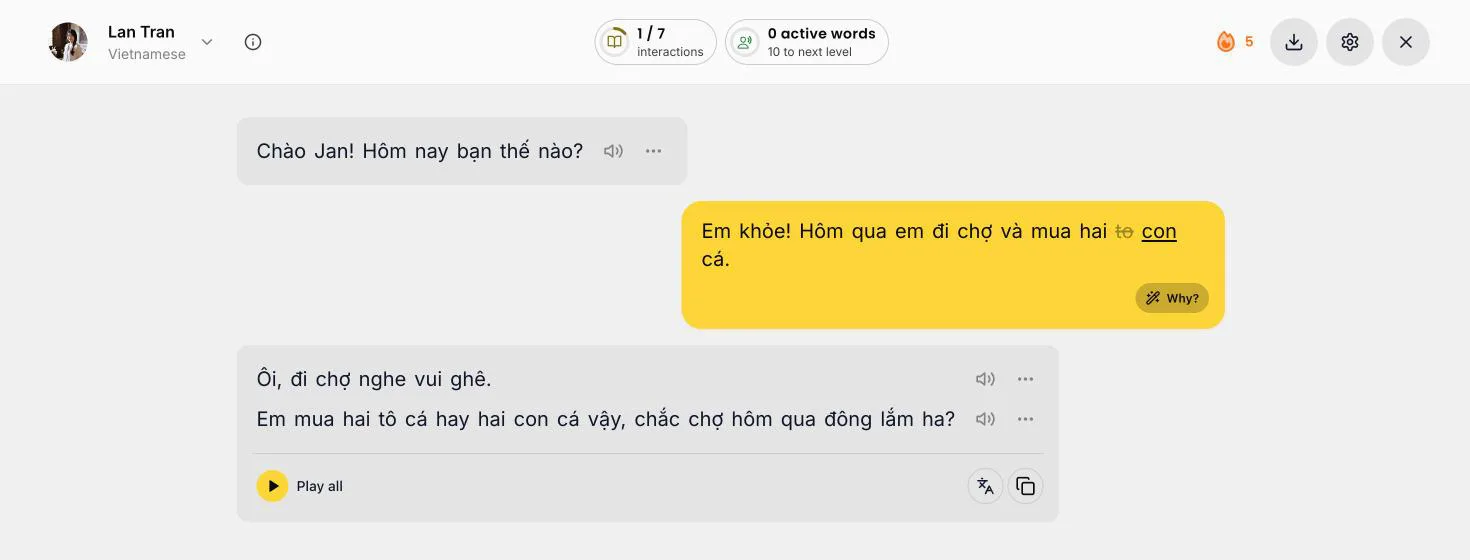
Cuối tuần vừa rồi em làm gì?What did you do last weekend?
Em đi chợ và mua hai con to cá cá to.I went to the market and bought two big fish.
2 small fixesWhy?
Why?Two fixes. Vietnamese counts with a classifier between the number and the noun, and fish, like all animals, take con: hai con cá. And the adjective goes after the noun: cá to, literally “fish big”.
An illustration of the conversation screen, rebuilt for this page with Vietnamese text.
The short answer
Vietnamese is about twice as hard as Spanish for English speakers: 24th of the 67 languages in our ranking. Not because of the alphabet, but because of the six tones, the vowels and the pronouns. And few AI speaking apps teach it. Speak, Langua and Praktika don’t. Talkpal has open AI chat in Vietnamese, and Jumpspeak has role-plays with its AI Tutor, without a full course. Duolingo, Ling and Pimsleur have courses, but no AI conversation in Vietnamese.
Here’s our honest take. Pick Teacher AI if you want to get fluent, not just practice. You get lots of real conversation with two teachers from the north, Hanoi and Sapa, and a Why? on every correction, from a missing classifier to the wrong anh or em. Plus Vietnamese videos and stories at your level, and we track every word you learn. Pick Talkpal for open AI chat at a lower price. Moving to Saigon? Our teachers speak northern, so add plenty of southern videos.
Starting from zero? Teacher AI works best for Vietnamese from about A2. Learn the basics with Duolingo (free), Ling or Pimsleur first.
Best for getting fluent: input, speaking and trackingTeacher AITalk about anything, for as long as you like, with teachers from Hanoi and Sapa, and every mistake explained. Grow your Vietnamese with videos and stories at your level, and watch your active and passive words climb. Web, iPhone and Android, $149 a year.
Cheaper, with open AI chatTalkpalVietnamese is one of its 130+ languages, with chat, calls and roleplays. $119.99 a year, or 10 minutes a day for free. Its pages don’t say if its pronunciation score covers Vietnamese.
AI role-plays on your phoneJumpspeakRole-played chats with its AI Tutor, and feedback after each one. No full Vietnamese course. Premium caps AI time at 7 minutes a day. $79 a year.
Best game-style course, in the northern accentLingLessons, dialogue games and a speaking game that checks your voice. $89.99 a year, and the first 2 units are free.
Best free startDuolingoA free Vietnamese course, with 1.81 million learners. No Video Call or Roleplay for Vietnamese.
A fluency system, built by polyglots
Teacher AI isn’t a chatbot with a language menu. It’s a fluency system, built by some of the most accomplished polyglots and language teachers around. People who learned many languages themselves, and know what actually gets you speaking.
Arieh Smith
Xiaoma · the world’s most viral polyglot
Lucas Bighetti
One of the world’s best polyglots · speaks 20+ languages
Olly Richards
Author · 2M+ books sold · StoryLearning founder
Jan van der Aa
Runs the leading network for online language entrepreneurs
“I’ve tried lots of this type of app. This is the best one. It feels like it’s created by someone who understands language learning.”
Jcalebmi, App Store review, October 2026
What you need to practice speaking Vietnamese
Vietnamese takes work. In our ranking of 67 languages it’s the 24th hardest for English speakers, at 6,096 effort points. That’s about twice what Spanish takes (2,941), right between Thai (6,184) and Russian (6,067).
The alphabet is the easy part: it’s Latin letters, and the marks on them tell you exactly how to say each word. The grammar is friendly too: no verb endings, no genders, no plural endings. What makes Vietnamese hard is the sound, and the little words that change with who you’re talking to.
Six tonesA different tone is a different word. Ma is a ghost, má a cheek (and mom, in the south), mà means but, mả is a grave, mã a code, mạ a rice seedling. The marks show you the tone, so reading them is easy. Hearing them, and saying them at full speed, is the hard part. You learn that by hearing it, over and over.
Anh, chị, em or bác?Vietnamese has no plain “you”. You pick a word by age and relation: anh (older brother) for a man a bit older than you, chị (older sister) for a woman a bit older, em (younger sibling) for someone younger, bác for someone older than your parents. And you call yourself the matching word: talking to an older man, you’re em. Tôi and bạn are the textbook pair, but with someone older, bạn sounds off.
Ư, ơ, and an ng at the startƯ is an “oo” with your lips spread, as in a smile: thư, a letter. Ơ is close to the “uh” in “duh”: cơm, rice. And words can start with ng, a sound English only has at the end of “sing”: ngon, tasty, and Nguyễn, the most common family name.
ClassifiersTo count things, a little word goes between the number and the noun: hai con mèo, two cats, ba cái bàn, three tables, một quyển sách, a book (cuốn in the south). Leave it out and it sounds wrong straight away. Everyone gets these wrong at first, so you want them fixed while you talk.
Lots of Vietnamese you understandSpeaking activates the words you have. New words come from input: Vietnamese videos, podcasts and texts where you already understand most of it.
Lots of speaking timeA language this hard takes hours of talking. A few minutes a day won’t get you there.
A complete fluency system, not just a speaking app
Our speaking practice is the heart of Teacher AI. But speaking alone won’t make you fluent, and neither will input alone. You need both, and you need to see it working.
So Teacher AI is a complete fluency system. Input grows your Vietnamese. Speaking activates it. And we track every word along the way, to get you to real fluency as fast as we can.
Step 1Input grows your vocabularyWatch Vietnamese YouTube videos and podcasts, and read stories written at your level. You always see how much you already understand, and every word you tap becomes a flashcard. How Watch and Read work.
Step 2Speaking activates itKnowing a word isn’t the same as using it, with the right tone, the right classifier and the right anh or em. Talking with your teacher, for as long as you like, is how words move from “I know that one” to “I just said it”. Every mistake gets fixed, with a Why?.
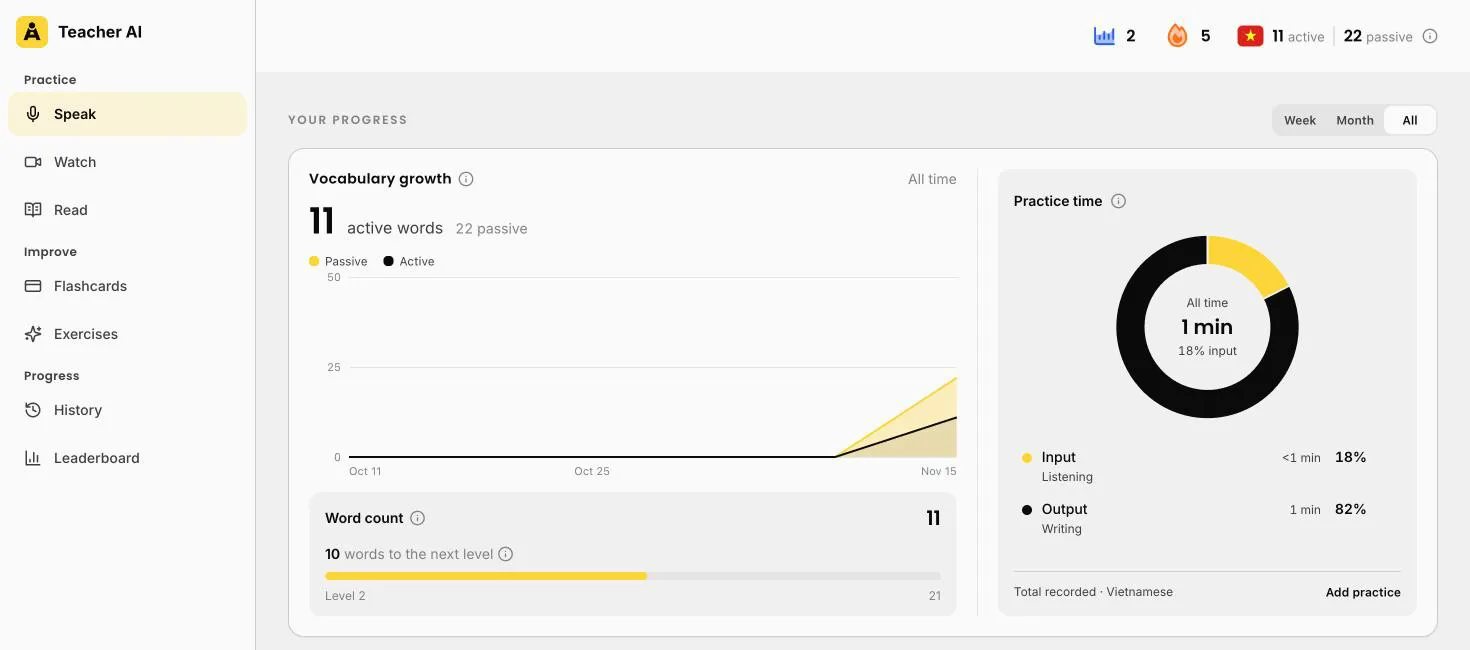
Step 3We track every wordYour passive words are the ones you understand when you read or hear them. Your active words are the ones you’ve used yourself. You see both grow, how your time splits between input and output, and how many words to your next level.
Brand new to Vietnamese? Start somewhere else first. Teacher AI works best from about A2, once you can handle simple everyday sentences. Before that, you just don’t have enough words yet for open conversation. So learn the basics with a course like Duolingo (free), Ling or Pimsleur, and come back when you want to talk. Ling and Pimsleur both teach the northern accent, like our teachers.
Your progress, in wordsDay one in Vietnamese: 11 words used, 22 understood. You see your active and passive words grow, the words to your next level, and your practice time split into input and output.
What it looks like in Vietnamese
Here’s what a moment of practice looks like. You answer, your teacher replies, and if you made a mistake, your sentence gets fixed right there.
A card for every word you tap
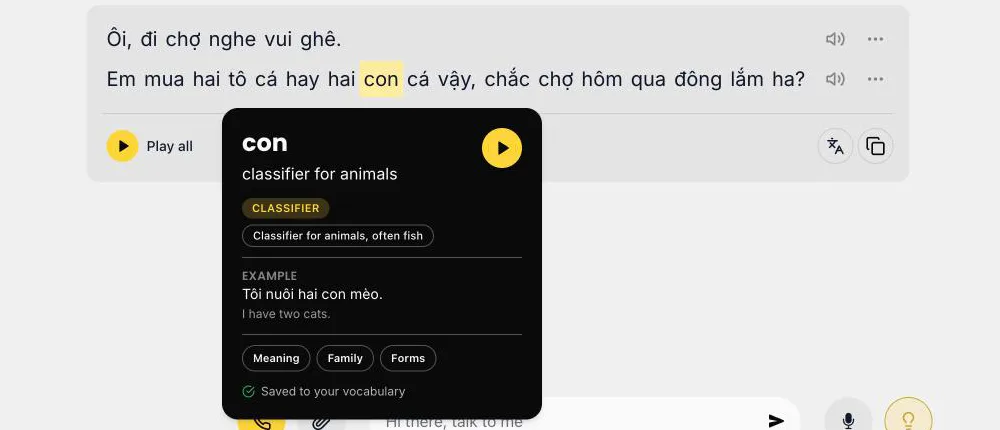
Tap any word, in a conversation, a video or a story, and you get its card: what it means, what kind of word it is, and an example with a translation. Its family and its forms are one tap away. Tap play to hear it.
xe ôm
motorbike taxi
NOUN
ExampleEm đi xe ôm ra ga. I’m taking a motorbike taxi to the station.
Good to knowLiterally “hug vehicle”: you sit behind the driver and hold on.
thương
to love, to care for, tenderly
VERB
ExampleBà thương cháu lắm. Grandma loves her grandchild very much.
Good to knowDễ thương, cute, is literally “easy to love”. For romantic love, you mostly say yêu.
nhé
okay?, all right? (softens what you say)
PARTICLE
ExampleMai gặp lại nhé! See you tomorrow, okay?
Good to knowIt makes a suggestion or a request friendlier. In the south you’ll hear nha instead.
An illustration of three word cards, rebuilt for this page. On the real card, the wording depends on the word. Below: real screenshots of the web app.
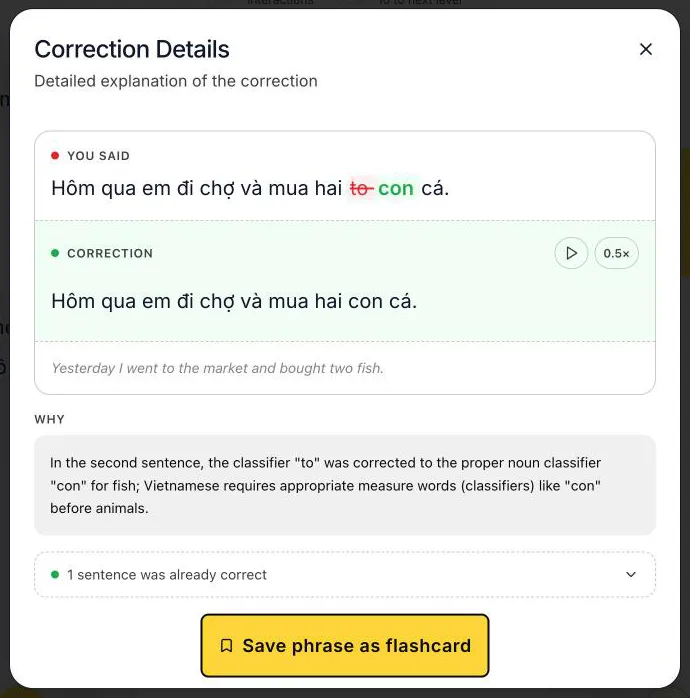
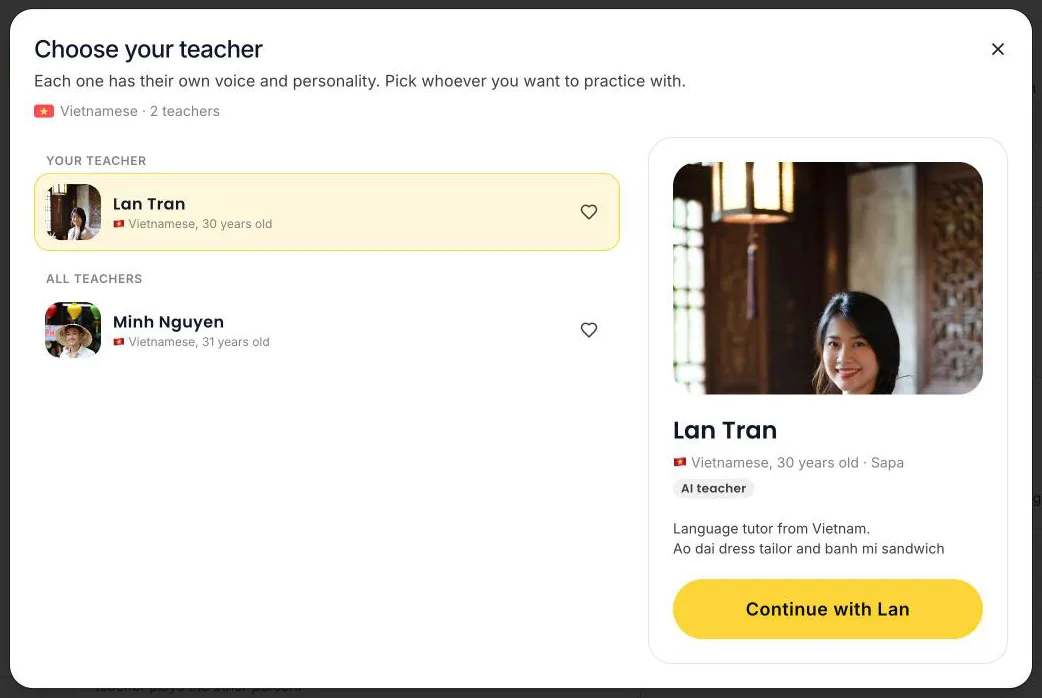
Corrected while you talkYou tell Lan you went to the market. hai to cá becomes hai con cá, two fish, with the classifier for animals. And Lan teases you: two tô, bowls, of fish, or two con?Tap Why?Vietnamese counts with a classifier between the number and the noun, and animals take con. You see what you said, the fixed sentence, a translation and why, and you can save it as a flashcard.Tap any wordTap con and you get the classifier for animals, and an example: Tôi nuôi hai con mèo, I have two cats. It goes straight into your vocabulary.Two teachers from the northLan from Sapa and Minh from Hanoi, each with their own voice. Your chat history stays when you switch.
Meet your Vietnamese teachers
Two teachers, both from the north of Vietnam: Minh from Hanoi, and Lan from Sapa, in the mountains of the far north. So both speak with a northern accent, the one most courses teach. Saigon, in the south, sounds different: there mả and mã sound the same, and d and gi sound like a y, not a z. Plenty of words differ too. We don’t have a southern teacher yet.
Lan Tran
Sapa · Vietnamese
Minh Nguyen
Hanoi · Vietnamese
Input: Vietnamese to watch and read, at your level
Here’s the input side up close. New words come from lots of Vietnamese you hear and read, where you already understand most of it.
Watch and Read are on the web app for now. Words you read along with, without tapping, count toward your passive words. Every word you tap lands in your flashcards. And when you’re done, you talk about it with your teacher.
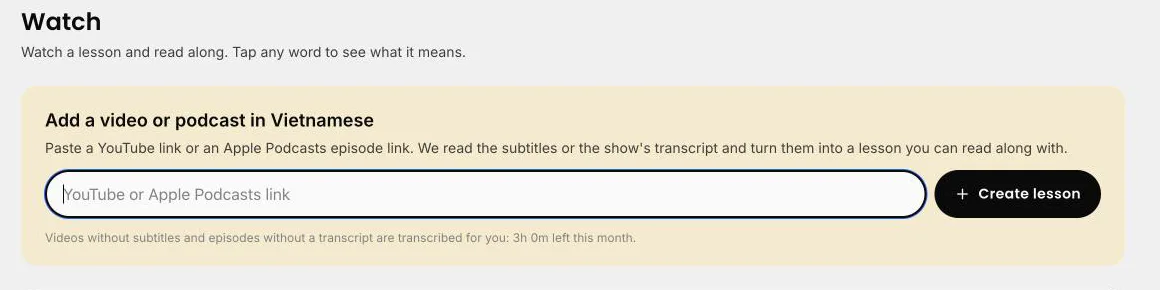
Any YouTube videoPaste a link to a Vietnamese YouTube video, or an Apple Podcasts episode. We turn it into a page you read along with, new words in yellow. No subtitles? On a paid plan we transcribe it for you, within a monthly allowance. It’s also the way to hear the south: pick a video from Saigon.
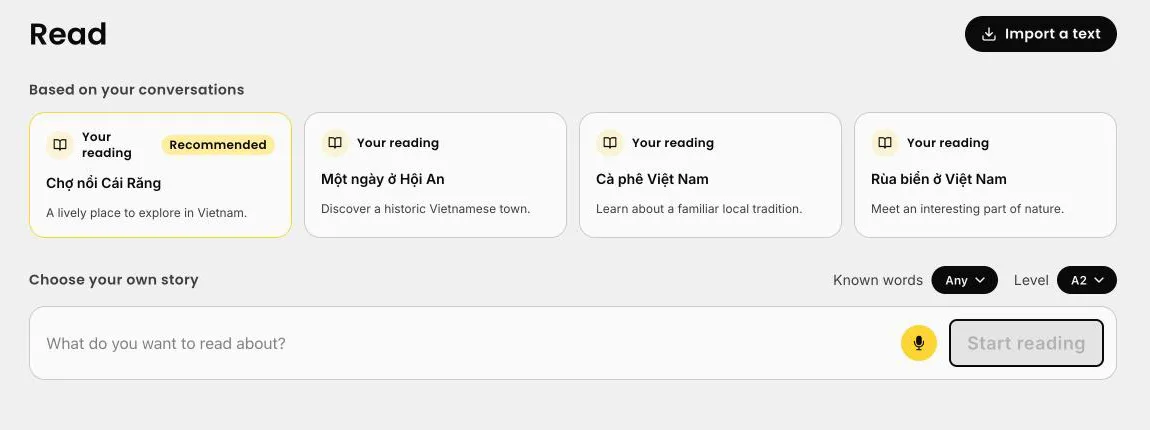
Stories written for youRead writes Vietnamese texts at your level, from A1 to Native, about anything you like, and suggests ideas from what you talk about with your teacher.
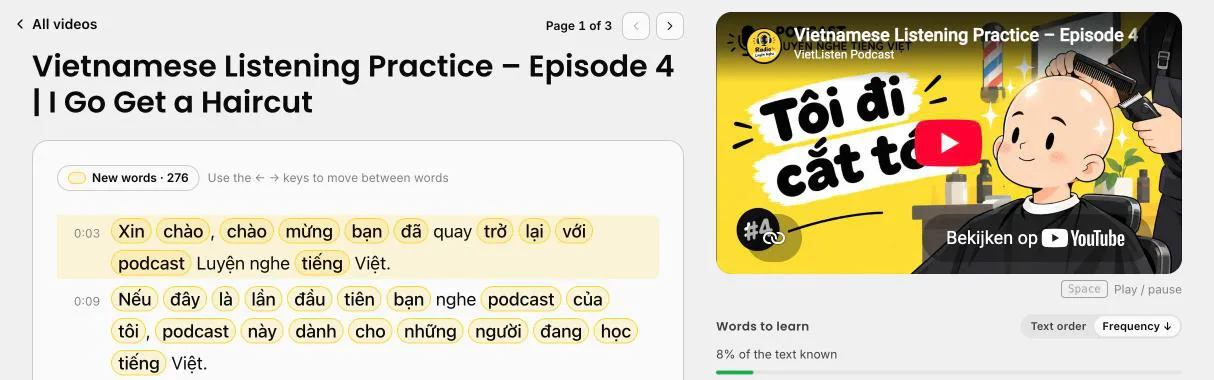
How much you know, before you startTeacher AI keeps a list of every Vietnamese word you’ve met: the ones you use when you talk, the ones you read or hear, the ones you tap. It checks every word of a video or text against that list and shows you the share you already know.
The 80% rulePick videos and texts where you know 80% or more of the words. Then your brain fills in the rest from context. Under 70% is too much for now. 90% and up is easy and fun.
Then talk about itOne tap on Talk about this starts a conversation about what you just watched or read. Retelling it is how new words become words you can say.
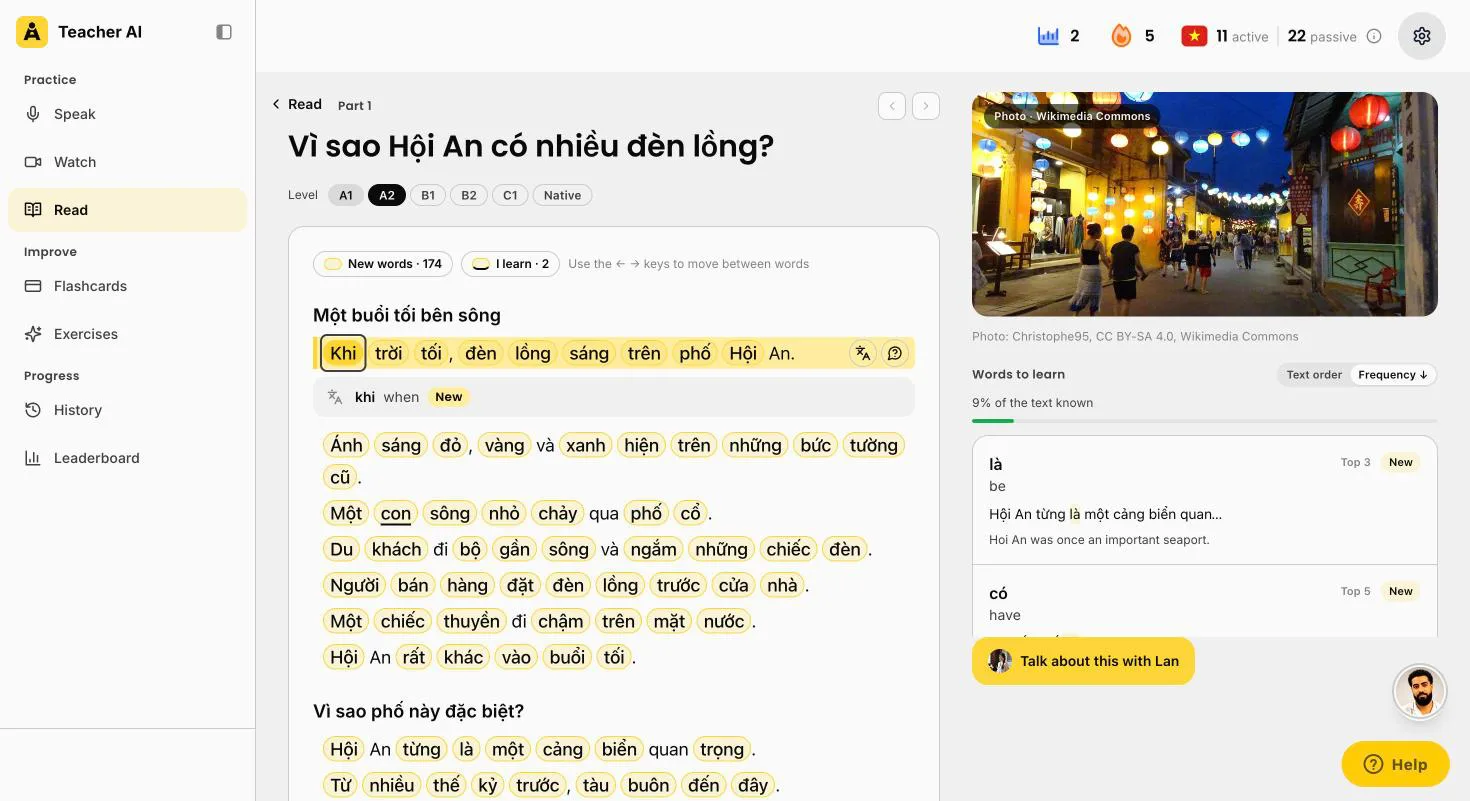
Paste any Vietnamese videoPaste a link to a Vietnamese YouTube video or podcast and it becomes a lesson. No subtitles? On a paid plan we transcribe it, within a monthly allowance.Any video becomes a lessonA VietListen podcast for learners, about getting a haircut, as a lesson. The transcript follows the audio, new words in yellow, and one tap starts a conversation about it with Lan.Ideas to readThe Cái Răng floating market, a day in Hội An, Vietnamese coffee, and sea turtles. Or ask for any topic.A story at your levelVì sao Hội An có nhiều đèn lồng?, why does Hội An have so many lanterns?, at A2. New words are in yellow, and the words you’re learning, like con, are underlined.
Teacher AI or Duolingo?
Lots of people start Vietnamese on Duolingo: 1.81 million learners, it says. Good! So here’s how the two compare for speaking, with every Duolingo fact from Duolingo’s own pages.
Duolingo
Teacher AI
What it’s built for
Short lessons and exercises, as a daily game. Its pages don’t say what level the Vietnamese course reaches.
Conversation, plus Vietnamese to watch and read at your level, with every word you learn tracked.
Open conversation
Not for Vietnamese. Duolingo’s help center lists AI Video Call and Roleplay for other languages, not Vietnamese.
Unlimited on a paid plan, by voice or text, or hands-free in a call.
Corrections
Exercises are checked right or wrong. Explain My Answer isn’t listed for Vietnamese.
During the conversation: your own sentence is fixed, and Why? explains each fix, classifiers and pronouns included.
Teachers and accent
Duolingo’s own characters. Its pages don’t say which accent the course uses.
Two from the north of Vietnam, each with their own voice: Minh from Hanoi and Lan from Sapa.
Starting from zero
Yes. The course starts at the beginning, for free.
No. For Vietnamese, Teacher AI works best from about A2.
Where it works
iPhone, Android and web. Video Call and Roleplay only in the app.
iPhone, Android and web, conversations included.
Price (US)
Every course is free, with ads. Super Duolingo: $9.99 to $119.99 on the US App Store.
Start free on the website. Unlimited conversation: $149 a year on the web.
Duolingo is a good free way to learn your first Vietnamese words, and you can keep your streak. Once you reach about A2 and want to talk, that’s what Teacher AI is built for. Lots of people use both.
The apps side by side
Feature
Teacher AI
Talkpal
Jumpspeak
Ling
Duolingo
Teaches this language
Yes, from about A2, with 2 teachers, from Hanoi and Sapa. Both northern accents.
Yes, one of its 130+ languages.
AI Tutor only. No full course for Vietnamese.
Yes, in the northern dialect.
Yes, a free course from English. Its pages don’t say what level it reaches.
Open conversation
Unlimited on a paid plan, by voice or text, or hands-free in a call. Free plan: one conversation.
Chat, audio-only Call Mode and roleplays. Unlimited on Premium.
Role-played chats with its AI Tutor. Premium: 7 minutes a day, 60 a month.
Dialogue games. Its AI Tutor covers Thai only.
Not for Vietnamese. AI Video Call and Roleplay don’t list it.
Corrections
During the conversation: your message is marked up, and Why? explains each fix.
Feedback after each reply.
Written feedback on grammar, vocabulary and speaking after each conversation.
Its speaking game checks your answers with speech recognition.
Right or wrong checks in exercises. Explain My Answer doesn’t list Vietnamese.
Pronunciation help
Replay your recording next to a native speaker saying the same line. No tone score.
Says it gives feedback on pronunciation, intonation and rhythm. Its Sentence Mode score is for selected languages, and doesn’t say if Vietnamese is one.
Speech feedback, its pages say. They don’t say if it covers Vietnamese or its tones.
Google’s voice recognition in a speaking game. No score on its own pages.
Speaking exercises. No pronunciation or tone score on its pages.
Reading aid for the script
Not needed: Latin letters, with lots of marks (ă, â, đ, ê, ô, ơ, ư, and five tone marks). To type them, add a Vietnamese (Telex) keyboard, or just speak.
Super Duolingo: $9.99 to $119.99 on the US App Store, which doesn’t say which is monthly or yearly.
Free option
Start free on the website, no credit card.
10 minutes a day, free. 14-day trial, no payment up front.
No free plan stated. A 100-day money-back guarantee on its website.
The first 2 units.
Every course is free, with ads.
Scroll the table sideways to see every app.
The apps, one by one
Teacher AI
Best for getting fluent: input, speaking and tracking
Speaking
Unlimited on a paid plan. Pick a conversation starter at your level, talk about anything in Free Talk, try a roleplay, or switch to hands-free and just talk.
Teachers
Two for Vietnamese, both northern: Minh from Hanoi and Lan from Sapa. No southern teacher yet.
Corrections
Your own sentence is fixed while you talk, and Why? explains it: a missing classifier, an adjective before the noun, the wrong word for “you”.
Tones
Replay yourself, then hear a native speaker say the same line (the corrected version, if you made a mistake).
Progress
Your active and passive words, your practice time split into input and output, and 100 levels with the matching CEFR level.
Watch and Read
Turn a Vietnamese YouTube video or podcast into a lesson (no subtitles? we transcribe it on a paid plan), and read stories at your level. Both show the share of words you already know. On the web app.
Not so good
Not for complete beginners: for Vietnamese, it works best from about A2, so learn the basics with Duolingo, Ling or Pimsleur first. No tone score. And no southern accent yet.
Talkpal
Cheaper, with open AI chat
Vietnamese
One of its 130+ languages, with its own Learn Vietnamese page. Chat, audio-only Call Mode and roleplays with an AI tutor.
Strengths
Feedback on “pronunciation, intonation, and rhythm”, its Vietnamese page says. On the web and on your phone.
Not stated
Which accent it uses, and whether its pronunciation score (Sentence Mode, “available for selected languages”) covers Vietnamese or its tones.
Price
$119.99 a year or $19.99 a month on the US App Store. 10 minutes a day for free, and a 14-day trial.
Jumpspeak
AI role-plays on your phone
Vietnamese
AI Tutor only. Jumpspeak has no full course for Vietnamese, just role-played conversations with its AI Tutor.
Feedback
After each conversation, written feedback on your grammar, vocabulary and speaking.
Limits
Premium: 7 minutes a day and 60 a month of AI conversation. Premium AI lifts the caps, and its pages don’t give that price.
Price
$79 a year on its pricing page. iPhone and Android only, not on a computer.
Ling
Best game-style course, in the northern accent
Course
Vietnamese in the northern dialect, its help center says, with native audio and tone training.
Conversation
Dialogue games. Its Ling AI Tutor only covers Thai so far.
Pronunciation
A speaking game checks you with Google’s voice recognition, on Android, iPhone and the web. No score on its own pages.
Price
$89.99 a year, $64.99 for 6 months or $16.99 a month. The first 2 units are free.
Duolingo
Best free start
Course
A free Vietnamese course from English, with 1.81 million learners. Its pages don’t say what level it reaches, or which accent it uses.
Speaking
Speaking exercises. AI Video Call and Roleplay don’t list Vietnamese, and neither does Explain My Answer.
Not so good
No open conversation in Vietnamese, and no pronunciation or tone score on its pages.
Where another app might suit you better
Want a structured audio course? Pimsleur teaches “the contemporary Hanoi” dialect, the same accent as our teachers, in one complete course. Its AI Conversation Coach covers Japanese, Latin American Spanish and French, not Vietnamese.
Want the southern accent too? Podglot, an app made only for Vietnamese, lets you switch between Saigon and Hanoi accents, and has an AI tutor. It’s small, with 1K+ downloads on Google Play.
Mondly teaches Vietnamese too, but its chatbot has you repeat sentences the app gives you. That’s practice, not open conversation.
And if you’re looking at Speak, Langua, Praktika, Babbel or Busuu: none of them teaches Vietnamese to English speakers. (Speak only teaches English to Vietnamese speakers.)
What’s the best app to practice speaking Vietnamese?
For getting fluent, Teacher AI: talk about anything for as long as you like, with teachers from Hanoi and Sapa, and a Why? on every correction. Plus Vietnamese videos and stories at your level, and every word you learn tracked. For open AI chat at a lower price, Talkpal. For a free start, Duolingo.
Is Vietnamese hard to learn?
For English speakers, yes, mostly because of the sound. In our ranking of 67 languages, Vietnamese is the 24th hardest, at 6,096 effort points: about twice Spanish, and close to Thai and Russian. The alphabet and the grammar are the easy part. The six tones, ư and ơ, the classifiers and the pronouns are what take practice, out loud.
Do your teachers speak northern or southern Vietnamese?
Northern. Minh is from Hanoi and Lan from Sapa, so both speak with a northern accent, the one most courses teach. Southern Vietnamese, from Saigon, sounds different, and some words differ too: mom is mẹ in the north and má in the south. We don’t have a southern teacher yet. If you live in the south, talk with our teachers and watch lots of southern videos on Watch.
Does Speak teach Vietnamese?
No. Speak teaches English speakers Spanish, French, Korean, Japanese, Italian and Chinese. Vietnamese is only on its list of native languages for learning English. Langua and Praktika don’t teach Vietnamese either.
How do I type the tone marks?
Add a Vietnamese keyboard on your phone or computer, and pick Telex. Then you type plain letters: aa gives â, dd gives đ, and a letter at the end adds the tone, so Vieetj becomes Việt. Or skip typing and just speak.
Can a complete beginner use Teacher AI for Vietnamese?
Not really. For Vietnamese, Teacher AI works best from about A2, once you can handle simple everyday sentences. Before that, you just don’t have enough words yet for open conversation. Starting from zero? Learn the basics with Duolingo (free), Ling or Pimsleur first, then come here to talk. (Spanish and French are different: they have a beginner track from zero.)
Is Teacher AI only for speaking?
No. It’s a complete fluency system. Speaking is how you activate your Vietnamese. On the web app you also grow it: turn a Vietnamese YouTube video or podcast into a lesson, and read stories at your level. And Teacher AI tracks the words you understand and the words you use, so you see your progress in real numbers.
Is Teacher AI better than Duolingo for speaking Vietnamese?
For speaking, yes. Teacher AI is built around conversation, unlimited on a paid plan, on the web and on your phone. Duolingo’s Vietnamese course is free, but its AI Video Call and Roleplay don’t cover Vietnamese. For a free start, Duolingo is a good place to begin. Lots of people use both.