Turkish · With Can from Turkishle, and every ending fixed as you talk
The best AI apps to practice speaking Turkish
Updated November 15, 2026. We checked every other app on its own website, help pages and app store page. See the sources.
We built Teacher AI, so of course we’re biased. That’s why we link every claim we make about another app, and tell you plainly when another app suits you better.
Hafta sonu ne yaptın?What did you do at the weekend?
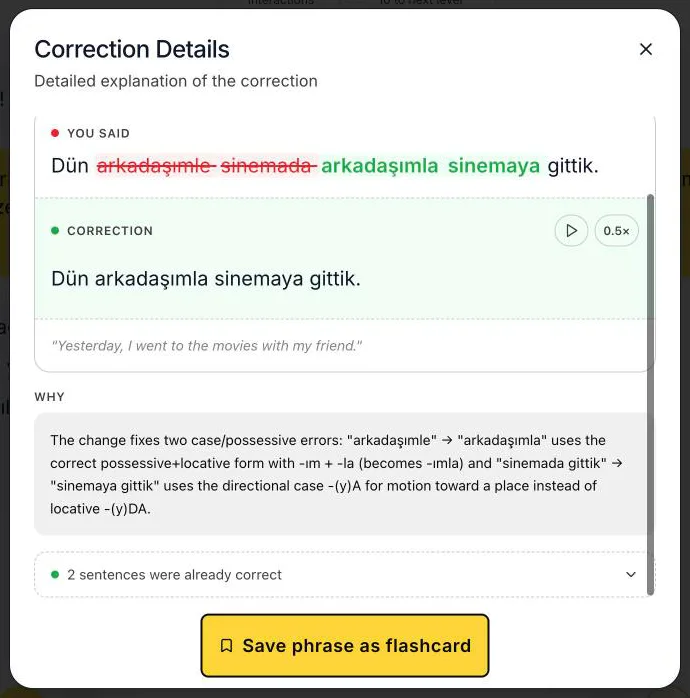
Cumartesi arkadaşımlela sinemada sinemaya gittim.On Saturday I went to the cinema with my friend.
2 small fixesWhy?
Why?“With” is -le or -la, and vowel harmony picks it: the last vowel of arkadaşım is ı, so it’s arkadaşımla. And going somewhere takes -a or -e, “to”: sinemaya. Sinemada means “at the cinema”.
An illustration of the conversation screen, rebuilt for this page with Turkish text.
The short answer
Turkish is more than twice as hard as Spanish for English speakers: 15th of the 67 languages in our ranking. Not because of the letters, but because of the endings, vowel harmony and the verb at the end. Only a few AI apps let you talk in Turkish: Langua and Talkpal. Speak and Praktika don’t teach Turkish, and Duolingo, Babbel and Busuu teach it, but their pages don’t list AI conversation in Turkish.
Here’s our honest take. Pick Teacher AI if you want to get fluent, not just practice. You get lots of real conversation, corrected as you go, with five teachers from Istanbul, Izmir and Ankara, among them Can from Turkishle. Plus Turkish videos and stories at your level, and we track every word you learn. Pick Langua for open AI chat on the web too, and Talkpal for the lowest price.
Starting from zero? Teacher AI works best for Turkish from about A2. Learn the basics with Duolingo or Busuu first.
Best for getting fluent: input, speaking and trackingTeacher AITalk about anything, for as long as you like, with teachers from Istanbul, Izmir and Ankara, and every mistake explained. Grow your Turkish with videos and stories at your level, and watch your active and passive words climb. Web, iPhone and Android, $149 a year.
Open AI chat, on the web tooLanguaChat and calls in Turkish, with voices cloned from real native speakers, its site says. $149.99 a year, or 3 minutes of calls a day for free. Its pronunciation score doesn’t cover Turkish.
Best price, with a free daily planTalkpalChat, calls and roleplays in Turkish. $119.99 a year, or 10 minutes a day for free.
Best free startDuolingoA free Turkish course, with ads, and 4 million learners. No AI conversation in Turkish listed.
A fluency system, built by polyglots
Teacher AI isn’t a chatbot with a language menu. It’s a fluency system, built by some of the most accomplished polyglots and language teachers around. People who learned many languages themselves, and know what actually gets you speaking.
Arieh Smith
Xiaoma · the world’s most viral polyglot
Lucas Bighetti
One of the world’s best polyglots · speaks 20+ languages
Olly Richards
Author · 2M+ books sold · StoryLearning founder
Jan van der Aa
Runs the leading network for online language entrepreneurs
“I’ve tried lots of this type of app. This is the best one. It feels like it’s created by someone who understands language learning.”
Jcalebmi, App Store review, October 2026
What you need to practice speaking Turkish
Turkish takes work. In our ranking of 67 languages it’s the 15th hardest for English speakers, at 6,521 effort points. That’s more than twice what Spanish takes (2,941), and more than Russian (6,067) or Polish (6,329). It sits right next to Arabic (6,480).
Some of it is easy. Turkish uses Latin letters, you say each letter the same way every time, and there’s no gender: o means he, she and it. What makes it hard is how words are built, and where they go in the sentence.
Vowel harmonyEndings change their vowel to match the word. The plural is -ler or -lar: evler, houses, but kitaplar, books. “In” is -de or -da: evde, at home, but okulda, at school. The rule fits on one page. Picking the right vowel without thinking takes practice.
Words built from endingsWhere English uses a string of words, Turkish stacks endings onto one. Evlerimizden is ev (house) + ler (plural) + imiz (our) + den (from): from our houses. You need to build words like that on the fly, mid-sentence.
The verb comes lastHer sabah kahve içerim, I drink coffee every morning, is literally “every morning coffee I-drink”. And where English says “to Ankara”, Turkish says Ankara’ya. So you plan the whole sentence before the verb, which feels backwards at first.
Letters that look familiar, but aren’tTurkish has six extra letters: ç, ğ, ı, ö, ş and ü. The dotless ı is a different vowel from i: kır is the countryside, kir is dirt. Ğ is silent and stretches the vowel before it, so dağ, mountain, sounds like “daa”. And c is said like the j in jam.
Lots of Turkish you understandSpeaking activates the words you have. New words come from input: Turkish videos, podcasts and texts where you already understand most of it.
Lots of speaking timeA language this hard takes hours of talking. A few minutes a day won’t get you there.
A complete fluency system, not just a speaking app
Our speaking practice is the heart of Teacher AI. But speaking alone won’t make you fluent, and neither will input alone. You need both, and you need to see it working.
So Teacher AI is a complete fluency system. Input grows your Turkish. Speaking activates it. And we track every word along the way, to get you to real fluency as fast as we can.
Step 1Input grows your vocabularyWatch Turkish YouTube videos and podcasts, and read stories written at your level. You always see how much you already understand, and every word you tap becomes a flashcard. How Watch and Read work.
Step 2Speaking activates itKnowing a word isn’t the same as using it, with the right endings, in the right vowel, and the verb at the end. Talking with your teacher, for as long as you like, is how words move from “I know that one” to “I just said it”. Every mistake gets fixed, with a Why?.
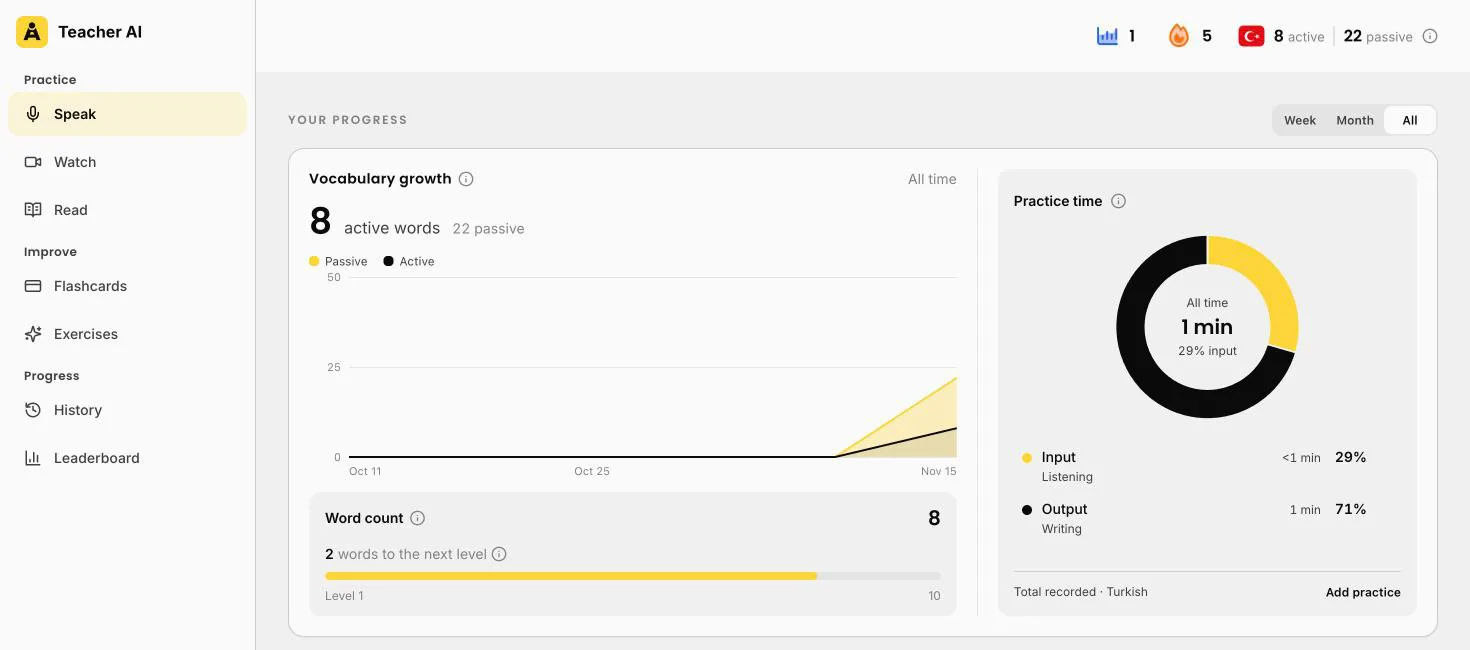
Step 3We track every wordYour passive words are the ones you understand when you read or hear them. Your active words are the ones you’ve used yourself. You see both grow, how your time splits between input and output, and how many words to your next level.
Brand new to Turkish? Start somewhere else first. Teacher AI works best from about A2, once you can handle simple everyday sentences. Before that, you just don’t have enough words yet for open conversation. So learn the basics with Duolingo (free) or Busuu, which both teach Turkish from zero, and come back when you want to talk.
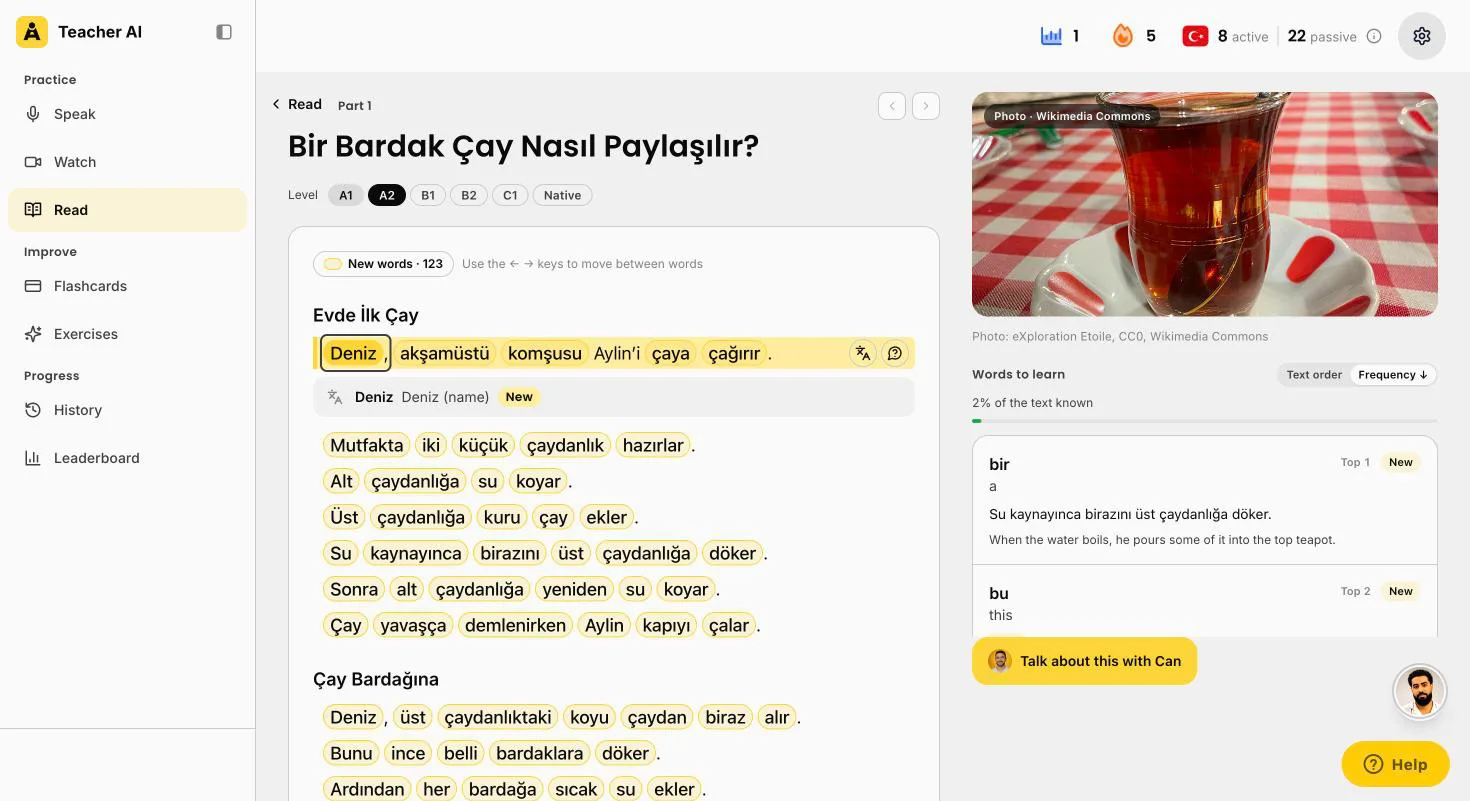
Your progress, in wordsDay one in Turkish: 8 words used, 22 understood. You see your active and passive words grow, the words to your next level, and your practice time split into input and output.
What it looks like in Turkish
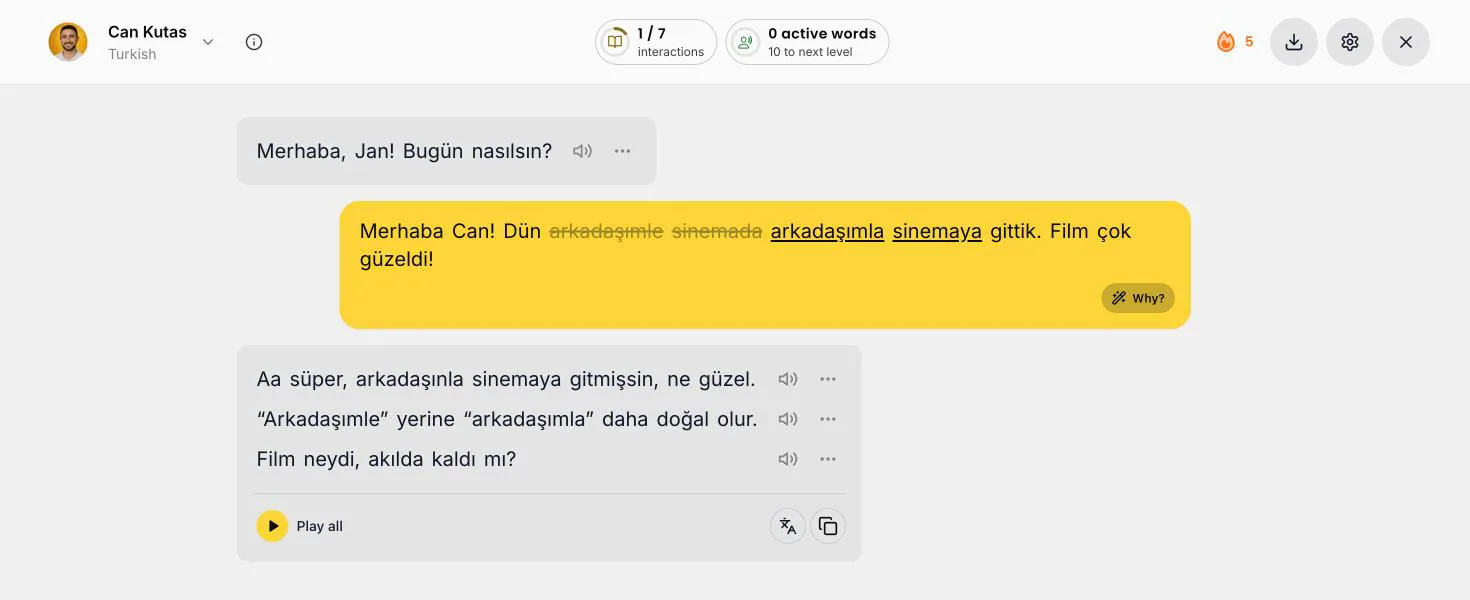
Here’s what a moment of practice looks like. You answer, your teacher replies, and if you made a mistake, your sentence gets fixed right there.
A card for every word you tap
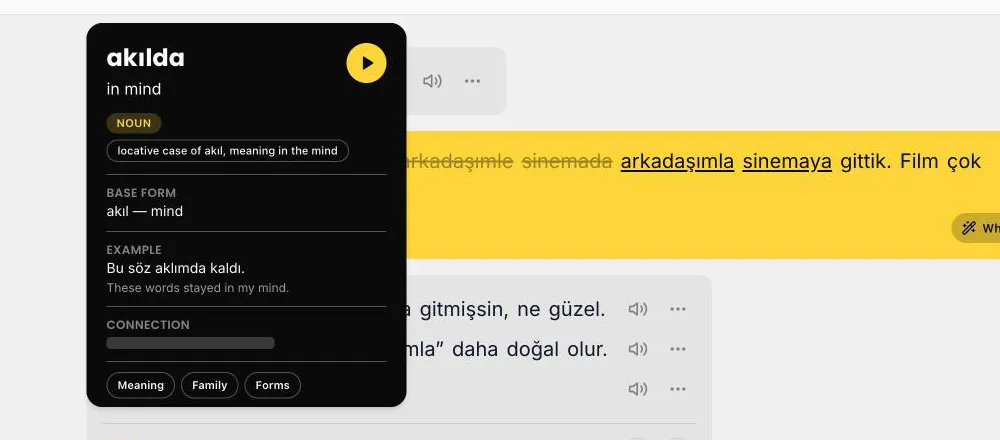
Tap any word, in a conversation, a video or a story, and you get its card: what it means, what kind of word it is, and an example with a translation. Tap play to hear it.
kolay gelsin
may it come easy
PHRASE
ExampleKolay gelsin! Teşekkürler. Hope the work goes easy! Thanks.
Good to knowThere’s no English version. You say it to anyone who’s working: a shopkeeper, a waiter, a friend painting a wall.
roman
novel
NOUN
ExampleBu romanı çok sevdim. I loved this novel.
Good to knowA false friend. It has nothing to do with Rome: Turkish took it from French roman, a novel.
keyif
pleasure, a good mood, taking it easy
NOUN
ExampleKeyfin nasıl? How are you doing?
Good to knowNotice the i drops out: keyif, but keyfin, your mood. Keyif yapmak is to sit back and enjoy yourself, often with a glass of tea.
An illustration of three word cards, rebuilt for this page. On the real card, the wording depends on the word. Below: real screenshots of the web app.
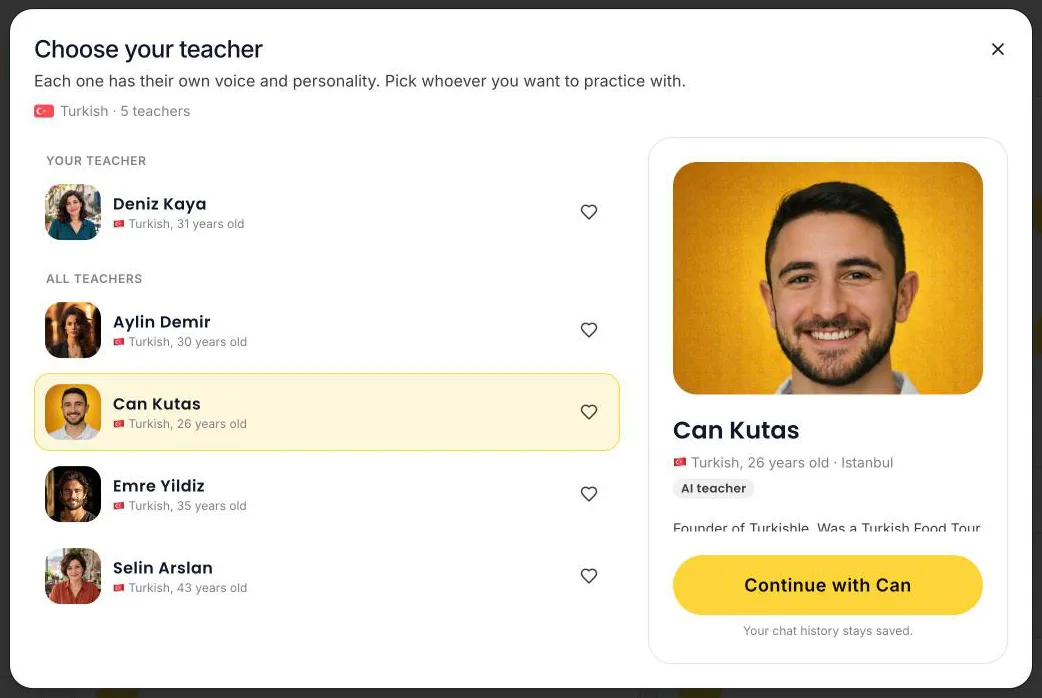
Corrected while you talkYou tell Can about the cinema. arkadaşımle becomes arkadaşımla, vowel harmony, and sinemada becomes sinemaya, because you go to it. Above the text box: ç, ğ and ı.Tap Why?-la follows the last vowel, so arkadaşımla. And motion toward a place takes -(y)A, not -(y)DA. You see the fixed sentence, a translation and why, and you can save it as a flashcard.Tap any wordTap akılda and you get in mind, the ending it carries, the base form akıl, and an example with a translation.Five teachers from TurkeyCan from Istanbul, the founder of Turkishle, with Deniz, Aylin, Emre and Selin. Each has their own voice, and your chat history stays when you switch.
Meet your Turkish teachers
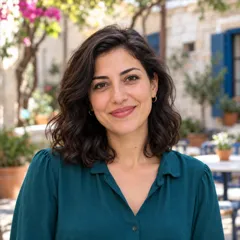
Five teachers, all from Turkey. Can from Istanbul, the YouTuber behind Turkishle, so if you already learn with his videos, you can practice with an AI version of him here. Emre from Istanbul too, Aylin and Deniz from Izmir, and Selin from Ankara.
Each one has their own voice. Pick the one you like, and switch whenever you want.
Aylin Demir
Izmir · Turkish
Can Kutas
Istanbul · Turkish
Turkishle
Deniz Kaya
Izmir · Turkish
Emre Yildiz
Istanbul · Turkish
Selin Arslan
Ankara · Turkish
Input: Turkish to watch and read, at your level
Here’s the input side up close. New words come from lots of Turkish you hear and read, where you already understand most of it.
Watch and Read are on the web app for now. Words you read along with, without tapping, count toward your passive words. Every word you tap lands in your flashcards. And when you’re done, you talk about it with your teacher.
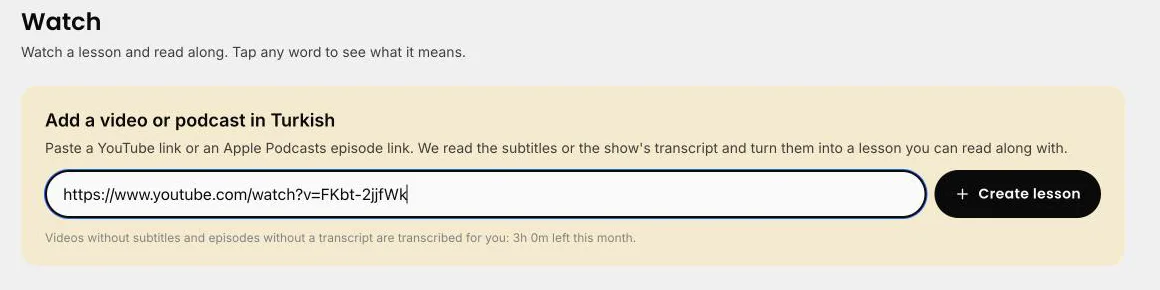
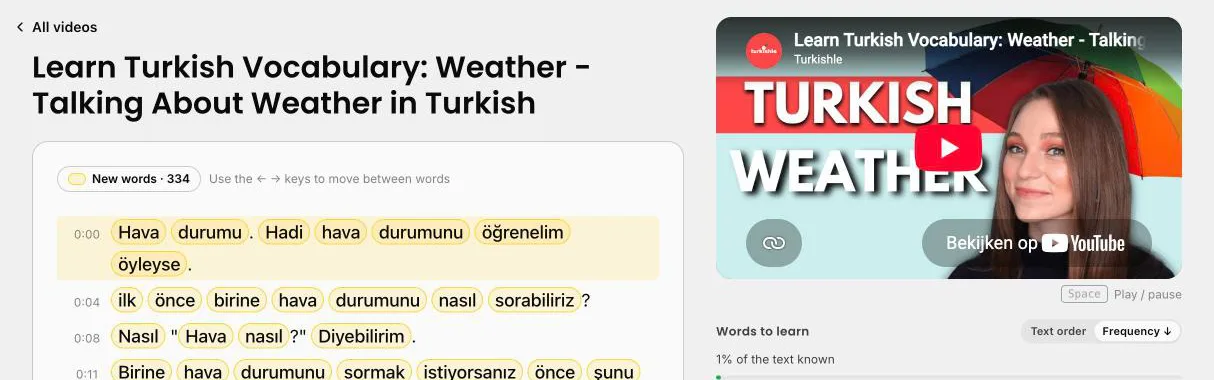
Any YouTube videoPaste a link to a Turkish YouTube video, or an Apple Podcasts episode. We turn it into a page you read along with, new words in yellow. No subtitles? On a paid plan we transcribe it for you, within a monthly allowance.
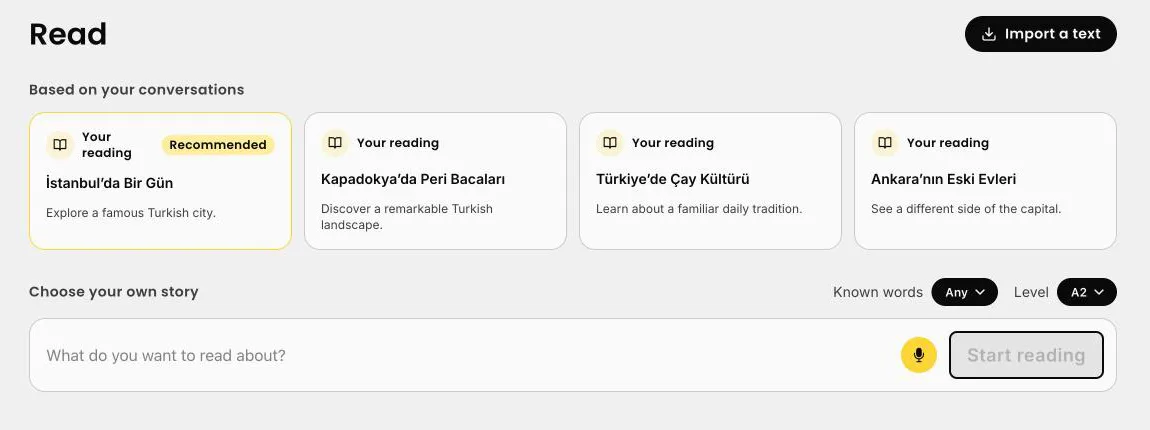
Stories written for youRead writes Turkish texts at your level, from A1 to Native, about anything you like, and suggests ideas from what you talk about with your teacher.
How much you know, before you startTeacher AI keeps a list of every Turkish word you’ve met: the ones you use when you talk, the ones you read or hear, the ones you tap. It checks every word of a video or text against that list and shows you the share you already know.
The 80% rulePick videos and texts where you know 80% or more of the words. Then your brain fills in the rest from context. Under 70% is too much for now. 90% and up is easy and fun.
Then talk about itOne tap on Talk about this starts a conversation about what you just watched or read. Retelling it is how new words become words you can say.
Paste any Turkish videoPaste a link to a Turkish YouTube video or podcast and it becomes a lesson. No subtitles? On a paid plan we transcribe it, within a monthly allowance.Any video becomes a lessonA Turkishle video about the weather, as a lesson. The transcript follows the video, new words in yellow, and one tap starts a conversation about it with Can.Ideas to readA day in Istanbul, the fairy chimneys of Cappadocia, Turkish tea, and the old houses of Ankara. Or ask for any topic.A story at your levelBir Bardak Çay Nasıl Paylaşılır?, how do you share a glass of tea?, at A2. New words are in yellow, and Words to learn starts with the most common ones.
Teacher AI or Duolingo?
Lots of people start Turkish on Duolingo: 4 million learners, it says. Good! So here’s how the two compare for speaking, with every Duolingo fact from Duolingo’s own pages.
Duolingo
Teacher AI
What it’s built for
Short lessons and exercises, as a daily game.
Conversation, plus Turkish to watch and read at your level, with every word you learn tracked.
Open conversation
Not for Turkish. Duolingo’s help center lists AI Video Call and Roleplay for other languages, not Turkish.
Unlimited on a paid plan, by voice or text, or hands-free in a call.
Corrections
Exercises are checked right or wrong. Explain My Answer isn’t listed for Turkish.
During the conversation: your own sentence is fixed, and Why? explains each fix.
Starting from zero
Yes. The course starts at the beginning, for free.
No. For Turkish, Teacher AI works best from about A2.
Where it works
iPhone, Android and web. Video Call and Roleplay only in the app.
iPhone, Android and web, conversations included.
Price (US)
Every course is free, with ads. Super Duolingo: $9.99 to $119.99 on the US App Store.
Start free on the website. Unlimited conversation: $149 a year on the web.
Duolingo is a good free way to learn your first Turkish words and keep a daily habit. Once you reach about A2 and want to talk, that’s what Teacher AI is built for. Lots of people use both.
The apps side by side
Feature
Teacher AI
Langua
Talkpal
Duolingo
Teaches this language
Yes, from about A2, with 5 teachers, from Istanbul, Izmir and Ankara.
Yes, one of its 23 languages.
Yes, one of its 130+ languages.
Yes, a free course. Its pages don’t say what level it reaches.
Open conversation
Unlimited on a paid plan, by voice or text, or hands-free in a call. Free plan: one conversation.
Free-form chat and Call Mode. Unlimited plan: no limit. Communicate plan: 30 minutes of calls a day.
Chat, calls, roleplays and debates. Unlimited on Premium.
Video Call and Roleplay aren’t listed for Turkish.
Corrections
During the conversation: your message is marked up, and Why? explains each fix.
Five correction modes, a tap to explain any correction, a report after the chat.
Feedback after each reply, and a tool that explains any sentence.
Explain My Answer isn’t listed for Turkish.
Pronunciation help
Replay your recording next to a native speaker saying the same line. No pronunciation score.
Its pronunciation score covers Spanish, French and English, not Turkish.
Says it gives feedback on pronunciation, intonation and rhythm. Its Sentence Mode score is for selected languages, and doesn’t say if Turkish is one.
Speaking exercises and speaking practice sets. No pronunciation score on its pages.
Reading aid for the script
Latin letters, plus ç, ğ, ı, ö, ş and ü. In text mode, a row with ç, ğ and ı sits above the text box. For the rest, add a Turkish keyboard, or just speak.
Not needed.
Not needed.
Not needed.
Where it works
Web, iOS and Android
Web, iOS and Android
Web, iOS and Android
iOS, Android and web. Video Call and Roleplay: app only.
$119.99/year or $19.99/month. On the web, $149.99 for 24 months.
Super Duolingo: $9.99 to $119.99 on the US App Store, which doesn’t say which is monthly or yearly.
Free option
Start free on the website, no credit card.
3 minutes of calls a day. Trial of 5 or 7 days, card needed.
10 minutes a day, free. 14-day trial, no payment up front.
Every course is free, with ads.
Scroll the table sideways to see every app.
The apps, one by one
Teacher AI
Best for getting fluent: input, speaking and tracking
Speaking
Unlimited on a paid plan. Pick a conversation starter at your level, talk about anything in Free Talk, try a roleplay, or switch to hands-free and just talk.
Teachers
Five for Turkish: Can from Istanbul (Turkishle on YouTube), Emre from Istanbul, Aylin and Deniz from Izmir, and Selin from Ankara.
Corrections
Your own sentence is fixed while you talk, and Why? explains it: an ending with the wrong vowel, -de where you meant -e, the verb in the wrong place.
Progress
Your active and passive words, your practice time split into input and output, and 100 levels with the matching CEFR level.
Watch and Read
Turn a Turkish YouTube video or podcast into a lesson (no subtitles? we transcribe it on a paid plan), and read stories at your level. Both show the share of words you already know. On the web app.
Not so good
Not for complete beginners: for Turkish, it works best from about A2, so learn the basics with Duolingo or Busuu first. And there’s no pronunciation score.
Langua
Open AI chat, on the web too
Speaking
Turkish is one of its 23 languages. Chat and hands-free Call Mode, with voices cloned from real native speakers. Unlimited plan: no limits. Communicate plan: 30 minutes of calls a day.
Not stated
Anything specific to Turkish. We didn’t find a Turkish tutor page or blog post on its site, like the ones it has for some other languages.
Not so good
Its pronunciation score covers Spanish, French and English, not Turkish. Unlimited costs $199.99 a year.
Talkpal
Best price, with a free daily plan
Speaking
Turkish is one of its 130+ languages, with its own Learn Turkish page. Chat, Call Mode, roleplays and debates with an AI tutor. Unlimited on Premium, 10 minutes a day for free.
Not stated
Whether its pronunciation score (Sentence Mode, “available for selected languages”) covers Turkish.
Price
$119.99 a year or $19.99 a month on the US App Store, with a 14-day trial.
Duolingo
Best free start
Course
A free Turkish course, with 4 million learners. Its pages don’t say what level it reaches.
Speaking
Speaking exercises for free. But Duolingo’s help center lists neither AI Video Call nor Roleplay for Turkish, and Explain My Answer isn’t listed for Turkish either.
Not so good
No open conversation in Turkish listed. Duolingo says nine of its courses now go up to B2, and Turkish isn’t one of them.
Where another app might suit you better
Want a longer course? Busuu’s Turkish goes from A1 to B2, and its site says the Complete Turkish course is free, with feedback from native speakers in its community. Its AI Conversations don’t cover Turkish.
Want a structured audio course? Pimsleur has one Turkish level, 16 hours, in standard Istanbul Turkish, with reading practice. $150 on its website. Its AI Conversation Coach doesn’t cover Turkish.
Looking at Babbel? Its Turkish goes up to A2, with extra topics up to A2/B1, and Babbel Speak, its AI conversation partner, doesn’t cover Turkish.
Memrise lists 200+ lessons and “75+ AI conversations” on its Turkish course page, at $61.99 a year on the US App Store. Its pages don’t say whether they correct you. Mondly teaches Turkish too, but its conversations have you repeat sentences the app gives you.
And if you’re looking at Speak or Praktika: neither teaches Turkish.
For getting fluent, Teacher AI: talk about anything for as long as you like, with teachers from Istanbul, Izmir and Ankara, and a Why? on every correction. Plus Turkish videos and stories at your level, and every word you learn tracked. For open AI chat on the web, Langua. For the lowest price, Talkpal.
Can I talk with Can from Turkishle?
Yes, an AI version of him. Can Kutas, the YouTuber behind Turkishle, is one of our five Turkish teachers, with his own voice. Pick him in the teacher list and start talking.
Is Turkish hard to learn?
Harder than most European languages. In our ranking of 67 languages, Turkish is the 15th hardest for English speakers, at 6,521 effort points, more than twice the effort of Spanish. The letters and the spelling are the quick part, and there’s no gender. The endings, vowel harmony and the verb at the end are what take practice, out loud.
What is vowel harmony?
Turkish endings change their vowel to match the last vowel of the word. So the plural is evler, houses, but kitaplar, books, and “with my friend” is arkadaşımla, not arkadaşımle. You learn it fastest by hearing it and having your slips fixed while you talk.
Does Speak teach Turkish?
No. Speak teaches English speakers Spanish, French, Korean, Japanese, Italian and Chinese. Praktika doesn’t teach Turkish either.
Can a complete beginner use Teacher AI for Turkish?
Not really. For Turkish, Teacher AI works best from about A2, once you can handle simple everyday sentences. Before that, you just don’t have enough words yet for open conversation. Starting from zero? Learn the basics with Duolingo or Busuu first, then come here to talk. (Spanish and French are different: they have a beginner track from zero.)
Is Teacher AI only for speaking?
No. It’s a complete fluency system. Speaking is how you activate your Turkish. On the web app you also grow it: turn a Turkish YouTube video or podcast into a lesson, and read stories at your level. And Teacher AI tracks the words you understand and the words you use, so you see your progress in real numbers.
Is Teacher AI better than Duolingo for speaking Turkish?
For speaking, yes. Teacher AI is built around conversation, unlimited on a paid plan, on the web and on your phone. Duolingo’s Turkish course is free, but its help center lists neither Video Call nor Roleplay for Turkish. Lots of people use both: Duolingo for the basics and a daily habit, Teacher AI for the conversations.