Danish · The soft d, the stød, and Danes who switch to English

The best AI apps to practice speaking Danish

Updated November 15, 2026. We checked every other app on its own website, help pages and app store page. See the sources.

We built Teacher AI, so of course we’re biased. That’s why we link every claim we make about another app, and tell you plainly when another app suits you better.

Available oniPhone and iPadAndroidWeb app

An illustration of the conversation screen, rebuilt for this page with Danish text.

The short answer

Danish grammar is one of the easier ones for English speakers: 54th of the 67 languages in our ranking. The pronunciation is another story. And fewer AI apps teach Danish than you’d think. Langua and Talkpal have open AI conversation in Danish. Jumpspeak has its AI Tutor for Danish, but not its full course. Speak, Praktika and Busuu don’t teach Danish at all. And Duolingo and Babbel do teach it, but their AI conversations don’t cover Danish.

Here’s our honest take. Pick Teacher AI if you want to get fluent, not just practice. You get lots of real conversation, corrected as you go, with two teachers from Aarhus, and nobody switching to English. Plus Danish videos and stories at your level, to train your ear, and we track every word you learn. Pick Langua for open AI chat on the web too, Talkpal for the lowest price, and Babbel for a step-by-step course.

Starting from zero? Teacher AI works best for Danish from about A2. Learn the basics with Duolingo or Babbel first.

  1. Best for getting fluent: input, speaking and trackingTeacher AITalk about anything, for as long as you like, corrected as you go, with teachers from Aarhus. Grow your Danish with videos and stories at your level, and watch your active and passive words climb. Web, iPhone and Android, $149 a year.
  2. Open AI chat, on the web tooLanguaChat and calls in Danish, with corrections. $149.99 a year, or 3 minutes of calls a day for free. Its pronunciation score doesn’t cover Danish.
  3. Best price, with a free daily planTalkpalChat, calls and roleplays in Danish. $119.99 a year, or 10 minutes a day for free.
  4. Best step-by-step courseBabbelDanish up to A2, with native-speaker audio in the lessons. No AI conversation in Danish. $107.99 a year for all its languages.
  5. Best free startDuolingoA free Danish course with ads, for the basics. Its AI Video Call and Roleplay don’t cover Danish.

A fluency system, built by polyglots

Teacher AI isn’t a chatbot with a language menu. It’s a fluency system, built by some of the most accomplished polyglots and language teachers around. People who learned many languages themselves, and know what actually gets you speaking.

  • Arieh Smith
    Arieh Smith
    Xiaoma · the world’s most viral polyglot
  • Lucas Bighetti
    Lucas Bighetti
    One of the world’s best polyglots · speaks 20+ languages
  • Olly Richards
    Olly Richards
    Author · 2M+ books sold · StoryLearning founder
  • Jan van der Aa
    Jan van der Aa
    Runs the leading network for online language entrepreneurs

“I’ve tried lots of this type of app. This is the best one. It feels like it’s created by someone who understands language learning.”

Jcalebmi, App Store review, October 2026

What you need to practice speaking Danish

On paper, Danish is one of the easier ones. In our ranking of 67 languages it’s the 54th hardest for English speakers, at 3,557 effort points. That’s a bit more than Dutch (3,422) and Swedish (3,379), clearly more than Norwegian (2,981), which has almost the same grammar, and far less than German (4,255).

The grammar really is kind: verbs don’t change for the person, jeg er, du er, hun er, and lots of words look like English. What makes Danish harder than its score is the sound. Danes swallow a lot of what they write, so the Danish you hear is far from the Danish you read. That’s the part you can only fix by listening a lot and talking a lot.

  • What you hear isn’t what you readDanish drops and softens sounds all the time. Hvad, what, sounds like “va”: the h and the d are silent. Jeg, I, sounds like “yai”. Og, and, is often just “o”. In fast speech, endings and whole syllables melt into each other. So you can read a sentence easily and still not catch it when a Dane says it. The fix is lots of real Danish in your ears.
  • The soft d and the stødDanes love to make you say rødgrød med fløde, red berry pudding with cream. None of those d’s is a hard d. It’s a soft sound, somewhere near the th in “this”. Then there’s the stød, a little catch in the throat that can change the word: hun, she, and hund, dog, sound the same except for the stød. And æ, ø and å are letters of their own: for is for, før is before, får is gets, or sheep.
  • En or etMost nouns are en-words, but lots are et-words, and there’s rarely a rule: en bil, a car, et hus, a house, et sted, a place. “The” goes on the end: bilen, huset. And the adjective follows: en stor bil, but et stort hus. Add the verb that has to come second, I dag arbejder jeg, today I’m working, not I dag jeg arbejder, and there’s plenty to get right at full speed.
  • Numbers that count in twenties50 is halvtreds, short for an old word that means two and a half twenties. 60 is tres, three twenties. 70 is halvfjerds, 80 firs, 90 halvfems. And the ones come first: 52 is tooghalvtreds, two-and-fifty. Fine on paper. Try it when someone reads you a phone number.
  • Lots of Danish you understandSpeaking activates the words you have. New words come from input: videos, podcasts and texts where you already understand most of it. For Danish, all that listening also trains your ear for the swallowed sounds.
  • Lots of speaking timeEven an easier language takes hours of talking. And Danes speak great English, so the moment you hesitate, many switch to it, to be nice. You need a place where you can be slow, make mistakes, and keep going in Danish.

A complete fluency system, not just a speaking app

Our speaking practice is the heart of Teacher AI. But speaking alone won’t make you fluent, and neither will input alone. You need both, and you need to see it working.

So Teacher AI is a complete fluency system. Input grows your Danish. Speaking activates it. And we track every word along the way, to get you to real fluency as fast as we can.

  1. Step 1Input grows your vocabularyWatch Danish YouTube videos and podcasts, and read stories written at your level. You always see how much you already understand, and every word you tap becomes a flashcard. How Watch and Read work.
  2. Step 2Speaking activates itKnowing a word isn’t the same as using it, with the right en or et, the verb in second place, and halvtreds when you mean 50. Talking with your teacher, for as long as you like, is how words move from “I know that one” to “I just said it”. Every mistake gets fixed, with a Why?. And nobody switches to English.
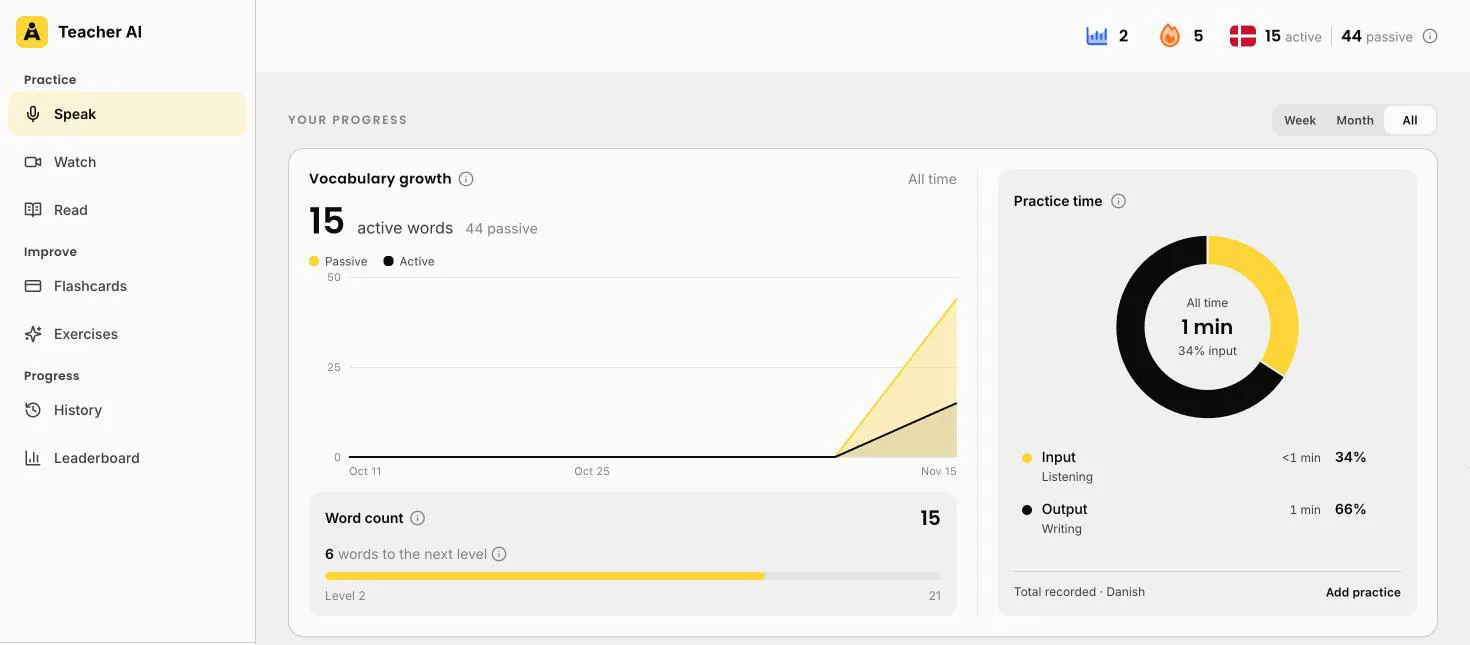
  3. Step 3We track every wordYour passive words are the ones you understand when you read or hear them. Your active words are the ones you’ve used yourself. You see both grow, how your time splits between input and output, and how many words to your next level.

Brand new to Danish? Start somewhere else first. Teacher AI works best from about A2, once you can handle simple everyday sentences. Before that, you just don’t have enough words yet for open conversation. So learn the basics with a course like Duolingo (free) or Babbel, which both teach Danish from zero, and come back when you want to talk.

Teacher AI progress in Danish after a first chat and a video: 15 active and 44 passive words, level 2, and practice time split into input and output
Your progress, in wordsDay one in Danish: 15 words used, 44 understood. You see your active and passive words grow, the words to your next level, and your practice time split into input and output.

What it looks like in Danish

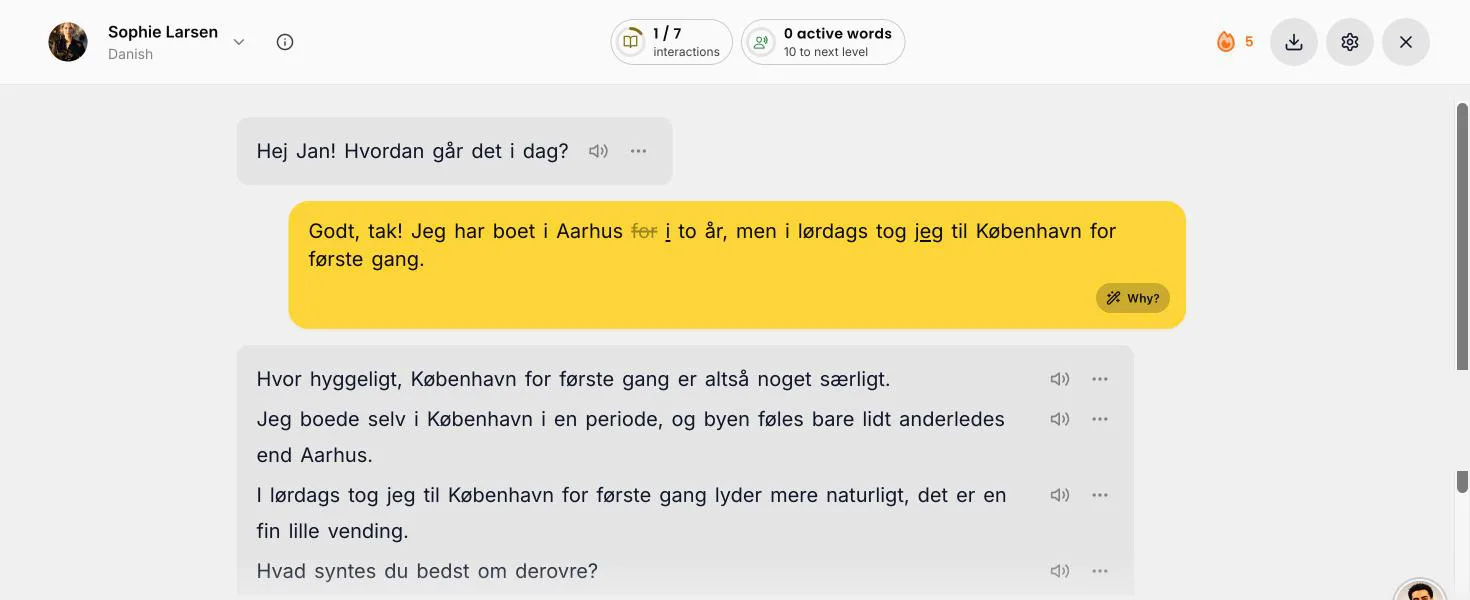
Here’s what a moment of practice looks like. You answer, your teacher replies, and if you made a mistake, your sentence gets fixed right there.

A card for every word you tap

Tap any word, in a conversation, a video or a story, and you get its card: what it means, what kind of word it is, and an example with a translation. Tap play to hear it.

hyggelig
cosy, nice, pleasant to be with
ADJECTIVE
ExampleTak for i aftes, det var rigtig hyggeligt. Thanks for last night, it was really nice.
Good to knowFrom hygge. There’s no one English word for it. Danes use it for evenings, places, even people.
tak for mad
thanks for the meal
PHRASE
ExampleTak for mad, det smagte dejligt. Thanks for the meal, it was lovely.
Good to knowDanes say it to whoever cooked, every time they get up from the table. Kids say it to their parents too.
frokost
lunch
NOUN
ExampleSkal vi spise frokost sammen? Shall we have lunch together?
Good to knowIn Norwegian, frokost is breakfast. In Danish, breakfast is morgenmad.

An illustration of three word cards, rebuilt for this page. On the real card, the wording depends on the word. Below: real screenshots of the web app.

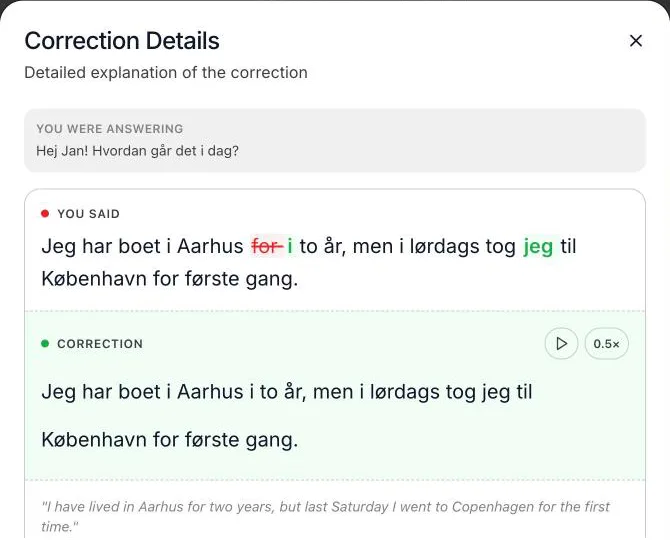
A Danish conversation on Teacher AI with Sophie: for to år corrected to i to år, and i lørdags jeg tog to i lørdags tog jeg
Corrected while you talkYou tell Sophie about your first trip to Copenhagen. for to år becomes i to år, and i lørdags jeg tog becomes i lørdags tog jeg, the verb in second place. Above the text box: æ, ø and å.
Teacher AI correction details for a Danish sentence about living in Aarhus and visiting Copenhagen, with the fixed sentence and a translation
Tap Why?You see what you said, the fixed sentence and a translation. Below it, Why? explains both fixes: i for how long, and the verb right after i lørdags. And you can save it as a flashcard.
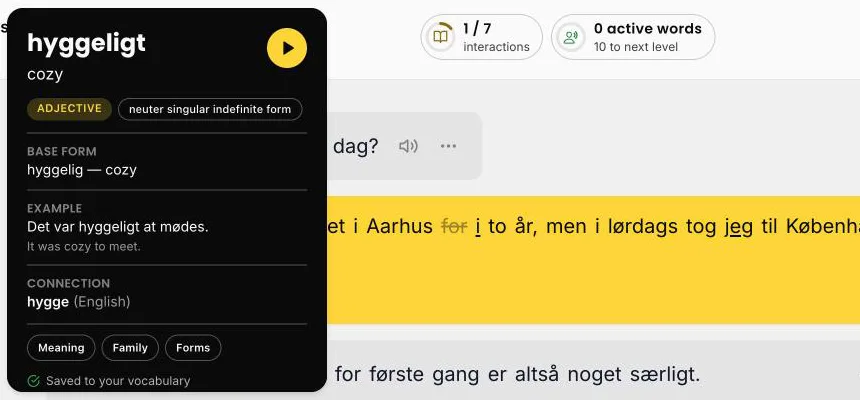
Teacher AI word card for hyggeligt: cozy, adjective, neuter form, with the base form hyggelig, an example and its link to hygge
Tap any wordTap hyggeligt and you get cozy, its form, the base form hyggelig, an example, and its link to hygge, a word English borrowed.
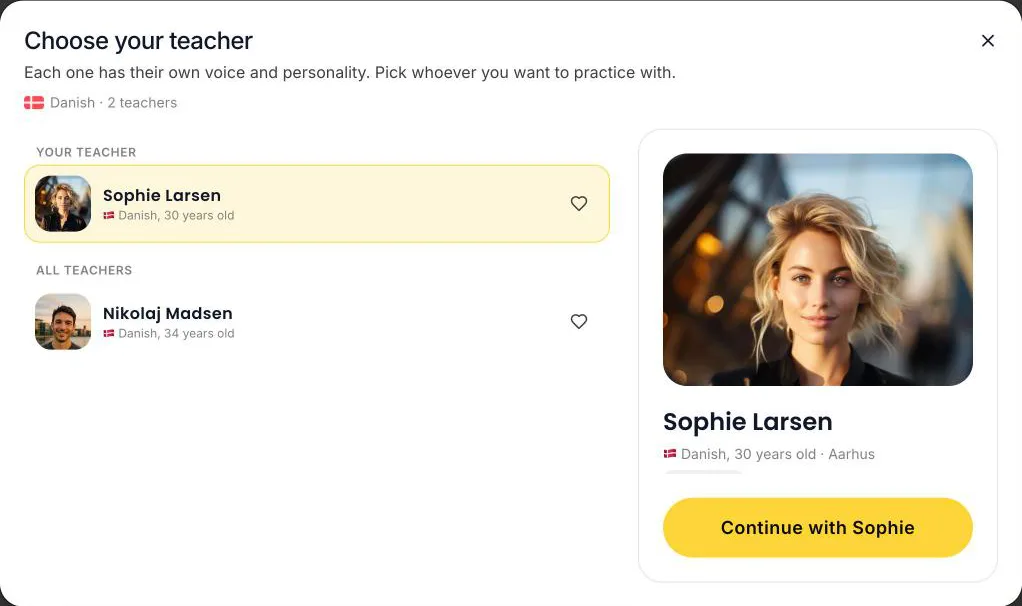
Teacher AI teacher picker for Danish: Sophie Larsen and Nikolaj Madsen, both from Aarhus
Two teachers from AarhusSophie and Nikolaj, each with their own voice. Your chat history stays when you switch.

Meet your Danish teachers

Two teachers, both from Aarhus, Denmark’s second city: Nikolaj and Sophie. Each has their own voice, so you get used to more than one way of saying things. Pick the one you like, and switch any time: your chat history stays.

  • Nikolaj Madsen
    Nikolaj Madsen
    Aarhus · Danish
  • Sophie Larsen
    Sophie Larsen
    Aarhus · Danish

Input: Danish to watch and read, at your level

Here’s the input side up close. New words come from lots of Danish you hear and read, where you already understand most of it. For Danish, that listening matters twice: it’s how your ear learns what Danes actually say.

Watch and Read are on the web app for now. Words you read along with, without tapping, count toward your passive words. Every word you tap lands in your flashcards. And when you’re done, you talk about it with your teacher.

  • Any YouTube videoPaste a link to a Danish YouTube video, or an Apple Podcasts episode. We turn it into a page you read along with, new words in yellow. So you see the words a Dane just swallowed. No subtitles? On a paid plan we transcribe it for you, within a monthly allowance.
  • Stories written for youRead writes Danish texts at your level, from A1 to Native, about anything you like, and suggests ideas from what you talk about with your teacher.
  • How much you know, before you startTeacher AI keeps a list of every Danish word you’ve met: the ones you use when you talk, the ones you read or hear, the ones you tap. It checks every word of a video or text against that list and shows you the share you already know.
  • The 80% rulePick videos and texts where you know 80% or more of the words. Then your brain fills in the rest from context. Under 70% is too much for now. 90% and up is easy and fun.
  • Then talk about itOne tap on Talk about this starts a conversation about what you just watched or read. Retelling it is how new words become words you can say.
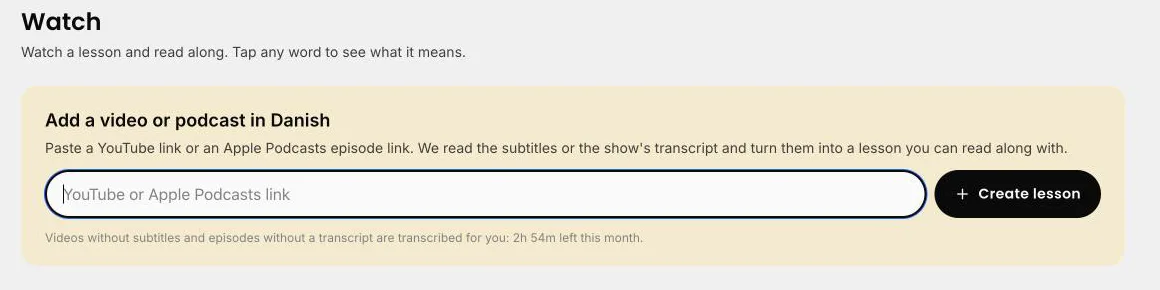
Teacher AI Watch in Danish: paste a YouTube or Apple Podcasts link to make a lesson
Paste any Danish videoPaste a link to a Danish YouTube video or podcast and it becomes a lesson. No subtitles? On a paid plan we transcribe it, within a monthly allowance.
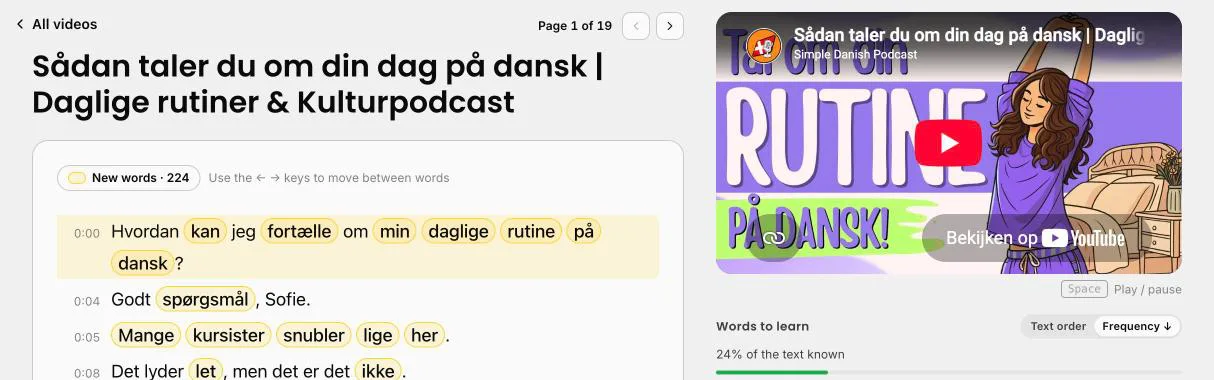
A Simple Danish Podcast episode about talking about your day as a Teacher AI lesson: the Danish transcript with new words marked
Any video becomes a lessonAn episode of Simple Danish Podcast, about how to talk about your day, as a lesson. The transcript follows the video, new words in yellow, and one tap starts a conversation about it with Sophie.
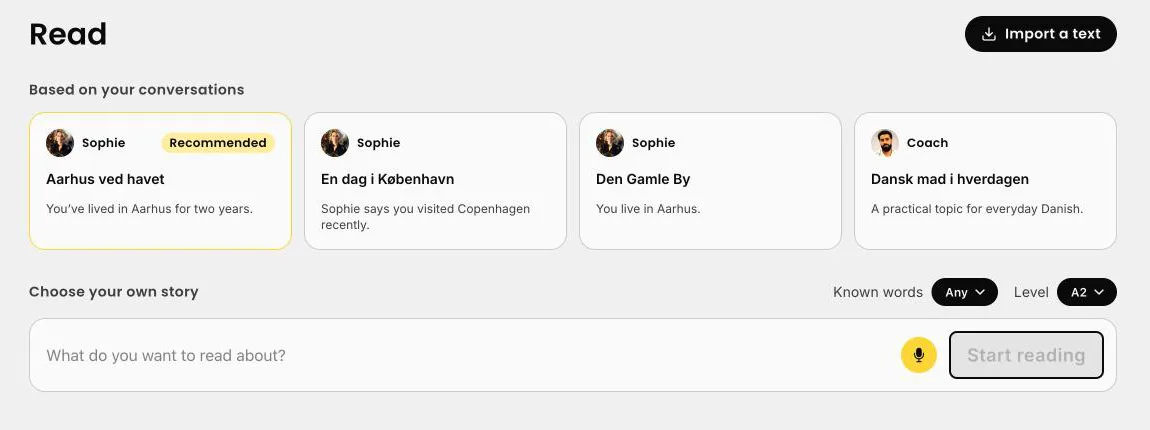
Teacher AI Read in Danish: reading ideas about Aarhus by the sea, a day in Copenhagen, Den Gamle By and everyday Danish food
Ideas from your conversationsYou told Sophie you live in Aarhus and went to Copenhagen. So Read suggests Aarhus by the sea, a day in Copenhagen, and Den Gamle By. And everyday Danish food.
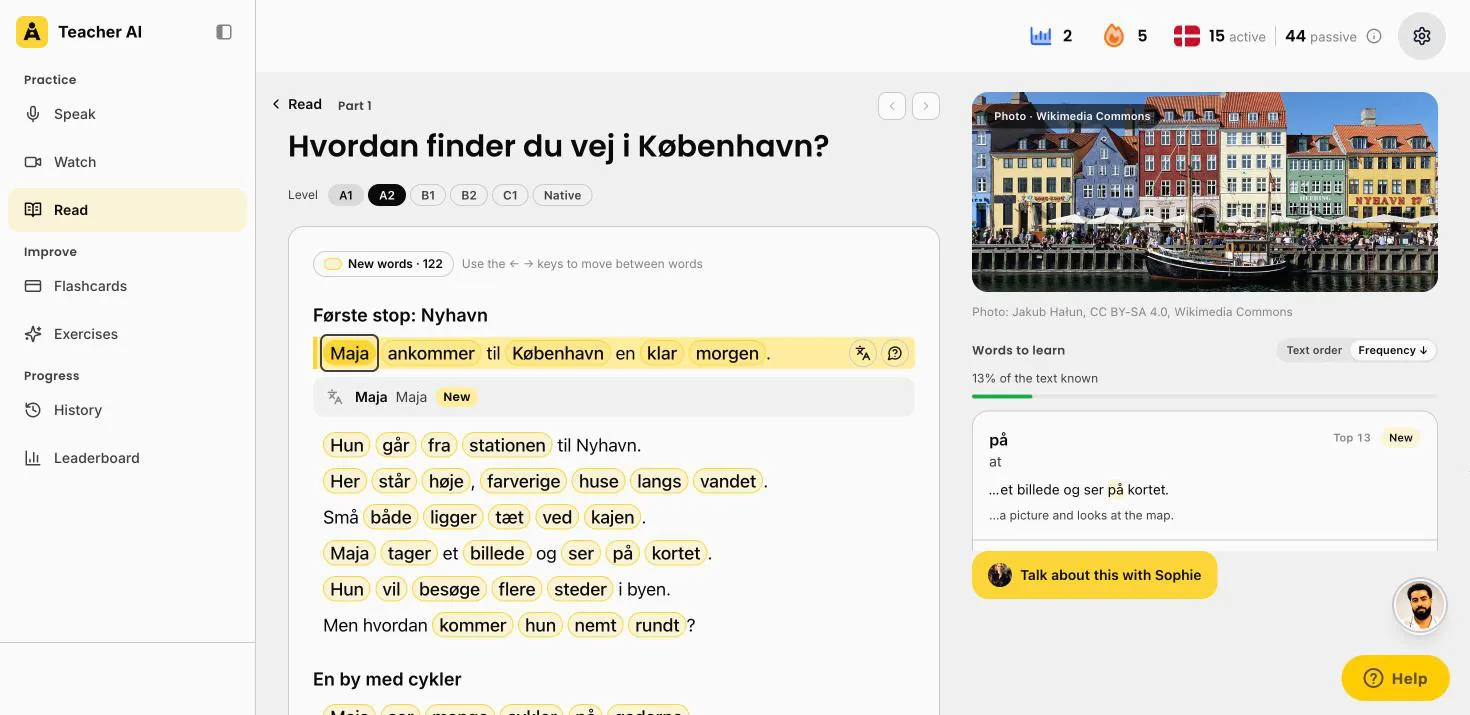
A Danish story on Teacher AI at A2: Hvordan finder du vej i København?, with levels A1 to Native, a photo of Nyhavn and new words marked
A story at your levelHvordan finder du vej i København?, how do you find your way around Copenhagen?, at A2, starting in Nyhavn. New words are in yellow, and Words to learn starts with the most common ones.

Teacher AI or Duolingo?

Lots of people start Danish on Duolingo: 910,000 learners, it says. Good! So here’s how the two compare for speaking, with every Duolingo fact from Duolingo’s own pages.

Duolingo
Teacher AI
What it’s built for
Short lessons and exercises, as a daily game.
Conversation, plus Danish to watch and read at your level, with every word you learn tracked.
Open conversation
Not for Danish. Video Call and Roleplay aren’t listed for Danish.
Unlimited on a paid plan, by voice or text, or hands-free in a call.
Corrections
Exercises are checked right or wrong. Explain My Answer isn’t listed for Danish.
During the conversation: your own sentence is fixed, and Why? explains each fix.
Teachers
Duolingo’s own characters.
Two, with their own voices: Nikolaj and Sophie, both from Aarhus.
Starting from zero
Yes. The course starts at the beginning, for free.
No. For Danish, Teacher AI works best from about A2.
Where it works
iPhone, Android and web. Video Call and Roleplay only in the app.
iPhone, Android and web, conversations included.
Price (US)
Every course is free, with ads. Super Duolingo: $9.99 to $119.99 on the US App Store.
Start free on the website. Unlimited conversation: $149 a year on the web.

Duolingo is a good free way to learn your first Danish words, and you can keep your streak. Teacher AI doesn’t have a step-by-step Danish course. Once you reach about A2 and want to talk, that’s what Teacher AI is built for. Lots of people use both.

The apps side by side

FeatureTeacher AILanguaTalkpalBabbelDuolingo
Teaches this languageYes, from about A2, with 2 teachers, both from Aarhus.Yes, one of its 23 languages.Yes. Its Danish page doesn’t name levels.Yes, a step-by-step course up to A2.Yes, a free course from English. Its top level isn’t stated.
Open conversationUnlimited on a paid plan, by voice or text, or hands-free in a call. Free plan: one conversation.Free-form chat and Call Mode. Unlimited plan: no limit. Communicate plan: 30 minutes of calls a day.Chat, calls, roleplays and debates. Unlimited on Premium.No for Danish. Babbel Speak, its AI conversation partner, doesn’t cover Danish.No for Danish. Video Call and Roleplay aren’t listed for Danish.
CorrectionsDuring the conversation: your message is marked up, and Why? explains each fix.Five correction modes, a tap to explain any correction, a report after the chat.Feedback after each reply, and a tool that explains any sentence.No AI conversation in Danish to correct.Exercises are checked right or wrong. Explain My Answer isn’t listed for Danish.
Pronunciation helpReplay your recording next to a native speaker saying the same line. No pronunciation score.Its pronunciation score covers Spanish, French and English, not Danish.Says it gives feedback on pronunciation, intonation and rhythm. Its Sentence Mode score is for selected languages, and doesn’t say if Danish is one.Native-speaker recordings, then you speak out loud, its Danish page says.Speaking exercises. No pronunciation score on its pages.
Reading aid for the scriptNot needed: the Latin alphabet, plus æ, ø and å. In text mode, a row with æ, ø and å sits above the text box.Not needed.Not needed.Not needed.Not needed.
Where it worksWeb, iOS and AndroidWeb, iOS and AndroidWeb, iOS and AndroidWeb, iPhone and Android.iOS, Android and web. Video Call and Roleplay: app only.
Price (US)Web: $149/year, $99/6 months, $25/month. App: $179, $119, $29.Unlimited $199.99/year. Communicate $149.99/year (US App Store).$119.99/year or $19.99/month. On the web, $149.99 for 24 months.$107.99/year for all its languages (US App Store).Super Duolingo: $9.99 to $119.99 on the US App Store, which doesn’t say which is monthly or yearly.
Free optionStart free on the website, no credit card.3 minutes of calls a day. Trial of 5 or 7 days, card needed.10 minutes a day, free. 14-day trial, no payment up front.A free first lesson.Every course is free, with ads.

Scroll the table sideways to see every app.

The apps, one by one

Teacher AI

Best for getting fluent: input, speaking and tracking
Speaking
Unlimited on a paid plan. Pick a conversation starter at your level, talk about anything in Free Talk, try a roleplay, or switch to hands-free and just talk.
Teachers
Two for Danish, both from Aarhus: Nikolaj and Sophie.
Corrections
Your own sentence is fixed while you talk, and Why? explains it: the verb in second place, en or et, the -t on an adjective, i to år instead of for to år.
Progress
Your active and passive words, your practice time split into input and output, and 100 levels with the matching CEFR level.
Watch and Read
Turn a Danish YouTube video or podcast into a lesson (no subtitles? we transcribe it on a paid plan), and read stories at your level. Both show the share of words you already know. On the web app.
Not so good
Not for complete beginners: for Danish, it works best from about A2, so learn the basics with Duolingo or Babbel first. And there’s no pronunciation score, so nothing grades your stød.

Langua

Open AI chat, on the web too
Speaking
Danish is one of its 23 languages. Chat and hands-free Call Mode. Unlimited plan: no limits. Communicate plan: 30 minutes of calls a day.
Corrections
Written or spoken, subtle or explicit, your choice. Nothing Danish-specific on its pages.
Not so good
Its pronunciation score covers Spanish, French and English, not Danish. Unlimited costs $199.99 a year.

Talkpal

Best price, with a free daily plan
Speaking
Chat, Call Mode, roleplays and debates with an AI tutor. Unlimited on Premium, 10 minutes a day for free.
Pronunciation
Its Danish page names the soft d and the stød as things that take practice, and says it gives feedback on pronunciation, intonation and rhythm. Its scored Sentence Mode is “available for selected languages”, without a list.
Price
$119.99 a year or $19.99 a month on the US App Store, with a 14-day trial.

Babbel

Best step-by-step course
Course
Danish up to A2. That’s a shorter course than its Swedish or Dutch (B1).
Pronunciation
Its Danish page says you listen to native Danish speakers, then practice speaking out loud.
Not so good
Babbel Speak, its AI conversation partner, covers French, German, Italian and Mexican Spanish, not Danish. So there’s no open conversation in Danish.

Duolingo

Best free start
Course
A free Danish course for English speakers, with 910,000 learners. Its pages don’t say up to which level.
Speaking
Speaking exercises. Video Call and Roleplay aren’t listed for Danish, and neither is Explain My Answer.
Not so good
No open conversation in Danish, and Danish isn’t one of the nine courses Duolingo says now go up to B2.

Where another app might suit you better

Want an AI tutor on your phone? Jumpspeak teaches Danish through its AI Tutor only, not its full course: its pricing page and help center both say so. $79 a year, iPhone and Android only.

Want a structured audio course? Pimsleur has one Danish course: Level 1, 30 lessons, 16 hours of audio, $150 on its website. Its pages don’t say which Danish it teaches, and its AI Conversation Coach doesn’t cover Danish.

Memrise lists “75+ AI conversations” on its Danish course page, at $61.99 a year on the US App Store. Its pages don’t say whether they correct you.

Want an app that does only Danish? Erla: Learn Danish with AI has an AI tutor you talk to out loud, which it says corrects you gently, plus listening, stories and a grammar course from A1 to B2. It’s small (1K+ downloads on Google Play) and doesn’t show its price, so try it before you pay.

And if you’re looking at Speak, Praktika or Busuu: none of them teaches Danish.

Try Teacher AI for free →No credit card needed

Questions people ask

What’s the best app to practice speaking Danish?

For getting fluent, Teacher AI: talk about anything for as long as you like, with teachers from Aarhus, and a Why? on every correction. Plus Danish videos and stories at your level, and every word you learn tracked. For open AI chat on the web, Langua. For the lowest price, Talkpal. For a step-by-step course, Babbel.

Is Danish hard to learn?

The grammar isn’t. In our ranking of 67 languages, Danish is the 54th hardest for English speakers, at 3,557 effort points: a bit more than Swedish and Dutch, and much less than German. Verbs don’t change for the person, and lots of words look like English. The hard part is the sound: the soft d, the stød, and endings Danes swallow, so what you hear is far from what you read. Plan on a lot of listening, and a lot of talking.

Why is spoken Danish so hard to understand?

Because Danes drop and soften so many sounds. Hvad is “va”, jeg is “yai”, and in fast speech whole syllables blend together. Reading doesn’t train your ear for that, listening does. On Teacher AI you can turn a Danish YouTube video into a page you read along with, so you see every word a speaker just swallowed, then talk about it with your teacher.

Do I need to learn the stød?

Not to be understood. Context usually tells people whether you mean hun, she, or hund, dog. But the stød is a big part of sounding Danish, and you pick it up by hearing a lot of Danish and saying it yourself. On Teacher AI you can replay your recording next to a native speaker saying the same line.

Does Speak teach Danish?

No. Speak teaches English speakers Spanish, French, Korean, Japanese, Italian and Chinese.

Can a complete beginner use Teacher AI for Danish?

Not really. For Danish, Teacher AI works best from about A2, once you can handle simple everyday sentences. Before that, you just don’t have enough words yet for open conversation. Starting from zero? Learn the basics with Duolingo or Babbel first, then come here to talk. (Spanish and French are different: they have a beginner track from zero.)

Is Teacher AI only for speaking?

No. It’s a complete fluency system. Speaking is how you activate your Danish. On the web app you also grow it: turn a Danish YouTube video or podcast into a lesson, and read stories at your level. And Teacher AI tracks the words you understand and the words you use, so you see your progress in real numbers.

Is Teacher AI better than Duolingo for speaking Danish?

For speaking, yes. Teacher AI is built around conversation, unlimited on a paid plan, on the web and on your phone. Duolingo’s Danish course is free, but its AI Video Call and Roleplay don’t cover Danish. For a free start with the basics, Duolingo is a good place to begin. Lots of people use both.

Sources, checked November 15, 2026

Head-to-head comparisons

Teacher AI vs Langua · Teacher AI vs Talkpal · Teacher AI vs Babbel · Teacher AI vs Duolingo. All comparisons.

Other languages

SpanishSpain and Latin AmericaFrenchFrance, Belgium and SwitzerlandMandarin ChineseSimplified or Traditional, with pinyinCantoneseHong Kong, with JyutpingThaiWith spaces between words, and Paiboon+ or IPAJapaneseWith furigana or romaji, and a kanji countDutchThe Netherlands and Flanders, with Flemish voicesBrazilian PortugueseWith Brazilian teachers and well-known polyglotsItalianWith Italian teachers from Podcast Italiano and Vaporetto ItalianoGermanWith German and Austrian teachers, from Lingster Academy to Herr AntrimEuropean PortugueseWith teachers from Lisbon, Porto, Coimbra and Faro, and Portuguese With LeoEnglishWith American and British teachers, from Espresso English to English Like A NativeKoreanWith teachers from Seoul and Busan, and every dropped 요 fixedRussianWith the stress marked above every wordTurkishWith Can from Turkishle, and every ending fixed as you talkArabicWith teachers from Cairo, Amman and Jeddah, and a straight answer on MSA or dialectPolishWith teachers from Warsaw, and every case ending fixedSwedishPitch accent, en or ett, and nobody switching to EnglishIndonesianWith teachers from Bali and Bandung, for the Indonesian people actually speakHindiWith teachers from Delhi, Jaipur and Mumbai, and every missing ने fixedRomanianWith teachers from Bucharest and Transylvania, and every ending explainedCatalanFor when Barcelona keeps answering you in SpanishVietnameseWith teachers from Hanoi and Sapa, and every tone, classifier and pronoun fixedUkrainianWith two teachers from Lviv, and every case fixed as you talkGreekWith teachers from Crete and Thessaloniki, and every gender and ending explainedHebrewFor Hebrew without the vowels, with two teachers from Tel AvivNorwegianBokmål in the app, dialect on TV, and two melodiesCzechWith Klara and Lukáš from Brno, and a Why? on every case endingFinnishFifteen cases, long vowels, and Finnish as it’s really spokenBulgarianWhere “the” goes on the end, and a nod means noCroatianFor the coast, the in-laws, and talking with bakaHungarianFor life in Budapest, your Hungarian family, and every -ban and -benMalayFor living in Malaysia, with teachers from Penang, lah and allSerbianTwo alphabets, seven cases, and teachers from SerbiaSwahiliWith teachers from Tanzania and Nairobi, and every ki- and vi- fixedTagalogFor partners, families and heritage learners, with po, opo and plenty of Taglish

The best way to find out is to talk

Pick a teacher and have a real conversation in Danish. Then decide.

No credit card needed

Available oniPhone and iPadAndroidWeb app