Afrikaans · For the South African in your life, and for Dutch speakers

The best AI apps to practice speaking Afrikaans

Updated November 15, 2026. We checked every other app on its own website, help pages and app store page. See the sources.

We built Teacher AI, so of course we’re biased. That’s why we link every claim we make about another app, and tell you plainly when another app suits you better.

Available oniPhone and iPadAndroidWeb app

An illustration of the conversation screen, rebuilt for this page with Afrikaans text.

The short answer

Afrikaans is the easiest language in our ranking for English speakers: 67th of 67. Learning it isn’t the problem. Finding Afrikaans practice is: very few AI speaking apps teach it. Speak, Langua, Praktika, Babbel, Busuu and Pimsleur don’t, and Duolingo has no Afrikaans course at all.

Here’s our honest take. Pick Teacher AI if you want to get fluent, not just practice. You get lots of real conversation with two South African teachers, Anika from Stellenbosch and Johan from Cape Town, who keep the conversation in Afrikaans, and a Why? on every correction, from a forgotten second nie to a verb in the wrong place. Plus Afrikaans videos and stories at your level, and we track every word you learn. Pick Talkpal for a cheaper AI chat, and Ling or Mondly for a step-by-step course.

Starting from zero? Teacher AI works best for Afrikaans from about A2. Learn the basics with Ling or Mondly first. Speak Dutch? You’ll get there fast.

  1. Best for getting fluent: input, speaking and trackingTeacher AITalk about anything, for as long as you like, with teachers from Stellenbosch and Cape Town, and every mistake explained. Grow your Afrikaans with videos and stories at your level, and watch your active and passive words climb. Web, iPhone and Android, $149 a year.
  2. Cheaper, with open AI chatTalkpalAfrikaans is one of its 130+ languages, with chat, calls and roleplays. $119.99 a year, or 10 minutes a day for free. Its pages say nothing about the double nie or Dutch.
  3. A step-by-step Afrikaans courseLingA Standard Afrikaans course with dialogues, on iPhone and Android. Speaking lessons on Android and the web. $89.99 a year.
  4. A beginner course with a voice chatbotMondlyIts own Afrikaans app, with speech recognition and a chatbot where you repeat set sentences. $47.99 a year.

A fluency system, built by polyglots

Teacher AI isn’t a chatbot with a language menu. It’s a fluency system, built by some of the most accomplished polyglots and language teachers around. People who learned many languages themselves, and know what actually gets you speaking.

  • Arieh Smith
    Arieh Smith
    Xiaoma · the world’s most viral polyglot
  • Lucas Bighetti
    Lucas Bighetti
    One of the world’s best polyglots · speaks 20+ languages
  • Olly Richards
    Olly Richards
    Author · 2M+ books sold · StoryLearning founder
  • Jan van der Aa
    Jan van der Aa
    Runs the leading network for online language entrepreneurs

“I’ve tried lots of this type of app. This is the best one. It feels like it’s created by someone who understands language learning.”

Jcalebmi, App Store review, October 2026

What you need to practice speaking Afrikaans

Good news first. In our ranking of 67 languages, Afrikaans is the easiest of all for English speakers: 67th of 67, at 2,498 effort points. That’s lighter than Spanish (2,941), Dutch (3,422) or German (4,255).

Lots of words are close to English: hand, water, huis, house. Verbs barely change. So the hard part isn’t the grammar. It’s finding someone to talk to who won’t switch to English, and a few habits English doesn’t have.

  • Nie ... nieAfrikaans says no twice. Ek praat nie Afrikaans nie: I don’t speak Afrikaans. Ek het niks gesien nie: I didn’t see anything. The second nie comes at the end of the sentence, and English speakers forget it all the time. You know the rule in a minute. Saying it without thinking takes a lot of practice.
  • Grammar that looks too easyNo verb endings: ek is, jy is, hulle is. No genders: die for every noun. Mostly one past tense: Ek het gister gewerk, I worked yesterday. But the word order is Dutch. The ge- word goes to the end, and after omdat, because, so does the verb: omdat ek moeg is. That’s where English speakers slip.
  • The g from your throatThe g in goeie môre, good morning, is the rasp in Scottish “loch”, not the g in “good”. The r is rolled. And the little word ’n, a, is just a short “uh”: ’n koppie koffie. The quickest fix: say your sentence, then hear a South African say the same one.
  • Afrikaans, English, and both at onceLots of South Africans mix English into their Afrikaans, and in Cape Town you’ll hear Kaaps, Cape Afrikaans, which mixes freely. The words come from everywhere: baie, very, and piesang, banana, from Malay, and eina, ouch, from Khoekhoe. And the moment you hesitate, people switch to English to be kind. So you need a place where you can be slow and keep going in Afrikaans.
  • Lots of Afrikaans you understandSpeaking activates the words you have. New words come from input: Afrikaans videos, podcasts and texts where you already understand most of it.
  • Lots of speaking timeEven the easiest language in our ranking takes hours of talking. A few minutes a day at the braai won’t get you there.

A complete fluency system, not just a speaking app

Our speaking practice is the heart of Teacher AI. But speaking alone won’t make you fluent, and neither will input alone. You need both, and you need to see it working.

So Teacher AI is a complete fluency system. Input grows your Afrikaans. Speaking activates it. And we track every word along the way, to get you to real fluency as fast as we can.

  1. Step 1Input grows your vocabularyWatch Afrikaans YouTube videos and podcasts, and read stories written at your level. You always see how much you already understand, and every word you tap becomes a flashcard. How Watch and Read work.
  2. Step 2Speaking activates itKnowing a word isn’t the same as using it, with the second nie at the end and the verb in the right place. Talking with your teacher, for as long as you like, is how words move from “I know that one” to “I just said it”. Your teacher keeps the conversation in Afrikaans. Every mistake gets fixed, with a Why?.
  3. Step 3We track every wordYour passive words are the ones you understand when you read or hear them. Your active words are the ones you’ve used yourself. You see both grow, how your time splits between input and output, and how many words to your next level.

Brand new to Afrikaans? Start somewhere else first. Teacher AI works best from about A2, once you can handle simple everyday sentences. Before that, you just don’t have enough words yet for open conversation. So learn the basics with a course like Ling or Mondly (Duolingo doesn’t teach Afrikaans), and come back when you want to talk. If you speak Dutch, you may be at A2 sooner than you think.

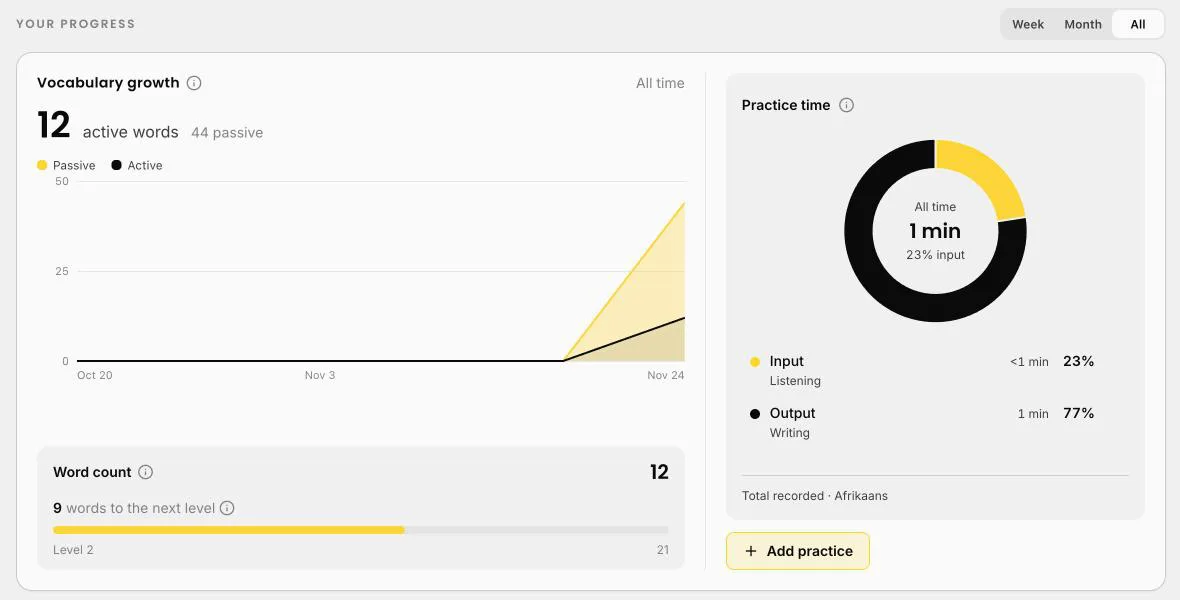
Teacher AI progress in Afrikaans after a chat, a story and a video: 12 active and 44 passive words, level 2, and practice time split into input and output
Your progress, in words12 Afrikaans words used, 44 understood, after one chat, a story and a video. You see your active and passive words grow, the words to your next level, and your practice time split into input and output.

What it looks like in Afrikaans

Here’s what a moment of practice looks like. You answer, your teacher replies, and if you made a mistake, your sentence gets fixed right there.

A card for every word you tap

Tap any word, in a conversation, a video or a story, and you get its card: what it means, what kind of word it is, and an example with a translation. Its family and its forms are one tap away. Tap play to hear it.

lekker
nice, great, tasty
ADJECTIVE
ExampleDit was ’n lekker braai! That was a great braai!
Good to knowFood, weather, a holiday, a person: anything good can be lekker. South Africans say it in English too.
die bakkie
pickup truck
NOUN
ExampleHy ry ’n wit bakkie. He drives a white pickup.
Good to knowSouth Africans say bakkie in English too. A false friend if you speak Dutch, where een bakkie is a cup of coffee.
baie
very, a lot, many
ADVERB
ExampleBaie dankie! Thank you very much!
Good to knowOne of the words Afrikaans took from Malay (banyak, many), from the Malay spoken at the Cape. Dutch says veel or heel.

An illustration of three word cards, rebuilt for this page. On the real card, the wording depends on the word. Below: real screenshots of the web app.

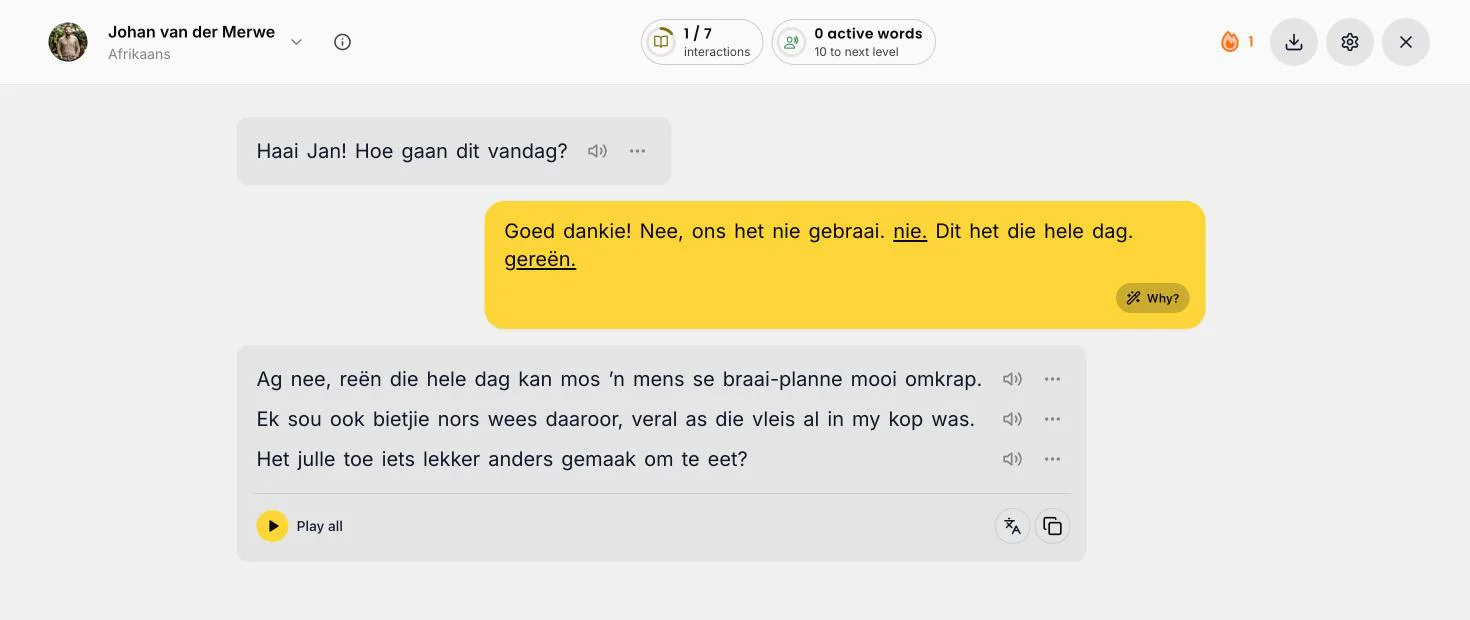
An Afrikaans conversation on Teacher AI with Johan: a second nie added, and gereën moved to the end of the sentence
Corrected while you talkYou tell Johan you didn’t braai because it rained all day. He adds the second nie and moves gereën to the end. Then he asks what you made instead.
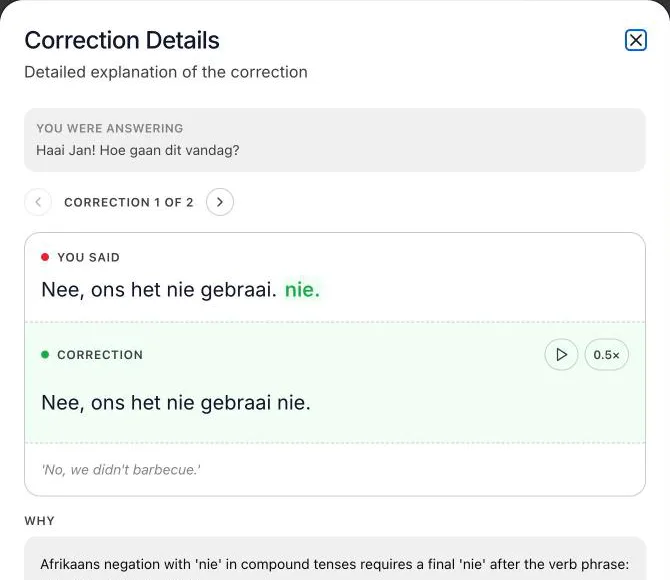
Teacher AI correction details for an Afrikaans sentence: Nee, ons het nie gebraai nie, with the translation No, we didn't barbecue, correction 1 of 2
Tap Why?A negative sentence needs a second nie at the end: ons het nie gebraai nie. You see what you said, the fixed sentence, a translation and why, one correction at a time, and you can save it as a flashcard.
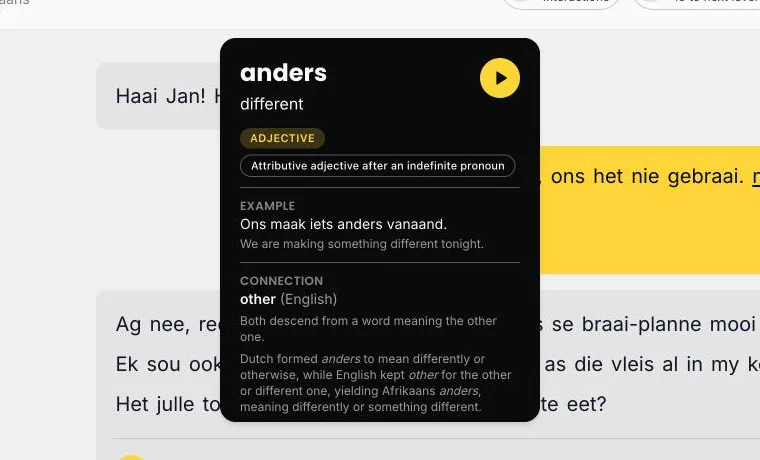
Teacher AI word card for anders: different, an adjective, with an example with a translation and a link to the English word other
Tap any wordTap anders and you get different, what kind of word it is, an example with a translation, and a link to English other.
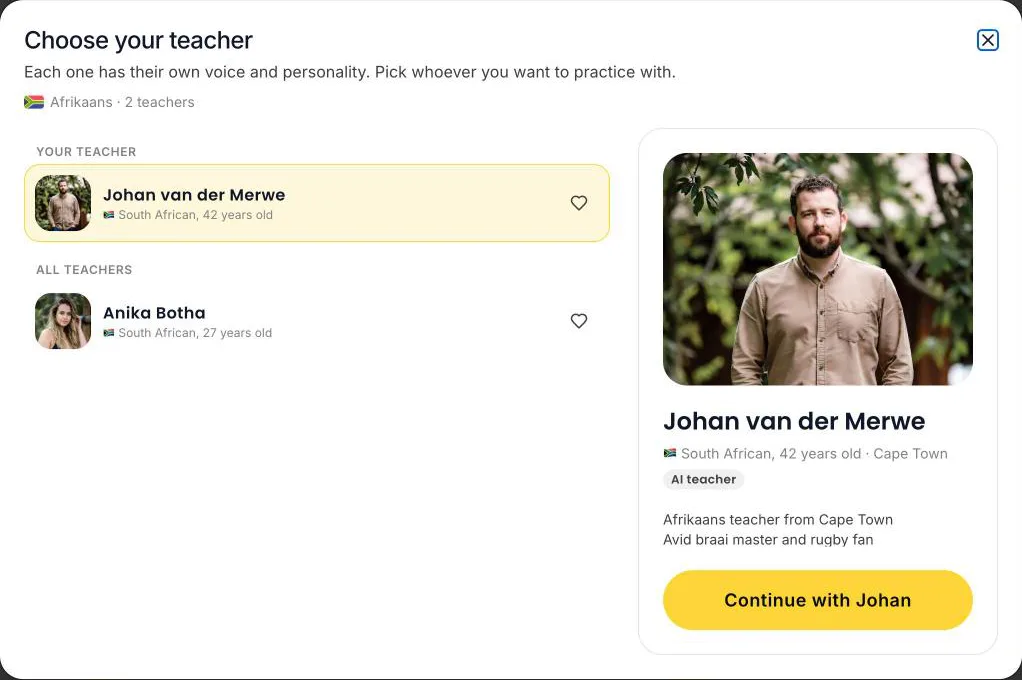
Teacher AI teacher picker for Afrikaans: Johan van der Merwe from Cape Town and Anika Botha
Two Afrikaans teachersJohan from Cape Town and Anika from Stellenbosch, each with their own voice. Your chat history stays when you switch.

Meet your Afrikaans teachers

Two teachers, both South African: Anika from Stellenbosch and Johan from Cape Town. Each has their own voice. Pick the one you like.

Teachers from South Africa

  • Anika Botha
    Anika Botha
    Stellenbosch · South African
  • Johan van der Merwe
    Johan van der Merwe
    Cape Town · South African

Input: Afrikaans to watch and read, at your level

Here’s the input side up close. New words come from lots of Afrikaans you hear and read, where you already understand most of it.

Watch and Read are on the web app for now. Words you read along with, without tapping, count toward your passive words. Every word you tap lands in your flashcards. And when you’re done, you talk about it with your teacher.

  • Any YouTube videoPaste a link to an Afrikaans YouTube video, or an Apple Podcasts episode. We turn it into a page you read along with, new words in yellow. No subtitles? On a paid plan we transcribe it for you, within a monthly allowance.
  • Stories written for youRead writes Afrikaans texts at your level, from A1 to Native, about anything you like, and suggests ideas from what you talk about with your teacher.
  • How much you know, before you startTeacher AI keeps a list of every Afrikaans word you’ve met: the ones you use when you talk, the ones you read or hear, the ones you tap. It checks every word of a video or text against that list and shows you the share you already know.
  • The 80% rulePick videos and texts where you know 80% or more of the words. Then your brain fills in the rest from context. Under 70% is too much for now. 90% and up is easy and fun.
  • Then talk about itOne tap on Talk about this starts a conversation about what you just watched or read. Retelling it is how new words become words you can say.
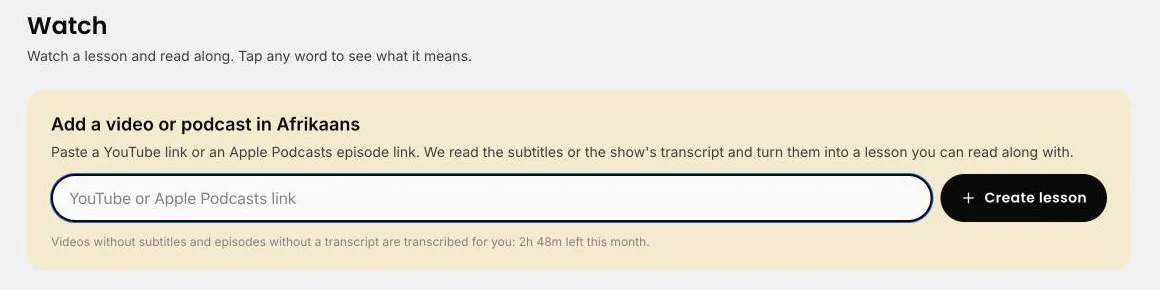
Teacher AI Watch in Afrikaans: paste a YouTube or Apple Podcasts link to make a lesson
Paste any Afrikaans videoPaste a link to an Afrikaans YouTube video or podcast and it becomes a lesson. No subtitles? On a paid plan we transcribe it, within a monthly allowance.
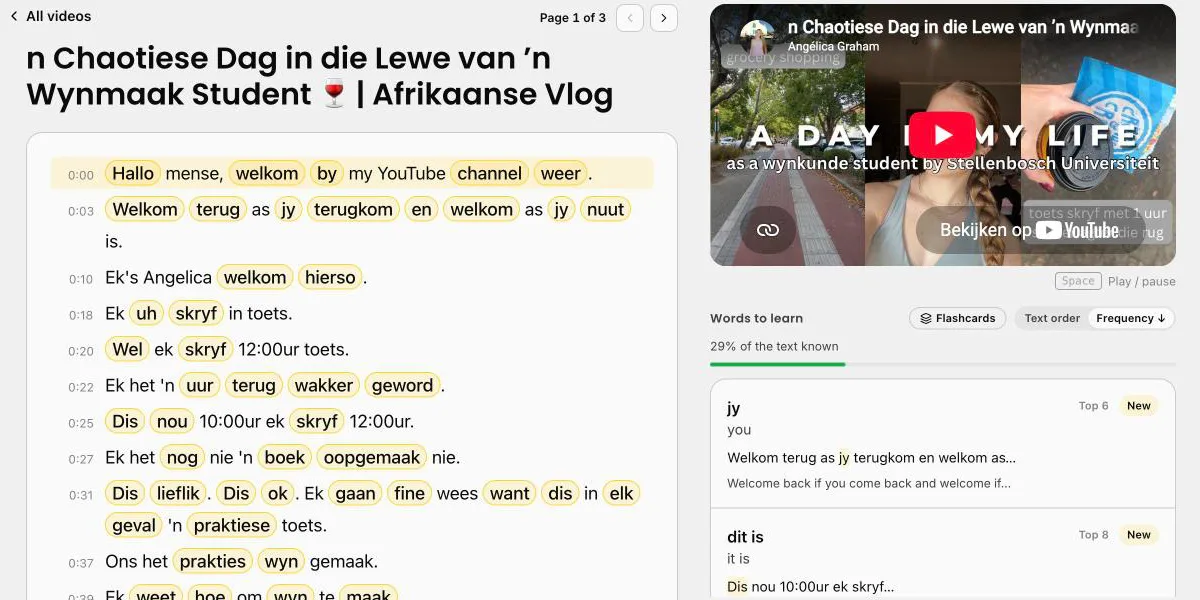
An Afrikaans vlog by a wine-making student in Stellenbosch as a Teacher AI lesson: the transcript with new words marked, 29% of the text known, and a list of words to learn
Any video becomes a lessonA day in the life of a wine-making student in Stellenbosch, from Angélica Graham’s vlog. New words are in yellow, and you see you already know 29% of the text. On the right, the words to learn, the most common first.
Teacher AI Read in Afrikaans: reading ideas about a day in Cape Town, the story of the railway, how a windpump works and a visit to the market
Ideas to read aboutRead suggests things to read about: a day in Cape Town, the story of the railway, how a windpump works, a visit to the market. Or type your own topic.
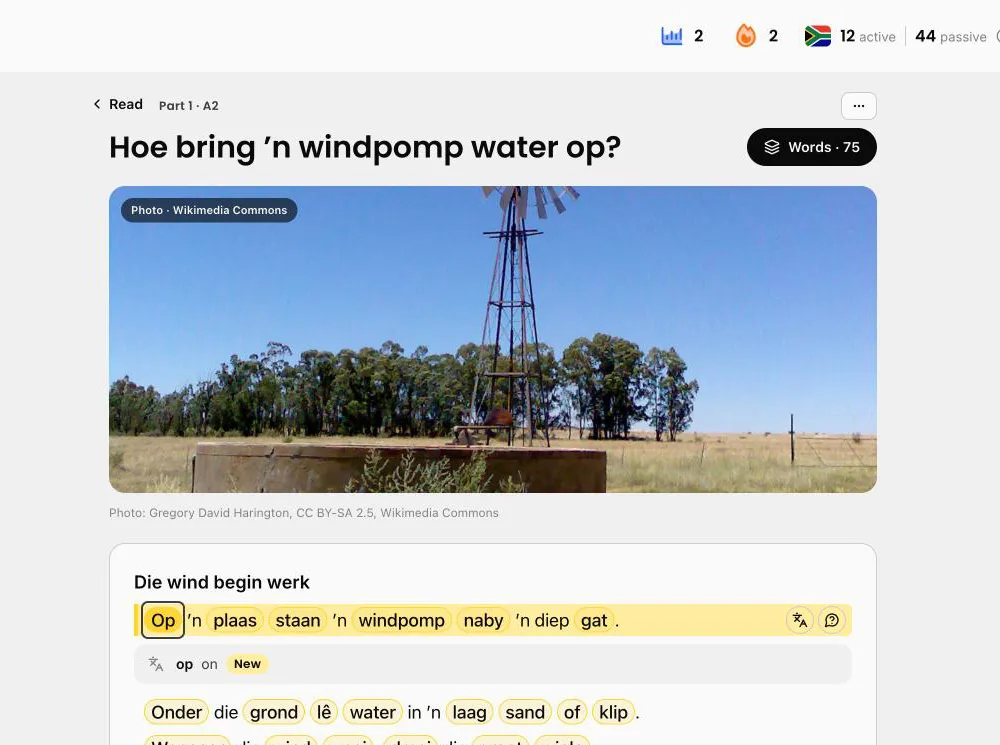
An Afrikaans story on Teacher AI at A2: Hoe bring 'n windpomp water op?, with a photo of a windpump on a farm, new words marked and a word translated
A story at your levelHoe bring ’n windpomp water op?, how does a windpump bring up water?, at A2, with a photo from a farm. New words are in yellow, and one tap shows what a word means.

Teacher AI or Duolingo?

Lots of people look for Afrikaans on Duolingo first. It isn’t there: Duolingo has no Afrikaans course, from English or from any other language. It does teach Zulu from English. Here’s how the two compare, from Duolingo’s own pages.

Duolingo
Teacher AI
Afrikaans course
No. Its full list of courses has no Afrikaans.
Yes. Your teacher can explain in English, or switch to your own language.
Open conversation
Not in Afrikaans.
Unlimited on a paid plan, by voice or text, or hands-free in a call.
Teachers
Duolingo’s own characters, in other languages.
Two South Africans, each with their own voice: Anika from Stellenbosch and Johan from Cape Town.
Starting from zero
Not for Afrikaans.
No. For Afrikaans, Teacher AI works best from about A2. Start with Ling or Mondly.
Where it works
iPhone, Android and web. Video Call and Roleplay only in the app.
iPhone, Android and web, conversations included.
Price (US)
Every course is free, with ads. Super Duolingo: $9.99 to $119.99 on the US App Store.
Start free on the website. Unlimited conversation: $149 a year on the web.

Duolingo is great for a daily habit in the languages it teaches, but Afrikaans isn’t one of them. Learn your first words with Ling or Mondly, and once you reach about A2 and want to talk, that’s what Teacher AI is built for.

The apps side by side

FeatureTeacher AITalkpalLingMondlyDuolingo
Teaches this languageYes, from about A2, with 2 teachers, from Stellenbosch and Cape Town.Yes, one of its 130+ languages. Its Afrikaans page doesn’t name levels.Yes, a Standard Afrikaans course.Yes, its own Learn Afrikaans app (4.6 from 413 ratings on the US App Store).No course for English speakers, or for anyone else.
Open conversationUnlimited on a paid plan, by voice or text, or hands-free in a call. Free plan: one conversation.Chat, audio-only Call Mode and roleplays. Unlimited on Premium.Dialogues and role-play scenarios in the app. Its AI Tutor is Thai only.A voice chatbot, but you repeat the sentences the app gives you. Not open conversation.No Afrikaans, so no Video Call or Roleplay in Afrikaans.
CorrectionsDuring the conversation: your message is marked up, and Why? explains each fix.Feedback after each reply, and a tool that explains any sentence.Not stated for Afrikaans.Not stated.Not applicable.
Pronunciation helpReplay your recording next to a native speaker saying the same line. No pronunciation score.Says it gives feedback on pronunciation, intonation and rhythm. Its Sentence Mode score is for selected languages, and doesn’t say if Afrikaans is one.Speaking lessons with speech recognition, on Android and the web, not iOS, per its help center. No score on its pages.Speech recognition gives feedback on your pronunciation.Not applicable.
Reading aid for the scriptNot needed: Latin letters, plus ê, ë, ô and a few more. On a phone, hold the letter to get them, or just speak.Not needed.Not needed.Not needed.Not needed.
Where it worksWeb, iOS and AndroidWeb, iOS and AndroidiOS and Android. Its help center lists Ling Web too.iPhone and Android.iOS, Android and web, but no Afrikaans.
Price (US)Web: $149/year, $99/6 months, $25/month. App: $179, $119, $29.$119.99/year or $19.99/month. On the web, $149.99 for 24 months.$89.99/year, $64.99/6 months, $16.99/month (website).$47.99/year or $9.99/month (US App Store).Free with ads, in the languages it teaches.
Free optionStart free on the website, no credit card.10 minutes a day, free. 14-day trial, no payment up front.The first 2 units. 7-day trial on the yearly plan only.Free daily lessons, its App Store page says.Not applicable.

Scroll the table sideways to see every app.

The apps, one by one

Teacher AI

Best for getting fluent: input, speaking and tracking
Speaking
Unlimited on a paid plan. Pick a conversation starter at your level, talk about anything in Free Talk, try a roleplay, or switch to hands-free and just talk. Your teacher stays in Afrikaans.
Teachers
Two for Afrikaans, both South African: Anika from Stellenbosch and Johan from Cape Town.
Corrections
Your own sentence is fixed while you talk, and Why? explains it: a missing second nie, the ge- word in the wrong place.
Progress
Your active and passive words, your practice time split into input and output, and 100 levels with the matching CEFR level.
Watch and Read
Turn an Afrikaans YouTube video or podcast into a lesson (no subtitles? we transcribe it on a paid plan), and read stories at your level. Both show the share of words you already know. On the web app.
Not so good
Not for complete beginners: for Afrikaans, it works best from about A2, so learn the basics with Ling or Mondly first. Only two teachers. And there’s no pronunciation score.

Talkpal

Cheaper, with open AI chat
Afrikaans
One of its 130+ languages, with its own Learn Afrikaans page. Chat, audio-only Call Mode and roleplays with an AI tutor.
Strengths
Feedback on grammar and pronunciation, on the web and on your phone. 10 minutes a day for free.
Not stated
Anything Afrikaans-specific, like the double negative or the difference from Dutch. And whether its pronunciation score (Sentence Mode, “available for selected languages”) covers Afrikaans.
Price
$119.99 a year or $19.99 a month on the US App Store, with a 14-day trial.

Ling

A step-by-step Afrikaans course
Afrikaans
A course in Standard Afrikaans, with lessons written by native speakers, dialogues and flashcards, on iPhone and Android.
Speaking
Speaking lessons with speech recognition on Android and the web, but not on iPhone, per its help center. That’s practice, not open conversation: its AI Tutor is Thai only.
Price
$89.99 a year or $16.99 a month on its website. The first 2 units are free.

Mondly

A beginner course with a voice chatbot
Afrikaans
Its own Learn Afrikaans app, rated 4.6 from 413 ratings on the US App Store, with free daily lessons.
Speaking
Speech recognition, and a chatbot that answers with a human voice. But its help page says you repeat the sentences the app gives you. Practice, not open conversation.
Price
$47.99 a year or $9.99 a month on the US App Store.

Duolingo

No Afrikaans course
Course
Duolingo doesn’t teach Afrikaans, from English or any other language. Its full list of courses has none. (It does teach Zulu from English.)
Speaking
So no Video Call or Roleplay in Afrikaans.
Instead
For a first course, look at Ling or Mondly.

Where another app might suit you better

Living in or near Stellenbosch, or anywhere with an internet connection? The Stellenbosch University Language Centre runs Afrikaans 123, a course for members of the public: eight weeks, 20 hours of live online classes on MS Teams plus 10 hours of activities, R5 040. Real people, real conversation, and we like that a lot.

A Dutch or Flemish student at Stellenbosch? The same Language Centre has a semester course in Afrikaans language and culture just for Dutch speakers from the Netherlands and Belgium: four hours a week for 14 weeks, on campus, R6 423.

Learning Dutch instead, or as well? Our Dutch guide covers the apps for Dutch, and lots more of them teach it: Langua, Praktika, Babbel, Busuu and Duolingo among them. None of those teaches Afrikaans.

Speekeezy, a small AI chat app with 16 ratings on the US App Store, lists Afrikaans among its languages, but says talking with your microphone works in “not all languages”, without naming them. Memrise has no official Afrikaans course, only word lists made by other users.

And if you’re looking at Speak, Langua, Praktika, Babbel, Busuu, Pimsleur or Jumpspeak: none of them teaches Afrikaans.

Try Teacher AI for free →No credit card needed

Questions people ask

What’s the best app to practice speaking Afrikaans?

For getting fluent, Teacher AI: talk about anything for as long as you like, with teachers from Stellenbosch and Cape Town, and a Why? on every correction. Plus Afrikaans videos and stories at your level, and every word you learn tracked. Very few AI speaking apps teach Afrikaans at all. Talkpal does, and it’s cheaper.

Is Afrikaans hard to learn?

No. In our ranking of 67 languages, Afrikaans is the easiest of all for English speakers: 67th of 67, at 2,498 effort points. Verbs don’t change for “I”, “you” or “they”, there are no genders, and lots of words are close to English. What takes practice is the double nie, Dutch word order, the throaty g, and getting people to stay in Afrikaans with you.

I speak Dutch. How different is Afrikaans?

You’ll read most of it straight away. Speaking is another matter. Dutch ik ben, jij bent is Afrikaans ek is, jy is. De and het are both die. You say no twice: Ek het dit nie gesien nie. Spelling changes: tijd is tyd, zien is sien. And some words differ or fool you: baie for veel, and a bakkie is a pickup truck. Our Dutch guide is here if you want to keep your Dutch going too.

Can I learn Afrikaans on Duolingo?

No. Duolingo doesn’t teach Afrikaans, from English or from any other language. It does teach Zulu, if you want a second South African language. For a first Afrikaans course, look at Ling or Mondly. On Teacher AI you can practice spoken Afrikaans from about A2.

Do Speak, Langua or Praktika teach Afrikaans?

No. Speak’s courses for English speakers, Langua’s 23 languages and Praktika’s 14 don’t include Afrikaans. Babbel, Busuu, Pimsleur and Jumpspeak don’t teach it either.

Why does Afrikaans say “nie” twice?

It’s just how negatives work. The first nie comes after the verb, the second closes the sentence: Ek is nie moeg nie, I’m not tired. With a short sentence, one does both jobs: Ek weet nie, I don’t know. Leave out the second one in a longer sentence and South Africans will understand you, but it sounds foreign.

Can a complete beginner use Teacher AI for Afrikaans?

Not really. For Afrikaans, Teacher AI works best from about A2, once you can handle simple everyday sentences. Before that, you just don’t have enough words yet for open conversation. Starting from zero? Learn the basics with Ling or Mondly first (Duolingo doesn’t teach Afrikaans), then come here to talk. If you speak Dutch, you can likely start much sooner. (Spanish and French are different: they have a beginner track from zero.)

Is Teacher AI only for speaking?

No. It’s a complete fluency system. Speaking is how you activate your Afrikaans. On the web app you also grow it: turn an Afrikaans YouTube video or podcast into a lesson, and read stories at your level. And Teacher AI tracks the words you understand and the words you use, so you see your progress in real numbers.

Is Teacher AI better than Duolingo for speaking Afrikaans?

For Afrikaans, Duolingo isn’t an option: it has no Afrikaans course. Teacher AI is built around conversation, unlimited on a paid plan, on the web and on your phone, with two South African teachers. If you love your Duolingo streak, keep it for another language, and practice your Afrikaans here.

Sources, checked November 15, 2026

Head-to-head comparisons

Teacher AI vs Talkpal · Teacher AI vs Duolingo. All comparisons.

Other languages

SpanishSpain and Latin AmericaFrenchFrance, Belgium and SwitzerlandMandarin ChineseSimplified or Traditional, with pinyinCantoneseHong Kong, with JyutpingThaiWith spaces between words, and Paiboon+ or IPAJapaneseWith furigana or romaji, and a kanji countDutchThe Netherlands and Flanders, with Flemish voicesBrazilian PortugueseWith Brazilian teachers and well-known polyglotsItalianWith Italian teachers from Podcast Italiano and Vaporetto ItalianoGermanWith German and Austrian teachers, from Lingster Academy to Herr AntrimEuropean PortugueseWith teachers from Lisbon, Porto, Coimbra and Faro, and Portuguese With LeoEnglishWith American and British teachers, from Espresso English to English Like A NativeKoreanWith teachers from Seoul and Busan, and every dropped 요 fixedRussianWith the stress marked above every wordTurkishWith Can from Turkishle, and every ending fixed as you talkArabicWith teachers from Cairo, Amman and Jeddah, and a straight answer on MSA or dialectPolishWith teachers from Warsaw, and every case ending fixedSwedishPitch accent, en or ett, and nobody switching to EnglishIndonesianWith teachers from Bali and Bandung, for the Indonesian people actually speakHindiWith teachers from Delhi, Jaipur and Mumbai, and every missing ने fixedRomanianWith teachers from Bucharest and Transylvania, and every ending explainedCatalanFor when Barcelona keeps answering you in SpanishVietnameseWith teachers from Hanoi and Sapa, and every tone, classifier and pronoun fixedUkrainianWith two teachers from Lviv, and every case fixed as you talkGreekWith teachers from Crete and Thessaloniki, and every gender and ending explainedHebrewFor Hebrew without the vowels, with two teachers from Tel AvivNorwegianBokmål in the app, dialect on TV, and two melodiesDanishThe soft d, the stød, and Danes who switch to EnglishCzechWith Klara and Lukáš from Brno, and a Why? on every case endingFinnishFifteen cases, long vowels, and Finnish as it’s really spokenArmenianEastern Armenian with teachers from Yerevan and Gyumri, for the diaspora tooAzerbaijaniFor Baku, for family, and for Turkish speakersBelarusianFor families, heritage learners and the diasporaBulgarianWhere “the” goes on the end, and a nod means noCebuanoFor Bisaya families, and for life in Cebu, Davao and DumagueteCroatianFor the coast, the in-laws, and talking with bakaEstonianFor e-residents, Tallinn’s tech scene, and Finnish speakersGalicianFor Galicia, the Camino, and the family back homeGeorgianFor life in Tbilisi, the supra, and your Georgian in-lawsHungarianFor life in Budapest, your Hungarian family, and every -ban and -benIcelandicFor when Reykjavík keeps answering you in EnglishIrishFor bringing your school Irish back to life, with Aoife from Dublin and Seán from GalwayJavaneseFor the in-laws, and for life in Yogyakarta, Solo or SurabayaKazakhFor when Almaty keeps answering you in RussianKyrgyzFor when Bishkek answers you in RussianLatvianWith teachers from Riga, and every long vowel and case ending fixedLingalaWith a teacher from Kinshasa, for family, rumba and the French in betweenLithuanianWith teachers from Vilnius, and every case ending fixedLuxembourgishFor when everyone in Luxembourg switches to French, and for the SproochentestMacedonianThree ways to say “the”, and the stress always in the same placeMalayFor living in Malaysia, with teachers from Penang, lah and allSerbianTwo alphabets, seven cases, and teachers from SerbiaSlovakFor your Slovak family, life in Bratislava, and Czech speakersSlovenianFor your partner’s family, life in Ljubljana, and the dualSwahiliWith teachers from Tanzania and Nairobi, and every ki- and vi- fixedTagalogFor partners, families and heritage learners, with po, opo and plenty of TaglishWelshFor Duolingo and SaySomethingIn learners who want to talk

The best way to find out is to talk

Pick a teacher and have a real conversation in Afrikaans. Then decide.

No credit card needed

Available oniPhone and iPadAndroidWeb app