Kazakh · For when Almaty keeps answering you in Russian
The best AI apps to practice speaking Kazakh
Updated November 15, 2026. We checked every other app on its own website, help pages and app store page. See the sources.
We built Teacher AI, so of course we’re biased. That’s why we link every claim we make about another app, and tell you plainly when another app suits you better.
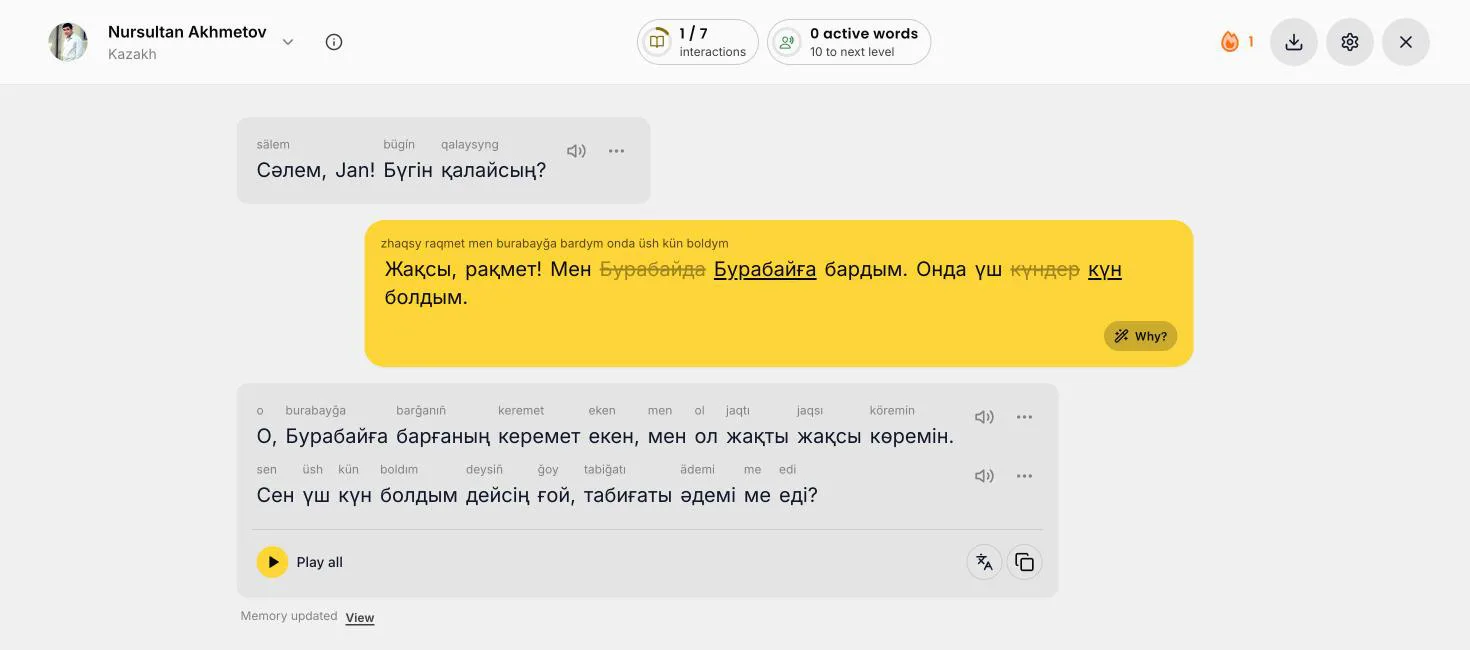
Демалыста қайда бардың?Where did you go on holiday?
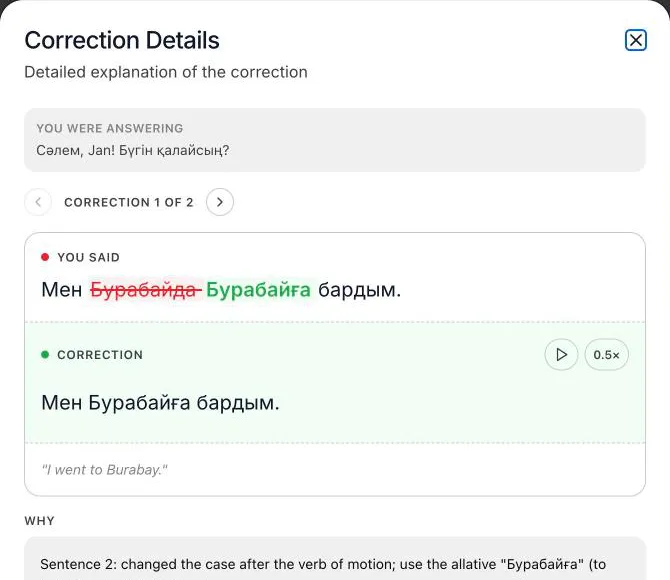
Мен Бурабайда Бурабайға бардым. Онда үш күндер күн болдым.I went to Burabay. I spent three days there.
2 small fixesWhy?
Why?Going somewhere takes “to”, -ға or -ге (-қа or -ке after some consonants): Бурабайға, to Burabay. Бурабайда means “in Burabay”. And after a number, the noun stays singular: үш күн, three days.
An illustration of the conversation screen, rebuilt for this page with Kazakh text.
The short answer
Kazakh is more than twice as hard as Spanish for English speakers: 13th of the 67 languages in our ranking. Not because of the letters, but because of the endings, vowel harmony and the verb at the end. And in Almaty or Astana, people often switch to Russian as soon as you hesitate. Very few AI speaking apps teach Kazakh. Speak, Langua, Praktika, Babbel and Busuu don’t, and Duolingo doesn’t either, not even from Russian. Talkpal does.
Here’s our honest take. Pick Teacher AI if you want to get fluent, not just practice. You get lots of real conversation with two teachers from Almaty, who keep talking Kazakh, the transliteration above every word, and a Why? on every correction. Plus Kazakh videos and stories at your level, and we track every word you learn. Pick Talkpal for a cheaper AI chat, and uTalk for your first words.
Starting from zero? Teacher AI works best for Kazakh from about A2. Learn the letters and your first words with uTalk, or with Soyle, a full course from Kazakhstan’s state language fund, if you read Russian.
Best for getting fluent: input, speaking and trackingTeacher AITalk about anything, for as long as you like, with Aigerim or Nursultan from Almaty, and every mistake explained. Grow your Kazakh with videos and stories at your level, and watch your active and passive words climb. Web, iPhone and Android, $149 a year.
Cheaper, with open AI chatTalkpalKazakh is one of its 130+ languages, with chat, calls and roleplays. $119.99 a year, or 10 minutes a day for free. Its pages don’t say anything Kazakh-specific beyond a landing page.
Your first Kazakh wordsuTalkOver 2,500 words and phrases with native-speaker audio, to about A1 to A2. Record yourself and compare. No AI conversation.
A fluency system, built by polyglots
Teacher AI isn’t a chatbot with a language menu. It’s a fluency system, built by some of the most accomplished polyglots and language teachers around. People who learned many languages themselves, and know what actually gets you speaking.
Arieh Smith
Xiaoma · the world’s most viral polyglot
Lucas Bighetti
One of the world’s best polyglots · speaks 20+ languages
Olly Richards
Author · 2M+ books sold · StoryLearning founder
Jan van der Aa
Runs the leading network for online language entrepreneurs
“I’ve tried lots of this type of app. This is the best one. It feels like it’s created by someone who understands language learning.”
Jcalebmi, App Store review, October 2026
What you need to practice speaking Kazakh
Kazakh takes work. In our ranking of 67 languages it’s the 13th hardest for English speakers, at 6,597 effort points. That’s more than twice what Spanish takes (2,941), and harder than its cousin Turkish (6,521) or Russian (6,067). It sits right next to Hungarian (6,819).
Speak Russian already? You’ll know most of the letters, and plenty of words like телефон and автобус. But the grammar is Turkic, nothing like Russian. What makes Kazakh hard is building words from endings, at full speed. And finding people who’ll let you practice.
Nine letters Russian doesn’t haveKazakh Cyrillic has 42 letters: Russian’s 33, plus ә ғ қ ң ө ұ ү һ і. They matter. Қ is a k from far back in the throat, as in қала, city. Ң is the ng in “sing”: таң, dawn. And у, ұ and ү are three different sounds: у is poison, ұл is a son, үй is a house. Kazakhstan has planned a switch to a Latin alphabet since 2017, and the date has moved more than once. For now, almost everything you’ll read is in Cyrillic.
Vowel harmonyEndings change to match the word. The plural is -лар, -лер, -дар, -дер, -тар or -тер: балалар, children, үйлер, houses, мектептер, schools. “In” is -да, -де, -та or -те: Алматыда, in Almaty, but үйде, at home. The rule fits on one page. Picking the right ending without thinking takes practice.
Words built from endings, the verb lastWhere English uses a string of words, Kazakh stacks endings onto one. Үйлерімізден is үй (house) + лер (plural) + іміз (our) + ден (from): from our houses. And the verb comes at the end: Мен күнде шай ішемін, I drink tea every day, is literally “I every day tea drink”. So you plan the whole sentence before the verb.
Everyone switches to RussianIn Almaty and Astana, lots of people speak Russian as easily as Kazakh, and many switch the moment you hesitate. It’s meant kindly. But it means you rarely get to practice. A line worth learning: Қазақша сөйлесейік. Мен үйреніп жүрмін. Let’s speak Kazakh. I’m learning. Then you need to keep up, so the hours of practice have to come from somewhere.
Lots of Kazakh you understandSpeaking activates the words you have. New words come from input: Kazakh videos, podcasts and texts where you already understand most of it.
Lots of speaking timeA language this hard takes hours of talking. A few minutes a day won’t get you there, and in Almaty, few people will give you those minutes in Kazakh.
A complete fluency system, not just a speaking app
Our speaking practice is the heart of Teacher AI. But speaking alone won’t make you fluent, and neither will input alone. You need both, and you need to see it working.
So Teacher AI is a complete fluency system. Input grows your Kazakh. Speaking activates it. And we track every word along the way, to get you to real fluency as fast as we can.
Step 1Input grows your vocabularyWatch Kazakh YouTube videos and podcasts, and read stories at your level, with the transliteration above every word. You always see how much you already understand, and every word you tap becomes a flashcard. How Watch and Read work.
Step 2Speaking activates itKnowing a word isn’t the same as using it, with the right ending, in the right vowel, and the verb at the end. Talking with your teacher, for as long as you like, is how words move from “I know that one” to “I just said it”. Your teacher keeps the conversation in Kazakh, and doesn’t switch to Russian on you. Every mistake gets fixed, with a Why?.
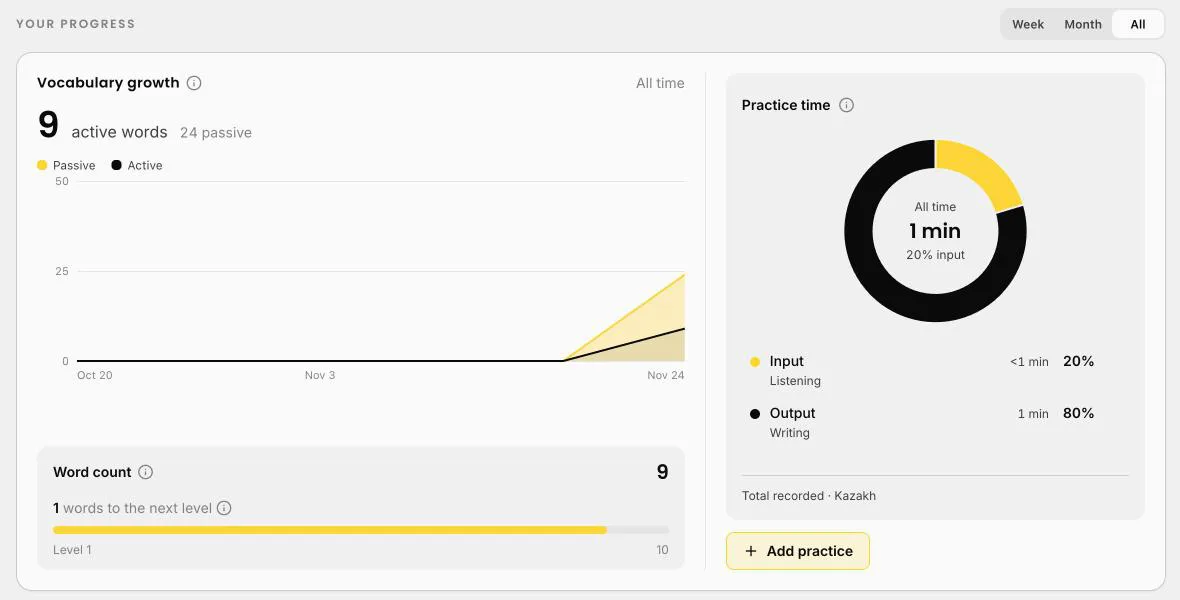
Step 3We track every wordYour passive words are the ones you understand when you read or hear them. Your active words are the ones you’ve used yourself. You see both grow, how your time splits between input and output, and how many words to your next level.
Brand new to Kazakh? Start somewhere else first. Teacher AI works best from about A2, once you can handle simple everyday sentences. Before that, you just don’t have enough words yet for open conversation. Duolingo doesn’t teach Kazakh, so learn the letters and your first words with uTalk, or with Soyle, a full course from Kazakhstan’s state language fund, if you read Russian. Then come back when you want to talk.
Your progress, in words9 Kazakh words used, 24 understood, after one chat and a story. You see your active and passive words grow, the words to your next level, and your practice time split into input and output.
What it looks like in Kazakh
Here’s what a moment of practice looks like. You answer, your teacher replies with the transliteration above every word, and if you made a mistake, your sentence gets fixed right there.
A card for every word you tap
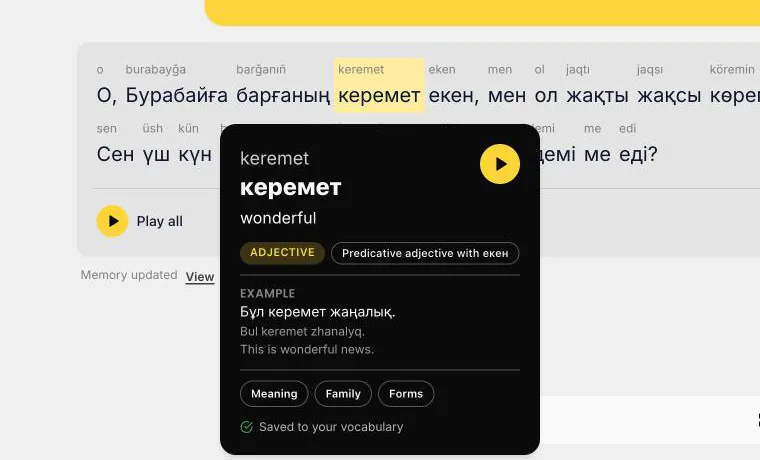
Tap any word, in a conversation, a video or a story, and you get its card: what it means, how to say it, what kind of word it is, and an example with a translation. Its family and its forms are one tap away. Tap play to hear it.
Ас болсын!as bolsyn
enjoy your meal
PHRASE
ExampleАс болсын! Рахмет. Enjoy your meal! Thanks.
Good to knowYou say it to anyone who’s eating, at home, at a той or in a café. Literally: “may it be food”.
тойtoy
a feast, a big celebration
NOUN
ExampleСенбіде тойға барамыз. We’re going to a celebration on Saturday.
Good to knowWeddings, birthdays, a baby’s first steps: they all get a той. A wedding is үйлену тойы.
ағаagha
older brother
NOUN
ExampleМенің ағам Астанада тұрады. My older brother lives in Astana.
Good to knowYou also call any older man аға, out of respect: Аға, кешіріңіз! Excuse me, sir!
An illustration of three word cards, rebuilt for this page. On the real card, the wording depends on the word. Below: real screenshots of the web app.
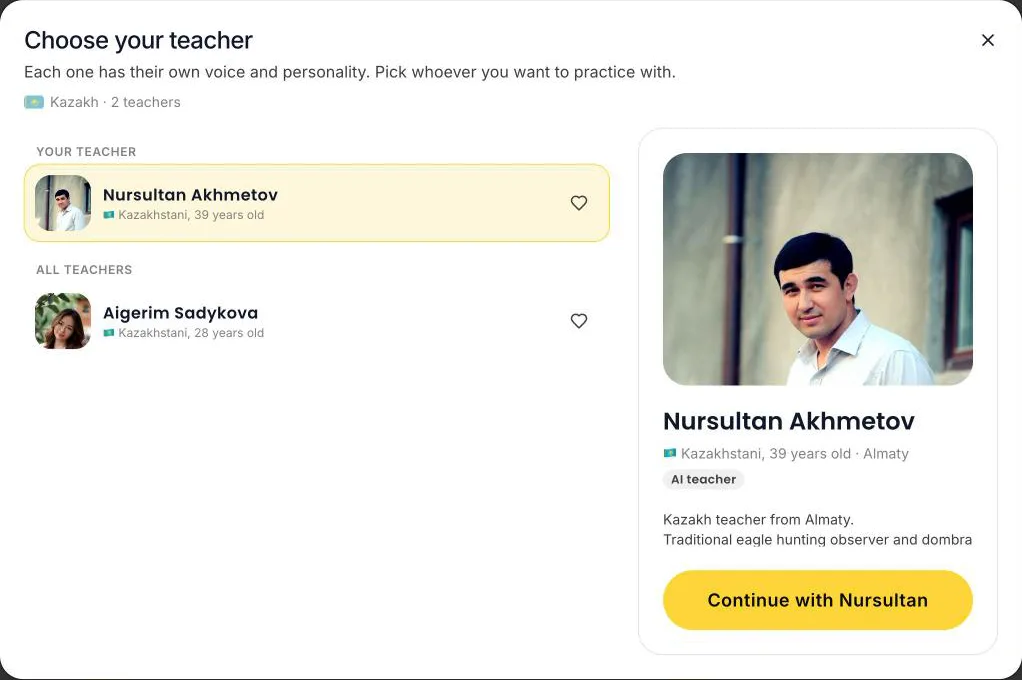
Corrected while you talkYou tell Nursultan you went to Burabay for three days. Бурабайда, in Burabay, becomes Бурабайға, to Burabay, and үш күндер becomes үш күн: no plural after a number. The transliteration is above every word.Tap Why?After a verb of going, the place takes -ға: Бурабайға бардым. You see what you said, the fixed sentence, a translation and why, one correction at a time, and you can save it as a flashcard.Tap any wordTap керемет and you get wonderful, the transliteration, what kind of word it is, and an example with a translation.Two Kazakh teachersNursultan and Aigerim, both from Almaty, each with their own voice. Your chat history stays when you switch.
Meet your Kazakh teachers
Two teachers, both from Almaty: Aigerim and Nursultan. Each has their own voice. Pick the one you like, and switch whenever you want.
And they stick to Kazakh. You can ask for an explanation in English, but they won’t drift into Russian the moment you pause.
Aigerim Sadykova
Almaty · Kazakhstani
Nursultan Akhmetov
Almaty · Kazakhstani
Input: Kazakh to watch and read, at your level
Here’s the input side up close. New words come from lots of Kazakh you hear and read, where you already understand most of it.
Watch and Read are on the web app for now, both with the transliteration above every word. Words you read along with, without tapping, count toward your passive words. Every word you tap lands in your flashcards. And when you’re done, you talk about it with your teacher.
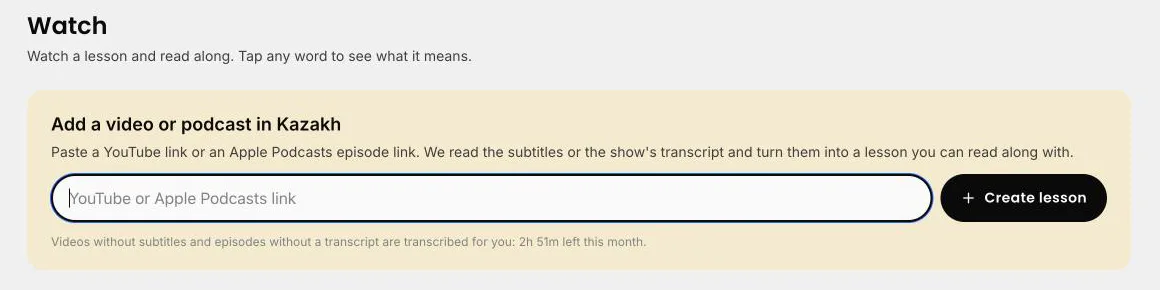
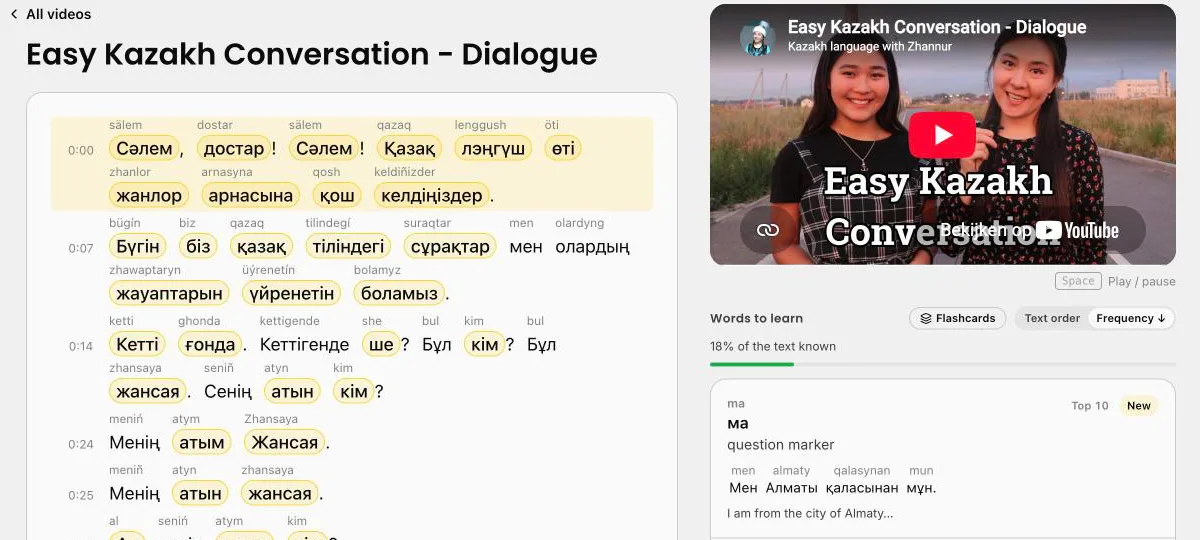
Any YouTube videoPaste a link to a Kazakh YouTube video, or an Apple Podcasts episode. We turn it into a page you read along with: the transliteration above the Cyrillic, new words in yellow. No subtitles? On a paid plan we transcribe it for you, within a monthly allowance.
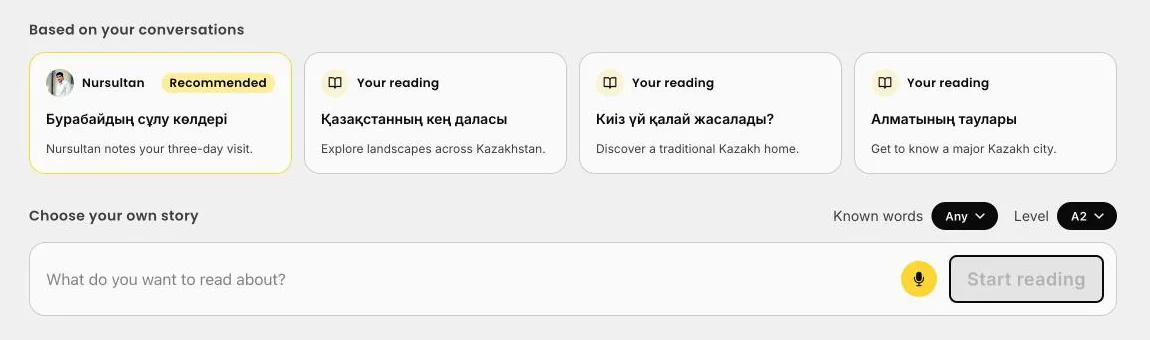
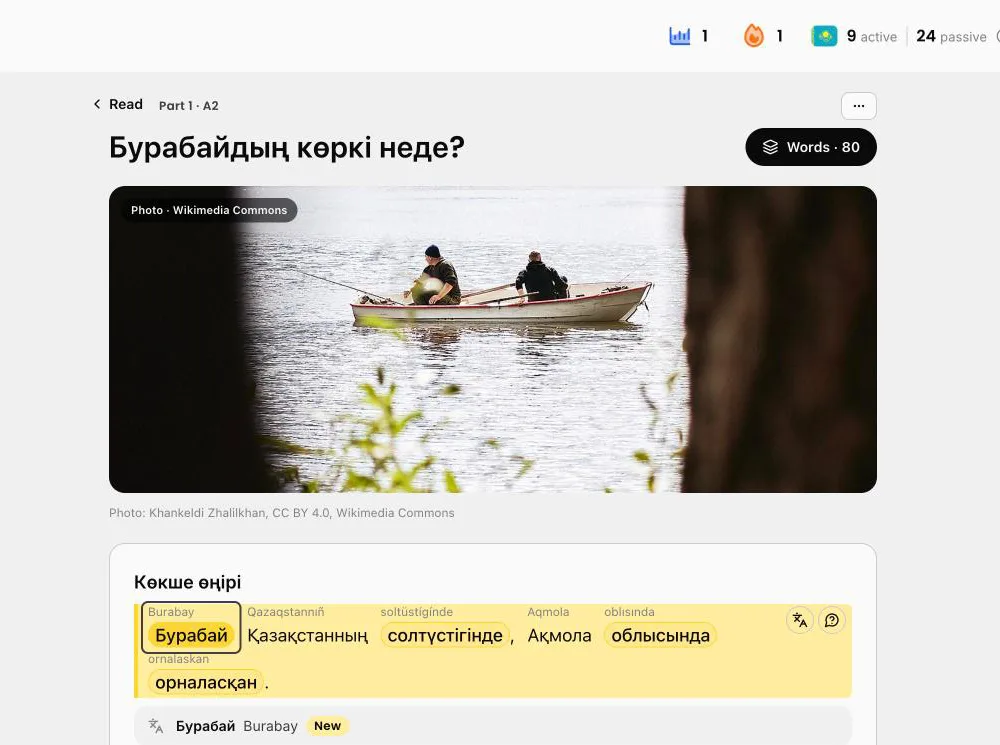
Stories written for youRead writes Kazakh texts at your level, from A1 to Native, about anything you like, and suggests ideas from what you talk about with your teacher.
How much you know, before you startTeacher AI keeps a list of every Kazakh word you’ve met: the ones you use when you talk, the ones you read or hear, the ones you tap. It checks every word of a video or text against that list and shows you the share you already know.
The 80% rulePick videos and texts where you know 80% or more of the words. Then your brain fills in the rest from context. Under 70% is too much for now. 90% and up is easy and fun.
Then talk about itOne tap on Talk about this starts a conversation about what you just watched or read. Retelling it is how new words become words you can say.
Paste any Kazakh videoPaste a link to a Kazakh YouTube video or podcast and it becomes a lesson. No subtitles? On a paid plan we transcribe it, within a monthly allowance.Any video becomes a lessonA short dialogue from Kazakh language with Zhannur, transcribed for you, as a lesson. The transliteration is above every word, new words are in yellow, and you see you already know 18% of the text. On the right, the words to learn, the most common first.Ideas from your conversationsYou told Nursultan about your three days in Burabay. So Read suggests Burabay’s lakes, along with the Kazakh steppe, how a yurt is made and the mountains of Almaty.A story at your levelБурабайдың көркі неде?, what makes Burabay so beautiful?, at A2, with a photo of the lake. The transliteration is above every word, new words are in yellow, and one tap shows what a word means.
Teacher AI or Duolingo?
Lots of people look for Kazakh on Duolingo first. It isn’t there: Duolingo has no Kazakh course for English speakers, and none for Russian speakers either. Here’s the comparison anyway, from Duolingo’s own pages.
Duolingo
Teacher AI
Kazakh course
None, from any language.
Yes. Talk about anything, with two teachers from Almaty.
Reading Cyrillic
Not offered for Kazakh.
The transliteration above every word.
Open conversation
Not for Kazakh.
Unlimited on a paid plan, by voice or text, or hands-free in a call.
Where it works
iPhone, Android and web. Video Call and Roleplay only in the app.
iPhone, Android and web, conversations included.
Price (US)
Every course is free, with ads. Super Duolingo: $9.99 to $119.99 on the US App Store.
Start free on the website. Unlimited conversation: $149 a year on the web.
Love your Duolingo streak? Keep it for another language. For Kazakh you’ll need a different app, and for speaking Kazakh, that’s what Teacher AI is built for.
The apps side by side
Feature
Teacher AI
Talkpal
uTalk
Duolingo
Teaches this language
Yes, from about A2, with 2 teachers, both from Almaty.
Yes, one of its 130+ languages.
Yes, 2,500+ words and phrases in 60+ topics, to about A1 to A2.
No course for English speakers. Duolingo doesn’t teach Kazakh at all, not even from Russian.
Open conversation
Unlimited on a paid plan, by voice or text, or hands-free in a call. Free plan: one conversation.
Chat, audio-only Call Mode and roleplays. Unlimited on Premium.
No AI conversation on its pages. Games with native-speaker audio.
No Kazakh course, so no Video Call or Roleplay in Kazakh.
Corrections
During the conversation: your message is marked up, and Why? explains each fix.
Feedback after each reply, and a tool that explains any sentence.
Not stated.
No Kazakh course.
Pronunciation help
Replay your recording next to a native speaker saying the same line. No pronunciation score.
Says it gives feedback on pronunciation, intonation and rhythm. Its Sentence Mode score is for selected languages, and doesn’t say if Kazakh is one.
Record yourself copying a native speaker and compare the two.
No Kazakh course.
Reading aid for the script
Cyrillic, with the transliteration above every word, in chats, Watch and Read. Learn the 42 letters anyway: they come quickly if you know Russian. To type, add a Kazakh keyboard, or just speak.
A Romanization feature for non-Latin scripts. The system isn’t named.
Not stated.
No Kazakh course.
Where it works
Web, iOS and Android
Web, iOS and Android
iPhone, Android, web, Mac and PC.
iOS, Android and web. Video Call and Roleplay: app only.
$119.99/year or $19.99/month. On the web, $149.99 for 24 months.
€34.99/year or €5.99/month on its plans page. US App Store: $10.99 a month.
Super Duolingo: $9.99 to $119.99 on the US App Store, which doesn’t say which is monthly or yearly.
Free option
Start free on the website, no credit card.
10 minutes a day, free. 14-day trial, no payment up front.
Free starter words. A 28-day money-back guarantee.
Every course is free, with ads.
Scroll the table sideways to see every app.
The apps, one by one
Teacher AI
Best for getting fluent: input, speaking and tracking
Speaking
Unlimited on a paid plan. Pick a conversation starter at your level, talk about anything in Free Talk, try a roleplay, or switch to hands-free and just talk. Your teacher stays in Kazakh.
Reading Kazakh
The transliteration above every word in the conversation, and in Watch and Read. Word cards show it too.
Teachers
Two for Kazakh: Aigerim and Nursultan, both from Almaty.
Corrections
Your own sentence is fixed while you talk: -да where you meant -ға, a plural after a number. Tap Why? for the explanation.
Progress
Your active and passive words, your practice time split into input and output, and 100 levels with the matching CEFR level.
Watch and Read
Turn a Kazakh YouTube video or podcast into a lesson (no subtitles? we transcribe it on a paid plan), and read stories at your level. Both show the share of words you already know. On the web app.
Not so good
Not for complete beginners: for Kazakh, it works best from about A2, so learn the letters and your first words with uTalk first, or with Soyle if you read Russian. And there’s no pronunciation score.
Talkpal
Cheaper, with open AI chat
Kazakh
One of its 130+ languages, with its own Learn Kazakh page. Chat, audio-only Call Mode and roleplays with an AI tutor.
Strengths
Feedback after each reply, and on pronunciation, on the web and on your phone. A Romanization feature for non-Latin scripts. 10 minutes a day for free.
Not stated
Anything Kazakh-specific beyond its landing page, which romanization it shows, and whether its pronunciation score (Sentence Mode, “available for selected languages”) covers Kazakh.
Price
$119.99 a year or $19.99 a month on the US App Store, with a 14-day trial.
uTalk
Your first Kazakh words
Kazakh
Over 2,500 words and phrases in 60+ everyday topics, from First Words to Business, which takes you to about A1 to A2, its Kazakh page says.
Speaking
You listen to native speakers, record yourself copying them, and compare the two. No AI conversation on its pages, and no grammar course.
Price
€34.99 a year or €5.99 a month on its Kazakh plans page, with a 28-day money-back guarantee. Free starter words.
Duolingo
No Kazakh course
Course
Duolingo doesn’t teach Kazakh, from English or from any other language. Not even from Russian.
Not so good
No Kazakh course, so no Video Call or Roleplay in Kazakh either.
Where another app might suit you better
Read Russian? Look at Soyle, an online Kazakh course from Kazakhstan’s Fund for the Development of the State Language, with levels from A1 to C2 and about ten lessons each. The lesson titles are translated into Russian, so it suits Russian speakers best. Its apps are on the App Store and Google Play.
Prefer a human teacher? Zhannur, who has taught Kazakh on YouTube since 2017, sells a video course for beginners and elementary learners on her site, $235 one-time, and gives 1:1 lessons online. Her Kaiwa page adds AI speaking practice between lessons, free for now.
Want people to talk with? HelloTalk is a free language exchange: you chat with Kazakh speakers by text, voice or video, or join a voice room. It’s the human version of what we do, and nobody there minds if you stay in Kazakh.
Want sentences to listen to and repeat? Glossika has Kazakh, from A1 to C1, with native-speaker audio and a 7-day free trial. There’s also KeelAI, a small app with an AI tutor you can answer out loud, in Kazakh and a handful of other languages. Too few ratings on the US App Store to show, and $99.99 a year, so try it before you pay.
And if you’re looking at Speak, Langua, Praktika, Babbel, Busuu, Pimsleur or Mondly: none of them teaches Kazakh. Memrise has no official Kazakh course either. Ling has a Kazakh page, but Kazakh isn’t in its help center’s list of languages.
For getting fluent, Teacher AI: talk about anything for as long as you like, with Aigerim or Nursultan from Almaty, the transliteration above every word, and a Why? on every correction. Plus Kazakh videos and stories at your level, and every word you learn tracked. Very few AI speaking apps teach Kazakh at all. Talkpal does, and it’s cheaper.
Is Kazakh hard to learn?
Yes, it takes work. In our ranking of 67 languages, Kazakh is the 13th hardest for English speakers, at 6,597 effort points, more than twice the effort of Spanish, and a bit more than Turkish. The letters are the quick part, especially if you know Russian. The endings, vowel harmony and the verb at the end are what take practice, out loud.
Do I need to learn the Cyrillic alphabet first?
It helps, and it’s quicker than you think: Kazakh Cyrillic is the Russian alphabet plus nine letters, ә ғ қ ң ө ұ ү һ і. On Teacher AI you don’t have to wait. Every Kazakh word has the transliteration above it, so you can read along while the letters sink in.
Is Kazakh switching to the Latin alphabet?
It’s been planned since 2017, and the date has moved more than once. For now, signs, books, news and most phones use Cyrillic, so that’s the one to learn. If the switch comes, the sounds stay the same, and so do your words.
Why does everyone answer me in Russian?
Mostly to be helpful. In Almaty and Astana, lots of people speak Russian as easily as Kazakh, and when they hear a learner, many switch. Ask Қазақша сөйлесейік. Мен үйреніп жүрмін. Let’s speak Kazakh, I’m learning. Most people are happy to. The better you get, the less they switch, and practice with a teacher who keeps talking Kazakh is how you get there.
Can I learn Kazakh on Duolingo?
No. Duolingo doesn’t teach Kazakh, from English or from any other language, Russian included. On Teacher AI you can practice spoken Kazakh from English.
Can a complete beginner use Teacher AI for Kazakh?
Not really. For Kazakh, Teacher AI works best from about A2, once you can handle simple everyday sentences. Before that, you just don’t have enough words yet for open conversation. Starting from zero? Learn the letters and your first words with uTalk, or with Soyle if you read Russian, then come here to talk. (Spanish and French are different: they have a beginner track from zero.)
Is Teacher AI only for speaking?
No. It’s a complete fluency system. Speaking is how you activate your Kazakh. On the web app you also grow it: turn a Kazakh YouTube video or podcast into a lesson, and read stories at your level, with the transliteration above every word. And Teacher AI tracks the words you understand and the words you use, so you see your progress in real numbers.
Is Teacher AI better than Duolingo for speaking Kazakh?
For Kazakh, Duolingo isn’t an option: it has no Kazakh course, from English or from Russian. Teacher AI is built around conversation, unlimited on a paid plan, on the web and on your phone. Love your Duolingo streak? Keep it for another language.