Lithuanian · With teachers from Vilnius, and every case ending fixed
The best AI apps to practice speaking Lithuanian
Updated November 15, 2026. We checked every other app on its own website, help pages and app store page. See the sources.
We built Teacher AI, so of course we’re biased. That’s why we link every claim we make about another app, and tell you plainly when another app suits you better.
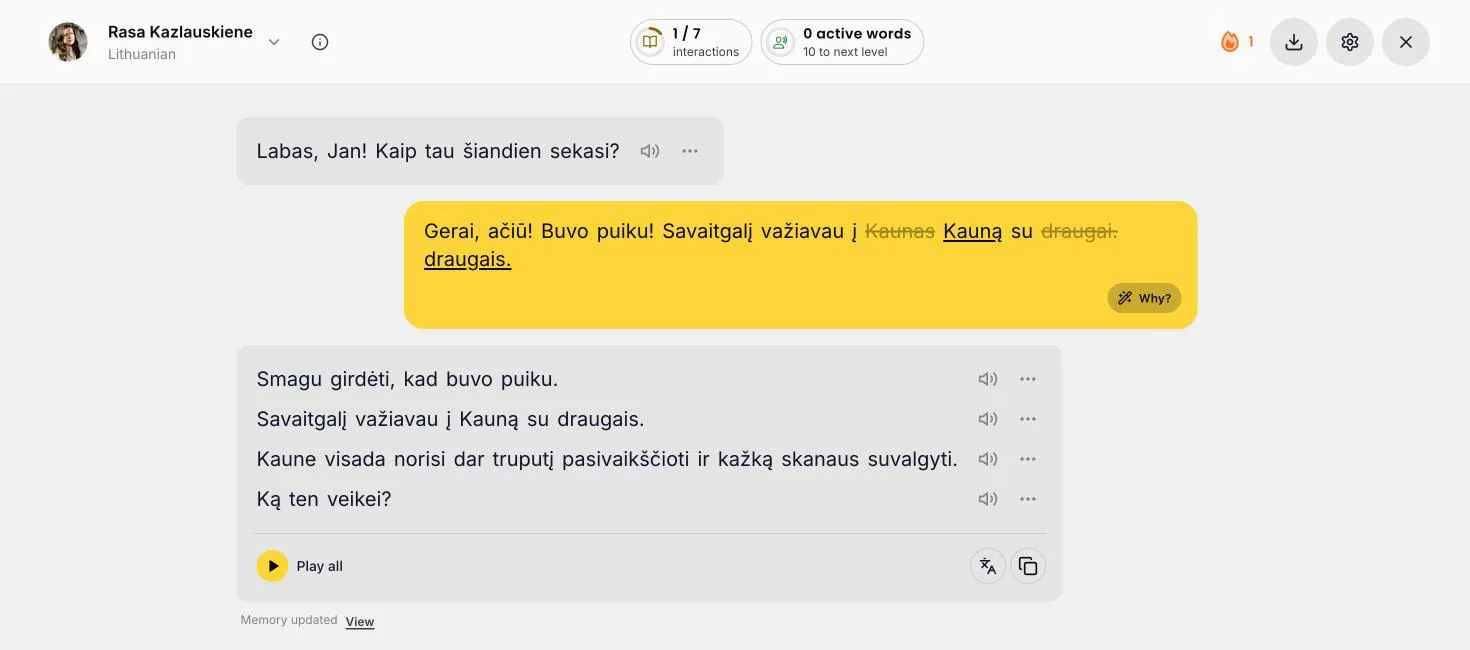
Ką veikei savaitgalį?What did you do at the weekend?
Buvo puiku! Važiavau į Kaunas Kauną su draugai draugais.It was great! I went to Kaunas with friends.
2 small fixesWhy?
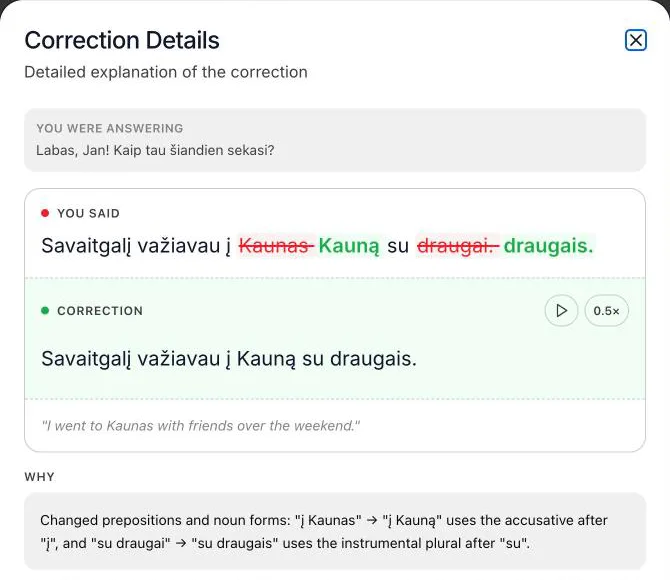
Why?After į meaning “to”, a place takes the accusative: į Kauną. That’s where the ą comes in. And after su meaning “with”, you need the instrumental: su draugais, with friends.
An illustration of the conversation screen, rebuilt for this page with Lithuanian text.
The short answer
Lithuanian is about twice as hard as Spanish for English speakers: 26th of the 67 languages in our ranking, right next to Russian. And very few AI speaking apps teach it. Speak, Langua, Praktika, Babbel and Busuu don’t, and Duolingo has no Lithuanian course. Talkpal has open AI chat in Lithuanian. Ling, Pimsleur and Mondly have courses.
Here’s our honest take. Pick Teacher AI if you want to get fluent, not just practice. You get lots of real conversation with Rasa or Tomas, both from Vilnius, and a Why? on every correction, from į Kauną to su draugais. Plus Lithuanian videos and stories at your level, and we track every word you learn. Pick Talkpal for a cheaper AI chat, and Ling for game-style lessons.
Starting from zero? Teacher AI works best for Lithuanian from about A2. Learn the basics with Pimsleur’s Lithuanian course or Ling first.
Best for getting fluent: input, speaking and trackingTeacher AITalk about anything, for as long as you like, with teachers from Vilnius, and every case ending explained. Grow your Lithuanian with videos and stories at your level, and watch your active and passive words climb. Web, iPhone and Android, $149 a year.
Cheaper, with open AI chatTalkpalLithuanian is one of its 130+ languages, with chat, calls and roleplays. $119.99 a year, or 10 minutes a day for free. Its pages don’t say anything Lithuanian-specific.
Best for game-style lessonsLingA Lithuanian course with dialogues, and speaking lessons on Android and the web, not on iPhone. $89.99 a year, and the first 2 units are free.
A fluency system, built by polyglots
Teacher AI isn’t a chatbot with a language menu. It’s a fluency system, built by some of the most accomplished polyglots and language teachers around. People who learned many languages themselves, and know what actually gets you speaking.
Arieh Smith
Xiaoma · the world’s most viral polyglot
Lucas Bighetti
One of the world’s best polyglots · speaks 20+ languages
Olly Richards
Author · 2M+ books sold · StoryLearning founder
Jan van der Aa
Runs the leading network for online language entrepreneurs
“I’ve tried lots of this type of app. This is the best one. It feels like it’s created by someone who understands language learning.”
Jcalebmi, App Store review, October 2026
What you need to practice speaking Lithuanian
Lithuanian takes work. In our ranking of 67 languages it’s the 26th hardest for English speakers, at 6,037 effort points. That’s right next to Russian (6,067), a bit easier than Polish (6,329), and about twice what Spanish takes (2,941). Latvian, its only living cousin, is easier: 35th, at 5,275.
The alphabet is the easy part: Latin letters, with a few extras. Lithuanian is often called one of the most conservative Indo-European languages, because it kept a lot of old grammar its relatives dropped. That’s what makes it so hard: the endings, the stress that moves, and a verb system full of participles. Plus, if you live in Vilnius, people often switch to English the moment you hesitate.
Seven casesNouns change their ending with their job in the sentence. You live Vilniuje, in Vilnius. You go į Vilnių, to Vilnius. You come iš Vilniaus, from Vilnius. There’s even a case for calling someone: when you call Tomas, he’s Tomai. And numbers change the noun too: vienas euras, du eurai, but dešimt eurų. Knowing the tables is one thing. Getting the ending right while you talk takes practice.
Stress that movesLithuanian stress can fall on any syllable, and it can move when the ending changes. Ranka, a hand, is stressed on the end: ran-KA. But ranką, when it’s the object, is RAN-ka. On a long syllable, the pitch rises or falls, too. Dictionaries mark all this. Normal Lithuanian writing doesn’t, so you learn it by hearing it, over and over.
Surnames that changeMr Kazlauskas’s wife is traditionally Kazlauskienė, and his unmarried daughter Kazlauskaitė. There’s a newer form, Kazlauskė, that says nothing about marriage. You’ll meet it on day one: our teacher Rasa Kazlauskiene has the -ienė form. And every one of those names takes case endings, like any other noun.
Verb prefixes and participlesA prefix can turn “doing” into “done”: rašiau laišką, I was writing a letter, parašiau laišką, I wrote it, to the end. And Lithuanian loves participles. Grįžęs namo, jis pavalgė: having come home, he ate. If it’s her, it’s grįžusi. You’ll read them everywhere, and you need a few of them to sound natural.
Lots of Lithuanian you understandSpeaking activates the words you have. New words come from input: Lithuanian videos, podcasts and texts where you already understand most of it.
Lots of speaking timeA language this hard takes hours of talking. A few minutes a day won’t get you there.
A complete fluency system, not just a speaking app
Our speaking practice is the heart of Teacher AI. But speaking alone won’t make you fluent, and neither will input alone. You need both, and you need to see it working.
So Teacher AI is a complete fluency system. Input grows your Lithuanian. Speaking activates it. And we track every word along the way, to get you to real fluency as fast as we can.
Step 1Input grows your vocabularyWatch Lithuanian YouTube videos and podcasts, and read stories written at your level. You always see how much you already understand, and every word you tap becomes a flashcard. How Watch and Read work.
Step 2Speaking activates itKnowing a word isn’t the same as using it, with the right case ending and the stress in the right place. Talking with your teacher, for as long as you like, is how words move from “I know that one” to “I just said it”. Every mistake gets fixed, with a Why?.
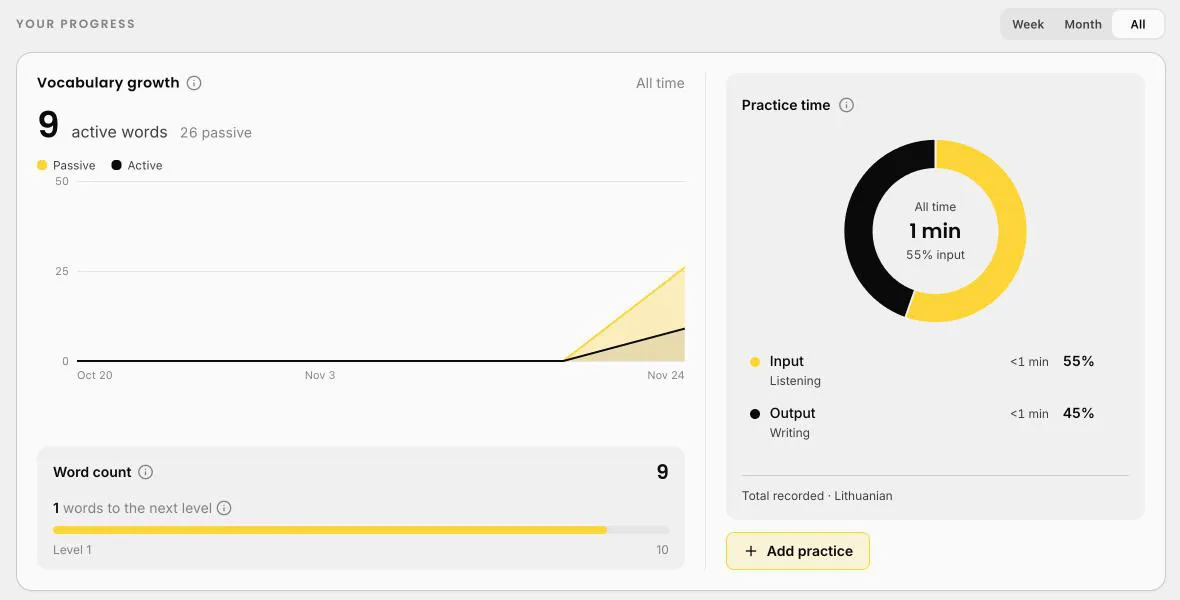
Step 3We track every wordYour passive words are the ones you understand when you read or hear them. Your active words are the ones you’ve used yourself. You see both grow, how your time splits between input and output, and how many words to your next level.
Brand new to Lithuanian? Start somewhere else first. Teacher AI works best from about A2, once you can handle simple everyday sentences. Before that, you just don’t have enough words yet for open conversation. Duolingo doesn’t teach Lithuanian, so learn the basics with Pimsleur’s Lithuanian course or the Ling app, and come back when you want to talk.
Your progress, in words9 Lithuanian words used, 26 understood, after one chat, a short video and a story. You see your active and passive words grow, the words to your next level, and your practice time split into input and output.
What it looks like in Lithuanian
Here’s what a moment of practice looks like. You answer, your teacher replies, and if you made a mistake, your sentence gets fixed right there.
A card for every word you tap
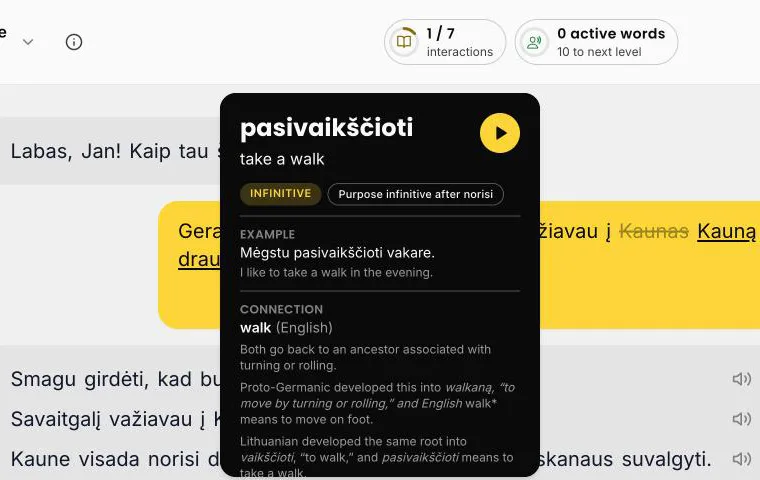
Tap any word, in a conversation, a video or a story, and you get its card: what it means, what kind of word it is, and an example with a translation. Its family and its forms are one tap away. Tap play to hear it.
simpatiškas
nice-looking, likeable
ADJECTIVE
ExampleJis labai simpatiškas. He’s really nice-looking.
Good to knowA false friend. “Sympathetic” is užjaučiantis.
pasiilgti
to miss someone or something
VERB
ExampleLabai pasiilgau Vilniaus. I really missed Vilnius.
Good to knowWhat you miss goes into the genitive: pasiilgau tavęs, I missed you.
šaltibarščiai
cold beet soup
NOUN
ExampleVasarą valgome šaltibarščius. In summer we eat cold beet soup.
Good to knowLiterally “cold borscht”: bright pink, made with kefir, and served with hot potatoes on the side. Always plural.
An illustration of three word cards, rebuilt for this page. On the real card, the wording depends on the word. Below: real screenshots of the web app.
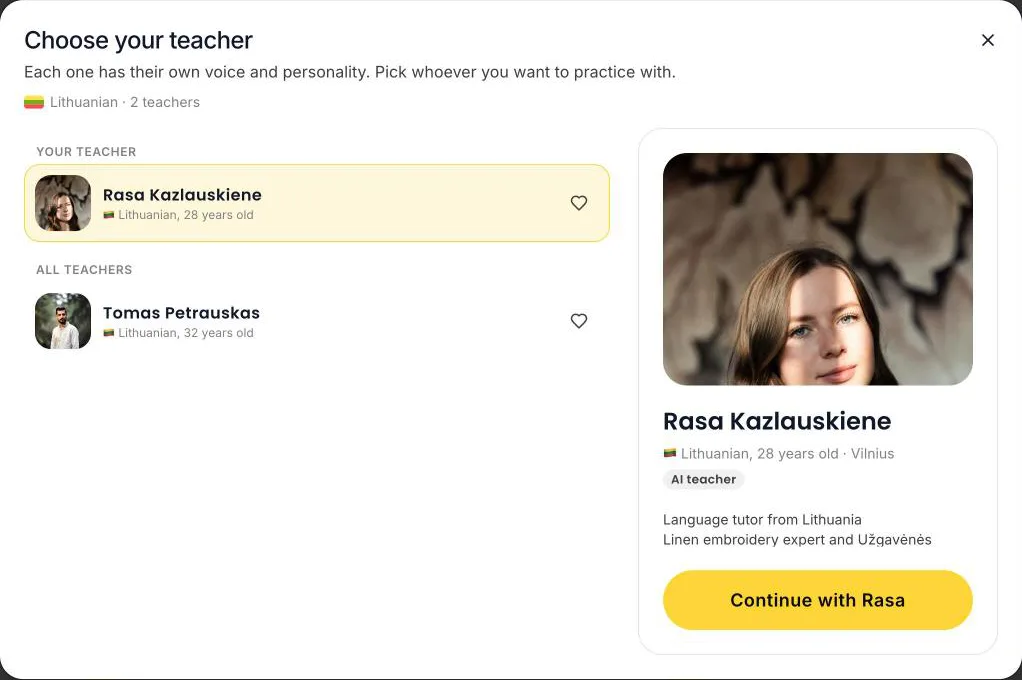
Corrected while you talkYou tell Rasa you went to Kaunas with friends at the weekend. Į Kaunas becomes į Kauną, and su draugai becomes su draugais. Then she asks what you did there.Tap Why?Į takes the accusative, į Kauną, and su the instrumental, su draugais. You see what you said, the fixed sentence, a translation and why, and you can save it as a flashcard.Tap any wordTap pasivaikščioti and you get take a walk, why it’s an infinitive here, and an example.Two Lithuanian teachersRasa and Tomas, both from Vilnius, each with their own voice. Your chat history stays when you switch.
Meet your Lithuanian teachers
Two teachers, both from Vilnius: Rasa and Tomas. Each has their own voice. Pick the one you like.
Rasa Kazlauskiene
Vilnius · Lithuanian
Tomas Petrauskas
Vilnius · Lithuanian
Input: Lithuanian to watch and read, at your level
Here’s the input side up close. New words come from lots of Lithuanian you hear and read, where you already understand most of it.
Watch and Read are on the web app for now. Words you read along with, without tapping, count toward your passive words. Every word you tap lands in your flashcards. And when you’re done, you talk about it with your teacher.
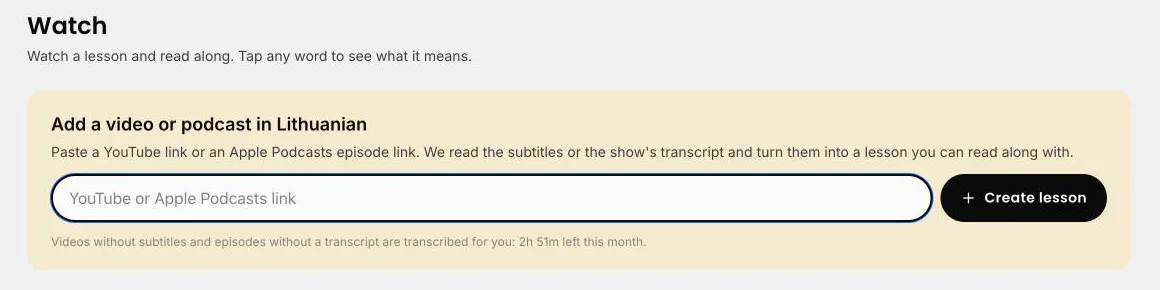
Any YouTube videoPaste a link to a Lithuanian YouTube video, or an Apple Podcasts episode. We turn it into a page you read along with, new words in yellow. No subtitles? On a paid plan we transcribe it for you, within a monthly allowance.
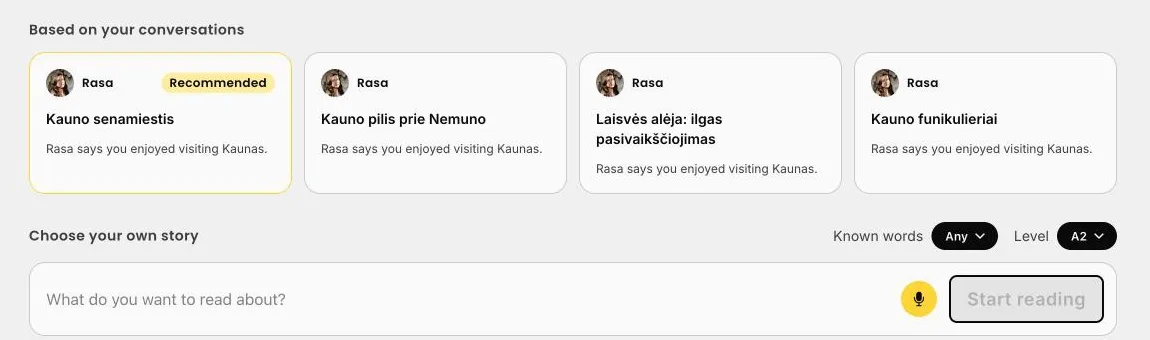
Stories written for youRead writes Lithuanian texts at your level, from A1 to Native, about anything you like, and suggests ideas from what you talk about with your teacher.
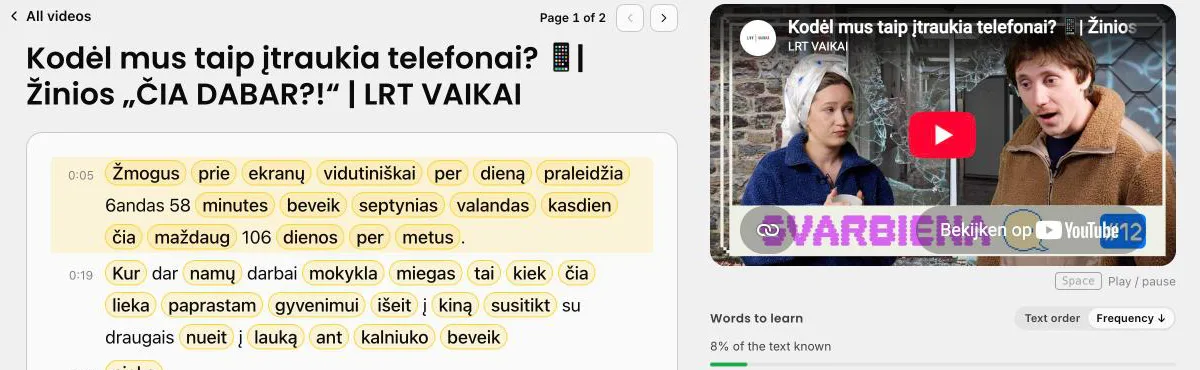
How much you know, before you startTeacher AI keeps a list of every Lithuanian word you’ve met: the ones you use when you talk, the ones you read or hear, the ones you tap. It checks every word of a video or text against that list and shows you the share you already know.
The 80% rulePick videos and texts where you know 80% or more of the words. Then your brain fills in the rest from context. Under 70% is too much for now. 90% and up is easy and fun.
Then talk about itOne tap on Talk about this starts a conversation about what you just watched or read. Retelling it is how new words become words you can say.
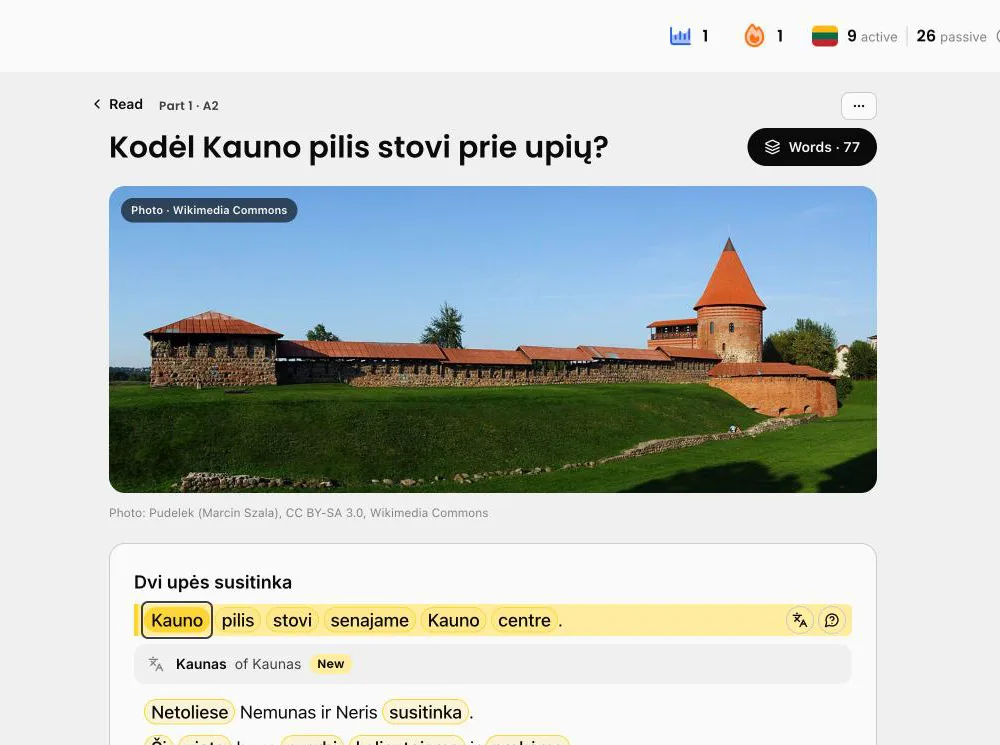
Paste any Lithuanian videoPaste a link to a Lithuanian YouTube video or podcast and it becomes a lesson. No subtitles? On a paid plan we transcribe it, within a monthly allowance.Any video becomes a lessonWhy are phones so addictive? A news video for kids from LRT VAIKAI, as a lesson. The transcript follows the video, new words in yellow, and you see how much of the text you already know.Ideas from your conversationsYou told Rasa about your weekend in Kaunas. So Read suggests its old town, the castle by the Nemunas, a long walk down Laisvės alėja and the city’s funiculars.A story at your levelKodėl Kauno pilis stovi prie upių?, why does Kaunas Castle stand by the rivers?, at A2, with a photo of the castle. New words are in yellow, and one tap shows what a word means.
Teacher AI or Duolingo?
Lots of people look for Lithuanian on Duolingo first. It isn’t there: Duolingo has no Lithuanian course for English speakers. Here’s how the two compare, from Duolingo’s own pages.
Duolingo
Teacher AI
Teaches Lithuanian
No. There’s no Lithuanian course.
Yes, from about A2. Your teacher can explain in English, or switch to your own language.
Open conversation
No Lithuanian course, so no Video Call or Roleplay in Lithuanian.
Unlimited on a paid plan, by voice or text, or hands-free in a call.
Corrections
No Lithuanian course.
During the conversation: your own sentence is fixed, and Why? explains each fix, case endings included.
Teachers
Duolingo’s own characters, in its other courses.
Two, each with their own voice: Rasa and Tomas, both from Vilnius.
Starting from zero
Not in Lithuanian.
No. For Lithuanian, Teacher AI works best from about A2. Start with Pimsleur or Ling.
Where it works
iPhone, Android and web. Video Call and Roleplay only in the app.
iPhone, Android and web, conversations included.
Price (US)
Every course is free, with ads. Super Duolingo: $9.99 to $119.99 on the US App Store.
Start free on the website. Unlimited conversation: $149 a year on the web.
Love your Duolingo streak? Keep it, in another language. For Lithuanian, learn the basics with Pimsleur’s Lithuanian course or Ling. Once you reach about A2 and want to talk, that’s what Teacher AI is built for.
The apps side by side
Feature
Teacher AI
Talkpal
Ling
Duolingo
Teaches this language
Yes, from about A2, with 2 teachers, both from Vilnius.
Yes, one of its 130+ languages.
Yes, a course in Standard Lithuanian, from the basics to advanced topics.
No course for English speakers.
Open conversation
Unlimited on a paid plan, by voice or text, or hands-free in a call. Free plan: one conversation.
Chat by writing or speaking, Call Mode and roleplays. Unlimited on Premium.
Dialogues and role-play scenarios in the app. Its AI Tutor is Thai only.
No Lithuanian course, so no Video Call or Roleplay in Lithuanian.
Corrections
During the conversation: your message is marked up, and Why? explains each fix.
Instant feedback on pronunciation and grammar, its Lithuanian page says.
Its speaking lessons check your answers with speech recognition.
No Lithuanian course.
Pronunciation help
Replay your recording next to a native speaker saying the same line. No pronunciation score.
Says it analyzes pronunciation, intonation and rhythm. Its Sentence Mode score is for selected languages, and doesn’t say if Lithuanian is one.
Google’s voice recognition in speaking lessons, on Android and the web, not on iPhone. No score on its own pages.
No Lithuanian course.
Reading aid for the script
Not needed: Latin letters, plus ą, č, ę, ė, į, š, ų, ū and ž. Add a Lithuanian keyboard, or just speak.
Not needed.
Not needed. Its help center lists no writing lessons for Lithuanian.
Super Duolingo: $9.99 to $119.99 on the US App Store, which doesn’t say which is monthly or yearly.
Free option
Start free on the website, no credit card.
10 minutes a day, free. 14-day trial, no payment up front.
The first 2 units. 7-day trial on the yearly plan only.
Every course is free, with ads.
Scroll the table sideways to see every app.
The apps, one by one
Teacher AI
Best for getting fluent: input, speaking and tracking
Speaking
Unlimited on a paid plan. Pick a conversation starter at your level, talk about anything in Free Talk, try a roleplay, or switch to hands-free and just talk.
Teachers
Two for Lithuanian: Rasa and Tomas, both from Vilnius.
Corrections
Your own sentence is fixed while you talk, and Why? explains it: the accusative after į, the instrumental after su.
Pronunciation
Replay your recording next to your teacher saying the same line, and hear where the stress should go.
Progress
Your active and passive words, your practice time split into input and output, and 100 levels with the matching CEFR level.
Watch and Read
Turn a Lithuanian YouTube video or podcast into a lesson (no subtitles? we transcribe it on a paid plan), and read stories at your level. Both show the share of words you already know. On the web app.
Not so good
Not for complete beginners: for Lithuanian, it works best from about A2, so learn the basics with Pimsleur’s Lithuanian course or Ling first. Only two teachers so far. And there’s no pronunciation score.
Talkpal
Cheaper, with open AI chat
Lithuanian
One of its 130+ languages, with its own Learn Lithuanian page. Chat about any topic by writing or speaking, plus Call Mode and roleplays with an AI tutor.
Strengths
Its Lithuanian page promises instant feedback on pronunciation and grammar, and says it analyzes your pronunciation, intonation and rhythm. On the web and on your phone, with 10 minutes a day for free.
Not stated
Anything Lithuanian-specific, like the cases or the moving stress. Which levels it covers. And whether its pronunciation score (Sentence Mode, “available for selected languages”) covers Lithuanian.
Price
$119.99 a year or $19.99 a month on the US App Store, with a 14-day trial.
Ling
Best for game-style lessons
Course
A Lithuanian course built by native speakers, in Standard Lithuanian, from the basics up to advanced topics, with dialogues, role-play scenarios and flashcards.
Speaking
Speaking lessons that check you with Google’s voice recognition, on Android and the web. Not on iPhone, its help center says. Its AI Tutor covers Thai only.
Price
$89.99 a year or $16.99 a month on its website. The first 2 units are free.
Duolingo
No Lithuanian course
Course
Duolingo doesn’t teach Lithuanian to English speakers. It isn’t on its list of courses.
Speaking
No Lithuanian course, so no Video Call, Roleplay or speaking exercises in Lithuanian.
Not so good
If you want Lithuanian, it isn’t an option. Keep your streak in another language if you like.
Where another app might suit you better
Want a structured audio course from zero? Pimsleur has one Lithuanian course, and you can try a lesson for free. Its AI Conversation Coach covers Japanese, Latin American Spanish and French, not Lithuanian.
Mondly lists Lithuanian too. Its conversations have you repeat sentences the app gives you: practice, but not open conversation.
Want an app made for Lithuanian? Two small iPhone apps are built around talking with an AI: Kalbo AI (Lithuanian, Latvian, Estonian and Polish, $119.99 a year on the US App Store) and Kalbukas, for beginners and intermediate learners. Both were too new to show ratings when we checked.
And if you’re looking at Speak, Langua, Praktika, Babbel or Busuu: none of them teaches Lithuanian. Memrise has no official Lithuanian course.
What’s the best app to practice speaking Lithuanian?
For getting fluent, Teacher AI: talk about anything for as long as you like, with Rasa or Tomas from Vilnius, and a Why? on every correction. Plus Lithuanian videos and stories at your level, and every word you learn tracked. Very few AI speaking apps teach Lithuanian at all. Talkpal does, and it’s cheaper.
Can I learn Lithuanian on Duolingo?
No. Duolingo has no Lithuanian course for English speakers. To learn Lithuanian from zero, try Pimsleur’s Lithuanian course or the Ling app. To practice speaking it, Teacher AI or Talkpal.
Is Lithuanian hard to learn?
For English speakers, yes. In our ranking of 67 languages, Lithuanian is the 26th hardest, at 6,037 effort points: about twice Spanish, and right next to Russian. The alphabet is the easy part. The seven cases, the stress that moves, the participles and the surnames that change are what take practice, out loud.
Is Lithuanian really such an old language?
Linguists often call it one of the most conservative Indo-European languages: it kept old features, like its cases and its pitch accent, that most of its relatives lost. Some words still look a lot like Sanskrit: Lithuanian sūnus and Sanskrit sūnú both mean son. That doesn’t mean Lithuanian is older than other languages, or that Lithuanians understand Sanskrit. It just kept more of the old grammar, which is why there’s so much of it to learn.
Is Lithuanian like Latvian, Russian or Polish?
Latvian is its only living cousin: both are Baltic languages. They share a lot of grammar and some words, but you can’t understand one just by speaking the other, and Latvian is easier (35th in our ranking). Russian and Polish are Slavic, not Baltic. They help with the idea of cases and verb prefixes, and you’ll hear both in Vilnius. The words and endings are Lithuanian’s own.
I grew up hearing Lithuanian at home. Is Teacher AI for me?
Very likely. Lots of Lithuanian families live abroad, from Chicago to London and Dublin, and lots of their kids understand far more than they can say. That’s exactly the gap conversation closes. Talk about anything with Rasa or Tomas, get the endings fixed, and ask for explanations in English. You don’t need to start from the alphabet.
Why do women’s surnames change?
Lithuanian surnames are nouns, with endings that show who you are. Mr Kazlauskas’s wife is traditionally Kazlauskienė, his unmarried daughter Kazlauskaitė. Since 2003 women can also choose a form like Kazlauskė, which doesn’t show whether they’re married. And all of them change with the case: you write to Kazlauskui, Mr Kazlauskas.
Can a complete beginner use Teacher AI for Lithuanian?
Not really. For Lithuanian, Teacher AI works best from about A2, once you can handle simple everyday sentences. Before that, you just don’t have enough words yet for open conversation. Starting from zero? Learn the basics with Pimsleur’s Lithuanian course or the Ling app first, then come here to talk. (Spanish and French are different: they have a beginner track from zero.)
Is Teacher AI only for speaking?
No. It’s a complete fluency system. Speaking is how you activate your Lithuanian. On the web app you also grow it: turn a Lithuanian YouTube video or podcast into a lesson, and read stories at your level. And Teacher AI tracks the words you understand and the words you use, so you see your progress in real numbers.
Is Teacher AI better than Duolingo for speaking Lithuanian?
Duolingo doesn’t teach Lithuanian, so there’s nothing to compare there. Teacher AI is built around conversation, unlimited on a paid plan, on the web and on your phone. If you love your Duolingo streak, keep it for another language, and practice Lithuanian here.