Cebuano · For Bisaya families, and for life in Cebu, Davao and Dumaguete
The best AI apps to practice speaking Cebuano
Updated November 15, 2026. We checked every other app on its own website, help pages and app store page. See the sources.
We built Teacher AI, so of course we’re biased. That’s why we link every claim we make about another app, and tell you plainly when another app suits you better.
Maayo ko, salamat! Ikaw, ano unsa imong gibuhat gahapon?Good, thanks! And you, what did you do yesterday?
1 small fixWhy?
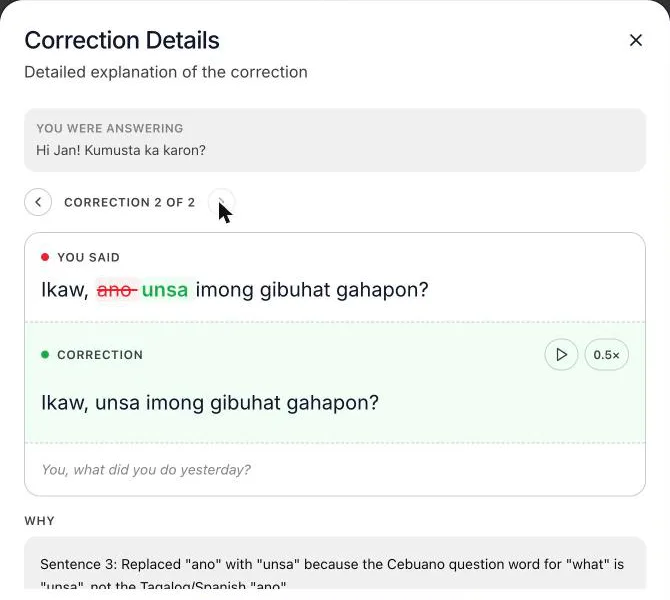
Why?Ano is Tagalog. In Cebuano, “what” is unsa: Unsa imong gibuhat?, what did you do?
An illustration of the conversation screen, rebuilt for this page with Cebuano text.
The short answer
Cebuano isn’t in our difficulty ranking, but its close relative Tagalog is: 49th of 67 for English speakers, close to German. Very few AI speaking apps teach Cebuano. Speak, Langua, Praktika, Babbel and Busuu don’t, and Duolingo has no Cebuano course at all. Talkpal has open AI chat in Cebuano. Ling and uTalk have courses.
Here’s our honest take. Pick Teacher AI if you want to get fluent, not just practice: for your partner’s family, for life in Cebu or Davao, or because your Tagalog doesn’t get you far in Mindanao. You get lots of real conversation with Carlo and Maria, and a Why? on every correction, like a Tagalog word that slipped in, hindi for wala or ano for unsa. Plus Cebuano videos and stories at your level, and we track every word you learn. Pick Talkpal for a cheaper AI chat, and Ling for a step-by-step course.
Starting from zero? Teacher AI works best for Cebuano from about A2. Learn the basics with Ling’s Cebuano course first.
Best for getting fluent: input, speaking and trackingTeacher AITalk about anything, for as long as you like, with two teachers from Cebu, and every mistake explained. Grow your Cebuano with videos and stories at your level, and watch your active and passive words climb. Web, iPhone and Android, $149 a year.
Cheaper, with open AI chatTalkpalCebuano is one of its 130+ languages, with chat, calls and roleplays. $119.99 a year, or 10 minutes a day for free. Its pages don’t say anything Cebuano-specific.
Best for a step-by-step courseLingA Cebuano course with dialogues and speaking exercises, from the basics to advanced topics. No AI chat. $89.99 a year, and the first lesson is free.
A fluency system, built by polyglots
Teacher AI isn’t a chatbot with a language menu. It’s a fluency system, built by some of the most accomplished polyglots and language teachers around. People who learned many languages themselves, and know what actually gets you speaking.
Arieh Smith
Xiaoma · the world’s most viral polyglot
Lucas Bighetti
One of the world’s best polyglots · speaks 20+ languages
Olly Richards
Author · 2M+ books sold · StoryLearning founder
Jan van der Aa
Runs the leading network for online language entrepreneurs
“I’ve tried lots of this type of app. This is the best one. It feels like it’s created by someone who understands language learning.”
Jcalebmi, App Store review, October 2026
What you need to practice speaking Cebuano
Cebuano isn’t in our ranking of 67 languages, but its closest ranked relative is. Tagalog is the 49th hardest for English speakers, at 4,486 effort points, close to German (4,255). Cebuano is built in much the same way, so expect it in about the same place.
You get a head start: the Latin alphabet, words spelled the way they sound, and lots of words from Spanish and English. What makes Cebuano hard is the verbs and the little words around them. And if you learned Tagalog first, the everyday words, because they’re different.
Not Tagalog with an accentCebuano and Tagalog are related, but a Tagalog speaker can’t follow a Cebuano conversation without learning it. The sentences are built in a similar way. The everyday words aren’t the same. What? Ano in Tagalog, unsa in Cebuano. Where? Saan, asa. Why? Bakit, ngano. Delicious? Masarap, lami. There is? Mayroon, naa. Moved south from Manila? Your Tagalog helps with the grammar, and it’s exactly what slips out when you’re tired.
Did it happen, or not yet?Cebuano verbs care about whether something happened. Mikaon ko, I ate. Nagkaon ko, I’m eating, or I was. Mokaon ko, I’ll eat. Saying no follows the same idea: wala for what didn’t happen or isn’t there (Wala koy kwarta, I don’t have any money), dili for what won’t (Dili ko mokaon, I won’t eat). And after wala, the verb goes back to its mo- form: Wala ko mokaon, I didn’t eat. Learners say wala ko mikaon for months.
Who’s in focusMikaon ko ug mangga, I ate a mango. Gikaon nako ang mangga, I ate the mango. Same meal, but the focus moves: mi- puts the eater in focus, gi- puts the mango in focus, and “I” changes from ko to nako. The little words change too, ug for “a” mango, ang for “the”. You can learn the table in a week. Picking the right form while you talk takes much longer.
Bisaya-English, with Spanish numbersIn Cebu City, people mix English into Bisaya all day. Nag-shopping mi sa Ayala, we went shopping at Ayala. I-text lang ko, just text me. Plenty of English words will do, but the grammar around them stays Cebuano. Spanish is in there too: lamesa, table, trabaho, work, kwarta, money, and prices and times in Spanish numbers. Tagpila ni?Baynte pesos. How much is this? Twenty pesos.
Lots of Cebuano you understandSpeaking activates the words you have. New words come from input: videos, podcasts and texts where you already understand most of it. That’s also where you hear how people really talk, English mixed in and all.
Lots of speaking timeCebuano takes more hours than the easiest languages, and most of them should be spent talking. That’s the tricky part in Cebu, Davao or Dumaguete: almost everyone speaks English, and they switch to it the moment they see a foreigner. It’s meant kindly. Try Mag-Bisaya lang ta, nagtuon ko, let’s just speak Bisaya, I’m learning. Then you have to keep up, so the practice has to come from somewhere.
A complete fluency system, not just a speaking app
Our speaking practice is the heart of Teacher AI. But speaking alone won’t make you fluent, and neither will input alone. You need both, and you need to see it working.
So Teacher AI is a complete fluency system. Input grows your Cebuano. Speaking activates it. And we track every word along the way, to get you to real fluency as fast as we can.
Step 1Input grows your vocabularyWatch Cebuano YouTube videos and podcasts, and read stories written at your level. You always see how much you already understand, and every word you tap becomes a flashcard. How Watch and Read work.
Step 2Speaking activates itKnowing a word isn’t the same as using it, with wala or dili in the right place, the right verb form after it, and no Tagalog sneaking in. Talking with your teacher, for as long as you like, is how words move from “I know that one” to “I just said it”. Your teacher keeps the conversation in Cebuano. Every mistake gets fixed, with a Why?.
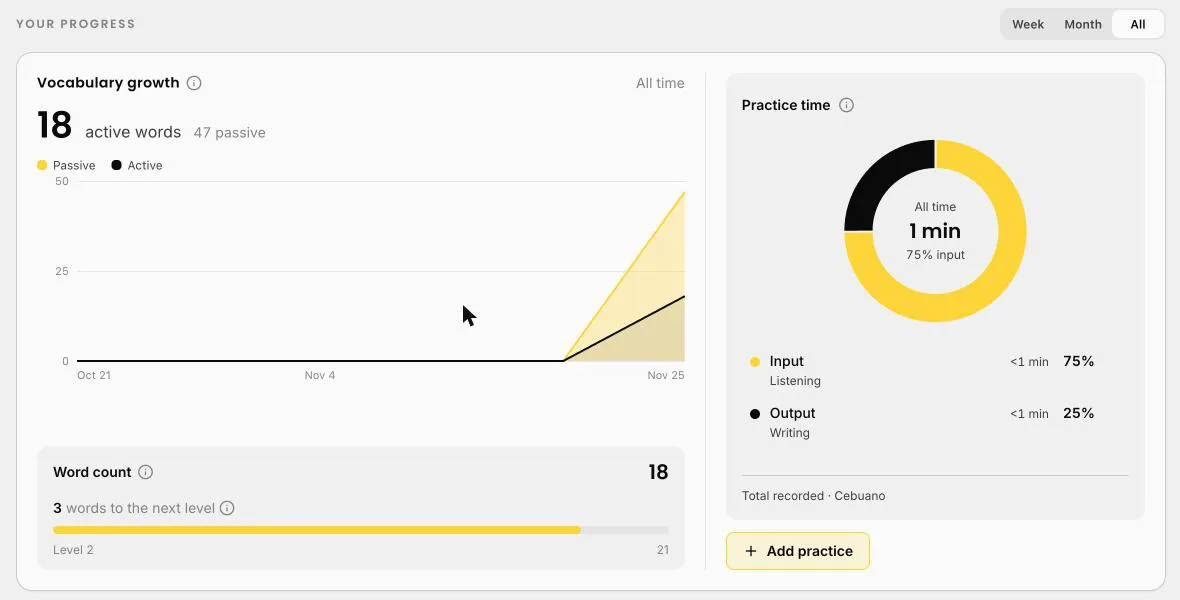
Step 3We track every wordYour passive words are the ones you understand when you read or hear them. Your active words are the ones you’ve used yourself. You see both grow, how your time splits between input and output, and how many words to your next level.
Brand new to Cebuano? Start somewhere else first. Teacher AI works best from about A2, once you can handle simple everyday sentences. Before that, you just don’t have enough words yet for open conversation. Duolingo doesn’t teach Cebuano, so learn the basics with the Ling app, which has a Cebuano course, or with uTalk’s everyday words and phrases. Then come back when you want to talk. Grew up hearing Bisaya at home? You may be further along than you think.
Your progress, in words18 Cebuano words used, 47 understood, after one chat and a story. You see your active and passive words grow, the words to your next level, and your practice time split into input and output.
What it looks like in Cebuano
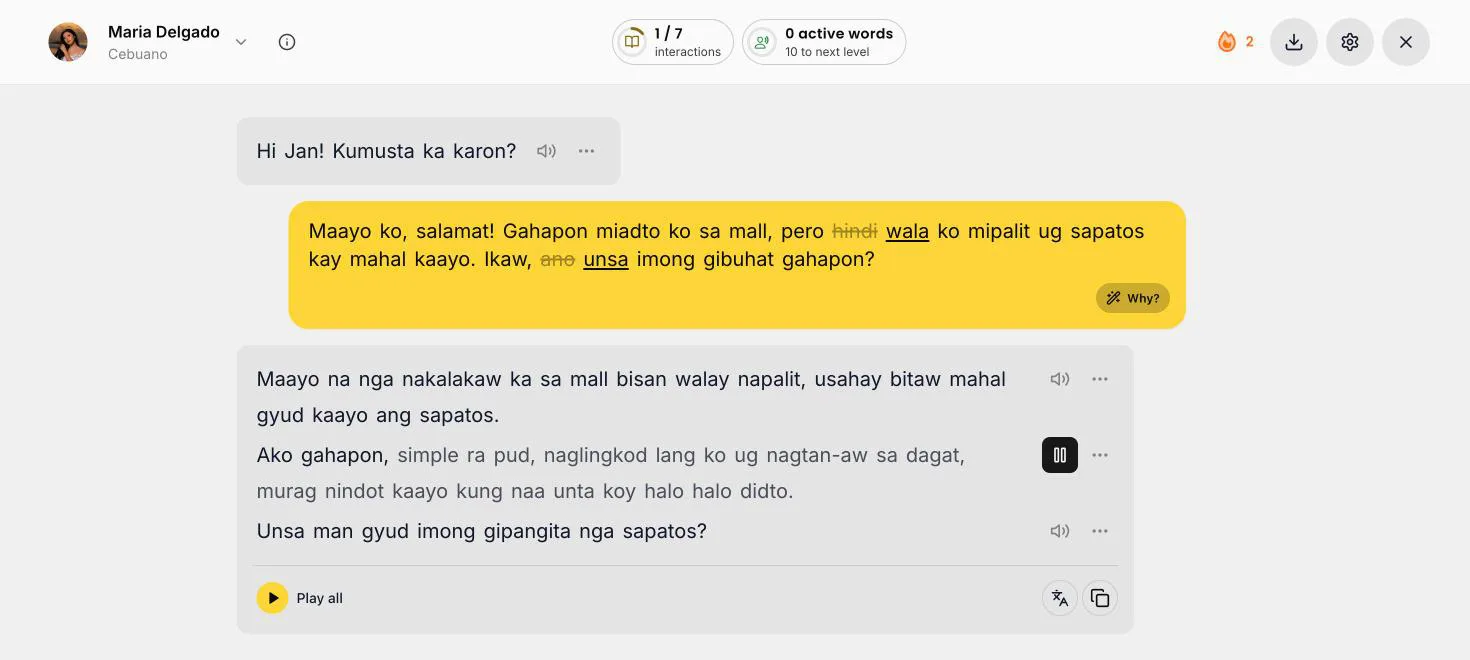
Here’s what a moment of practice looks like. You answer, your teacher replies, and if you made a mistake, your sentence gets fixed right there.
A card for every word you tap
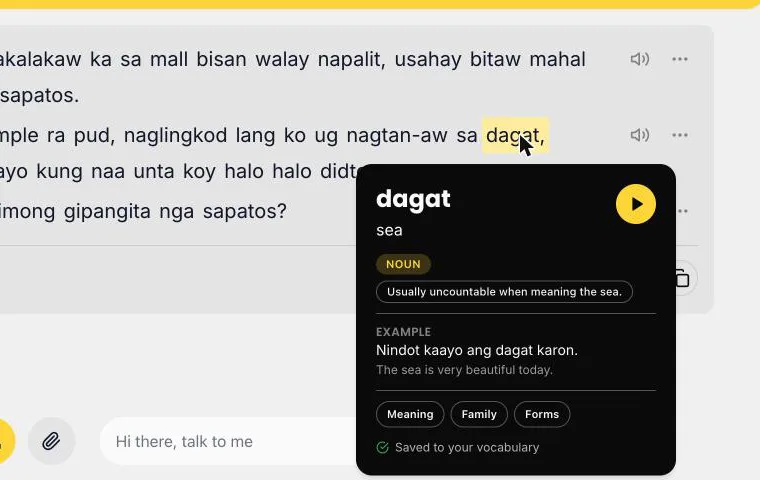
Tap any word, in a conversation, a video or a story, and you get its card: what it means, what kind of word it is, and an example with a translation. Tap play to hear it.
uyab
boyfriend or girlfriend
NOUN
ExampleNaa kay uyab? Do you have a boyfriend (or a girlfriend)?
Good to knowOne word for both. Single and visiting the family? Expect this question from every aunt within five minutes.
mingaw
lonely, too quiet; with gi-, missing someone
ADJECTIVE
ExampleGimingaw na ko nimo. I miss you already.
Good to knowA house can be mingaw too, when everyone’s gone home. You’ll hear it on every video call with family abroad.
ambot
I don’t know; who knows
INTERJECTION
ExampleAsa si Ben? Ambot. Where’s Ben? No idea.
Good to knowThe Bisaya shrug. Said with a sigh, Ambot nimo! means something like “that’s your problem”.
An illustration of three word cards, rebuilt for this page. On the real card, the wording depends on the word. Below: real screenshots of the web app.
Corrected while you talkYou tell Maria you went to the mall but didn’t buy shoes, and ask what she did. Two Tagalog words get fixed: hindi becomes wala, ano becomes unsa. Then she answers, in Cebuano.Tap Why?In Cebuano, “what” is unsa, not the Tagalog ano. You see what you said, the fixed sentence, a translation and why, and you can save it as a flashcard.Tap any wordTap dagat in Maria’s reply and you get sea, with an example and a translation: Nindot kaayo ang dagat karon, the sea is very beautiful today.Two Cebuano teachersMaria and Carlo, both from Cebu, each with their own voice. Your chat history stays when you switch.
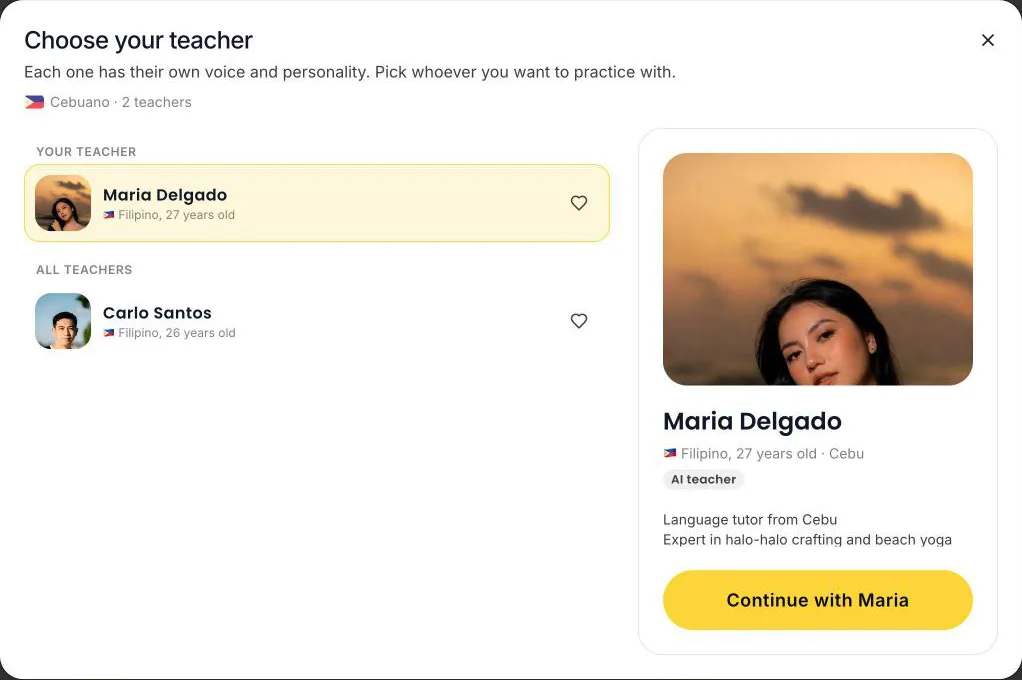
Meet your Cebuano teachers
Two teachers, both from Cebu: Carlo and Maria. Each has their own voice. Pick the one you like.
Carlo Santos
Cebu · Filipino
Maria Delgado
Cebu · Filipino
Input: Cebuano to watch and read, at your level
Here’s the input side up close. New words come from lots of Cebuano you hear and read, where you already understand most of it.
Watch and Read are on the web app for now. Words you read along with, without tapping, count toward your passive words. Every word you tap lands in your flashcards. And when you’re done, you talk about it with your teacher.
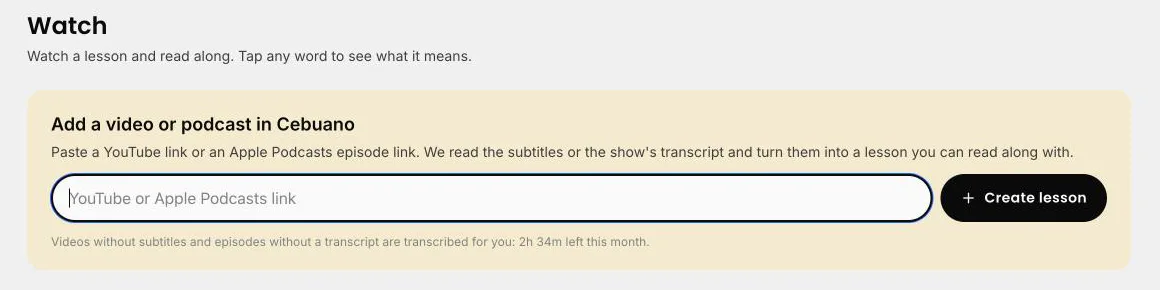
Any YouTube videoPaste a link to a Cebuano YouTube video, or an Apple Podcasts episode. We turn it into a page you read along with, new words in yellow. No subtitles? On a paid plan we transcribe it for you, within a monthly allowance. Bisaya vlogs are where you hear the language the way people really speak it, English and all. One catch: in our test, Watch turned down one Bisaya vlog as not in Cebuano and couldn’t transcribe another, so finding one that goes in can take a few tries.
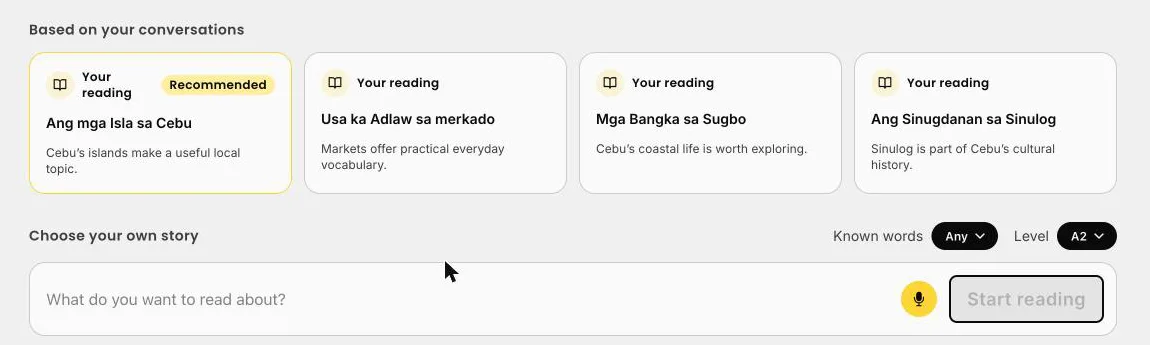
Stories written for youRead writes Cebuano texts at your level, from A1 to Native, about anything you like, and suggests ideas from what you talk about with your teacher.
How much you know, before you startTeacher AI keeps a list of every Cebuano word you’ve met: the ones you use when you talk, the ones you read or hear, the ones you tap. It checks every word of a video or text against that list and shows you the share you already know.
The 80% rulePick videos and texts where you know 80% or more of the words. Then your brain fills in the rest from context. Under 70% is too much for now. 90% and up is easy and fun.
Then talk about itOne tap on Talk about this starts a conversation about what you just watched or read. Retelling it is how new words become words you can say.
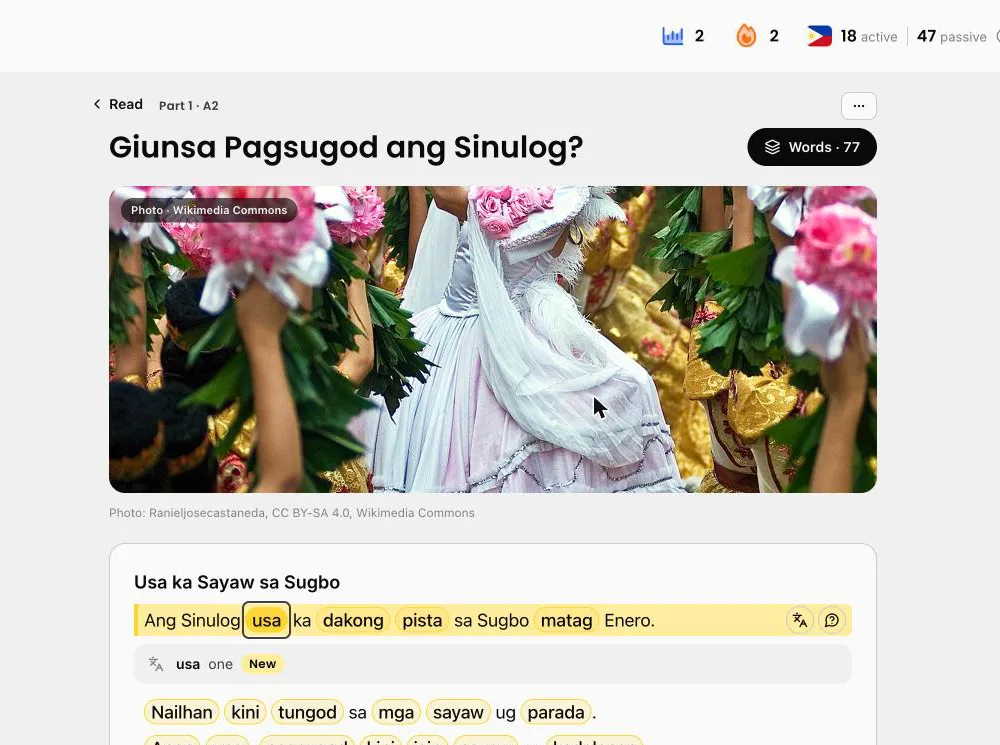
Paste a Cebuano videoPaste a link to a Cebuano YouTube video or podcast and it becomes a lesson. No subtitles? On a paid plan we transcribe it, within a monthly allowance. In our test, the vlogs we tried didn’t go in, so it can take a few tries.Ideas to read aboutRead suggests things to read about: the islands of Cebu, a day at the market, boats in Cebu and how Sinulog began. Or type your own topic.A story at your levelGiunsa Pagsugod ang Sinulog?, how did Sinulog begin?, at A2, with a photo of the dancers. New words are in yellow, and one tap shows what a word means.
Teacher AI or Duolingo?
Lots of people look for Cebuano on Duolingo first. It isn’t there. Duolingo has no Cebuano course, from English or from any other language, and Cebuano isn’t one of the languages you can learn from either. Here’s how the two compare, from Duolingo’s own pages.
Duolingo
Teacher AI
Teaches Cebuano
No. There’s no Cebuano course.
Yes, from about A2. Your teacher can explain in English, or switch to your own language.
Open conversation
No Cebuano course, so no Video Call or Roleplay in Cebuano.
Unlimited on a paid plan, by voice or text, or hands-free in a call.
Teachers
Duolingo’s own characters, in its other courses.
Two, each with their own voice: Carlo and Maria, both from Cebu.
Starting from zero
Not in Cebuano.
No. For Cebuano, Teacher AI works best from about A2. Start with Ling.
Where it works
iPhone, Android and web. Video Call and Roleplay only in the app.
iPhone, Android and web, conversations included.
Price (US)
Every course is free, with ads. Super Duolingo: $9.99 to $119.99 on the US App Store.
Start free on the website. Unlimited conversation: $149 a year on the web.
Love your Duolingo streak? Keep it, in another language. For Cebuano, learn the basics with Ling or uTalk. Once you reach about A2 and want to talk, that’s what Teacher AI is built for.
The apps side by side
Feature
Teacher AI
Talkpal
Ling
Duolingo
Teaches this language
Yes, from about A2, with 2 teachers, both from Cebu.
Yes, one of its 130+ languages.
Yes, a Cebuano course, from the basics to advanced topics.
No course for English speakers. Duolingo doesn’t teach Cebuano at all.
Open conversation
Unlimited on a paid plan, by voice or text, or hands-free in a call. Free plan: one conversation.
Chat with an AI, audio-only Call Mode and roleplays. Unlimited on Premium.
Dialogues and role-play scenarios in the app. Its AI Tutor is Thai only.
No Cebuano course, so no Video Call or Roleplay in Cebuano.
Corrections
During the conversation: your message is marked up, and Why? explains each fix.
Personalized feedback, and instant feedback on grammar, its Cebuano page says.
Not stated for Cebuano.
No Cebuano course.
Pronunciation help
Replay your recording next to a native speaker saying the same line. No pronunciation score.
Says it uses speech recognition to give feedback on your pronunciation. Its Sentence Mode score is for selected languages, and doesn’t say if Cebuano is one.
Speaking exercises, its Cebuano page says. Cebuano isn’t in its table of speaking lessons. No score on its pages.
No Cebuano course.
Reading aid for the script
Not needed. Cebuano uses the Latin alphabet, without accents in everyday writing, so any keyboard works.
Super Duolingo: $9.99 to $119.99 on the US App Store, which doesn’t say which is monthly or yearly.
Free option
Start free on the website, no credit card.
10 minutes a day, free. 14-day trial, no payment up front.
The first lesson, its Cebuano page says.
Every course is free, with ads.
Scroll the table sideways to see every app.
The apps, one by one
Teacher AI
Best for getting fluent: input, speaking and tracking
Speaking
Unlimited on a paid plan. Pick a conversation starter at your level, talk about anything in Free Talk, try a roleplay, or switch to hands-free and just talk.
Teachers
Two for Cebuano, both from Cebu: Carlo and Maria.
Corrections
Your own sentence is fixed while you talk, and Why? explains it, like a Tagalog word that slipped in: hindi where Cebuano says wala, ano where it says unsa.
Progress
Your active and passive words, your practice time split into input and output, and 100 levels with the matching CEFR level.
Watch and Read
Turn a Cebuano YouTube video or podcast into a lesson (no subtitles? we transcribe it on a paid plan), and read stories at your level. Both show the share of words you already know. On the web app.
Not so good
Not for complete beginners: for Cebuano, it works best from about A2, so learn the basics with Ling first. Only two teachers so far. Corrections can miss things: in our test, wala ko mipalit got through. And there’s no pronunciation score.
Talkpal
Cheaper, with open AI chat
Cebuano
One of its 130+ languages, with its own Learn Cebuano page. Chat with an AI, audio-only Call Mode and roleplays.
Strengths
Its Cebuano page promises personalized feedback, and “instant feedback on pronunciation and grammar” using speech recognition. On the web and on your phone. 10 minutes a day for free.
Not stated
Anything Cebuano-specific, like the verb forms or how it differs from Tagalog. Which levels it covers. And whether its pronunciation score (Sentence Mode, “available for selected languages”) covers Cebuano.
Price
$119.99 a year or $19.99 a month on the US App Store, with a 14-day trial.
Ling
Best for a step-by-step course
Course
A Cebuano course, from pronunciation and greetings up to advanced topics, its Cebuano page says, with lessons written and reviewed by native speakers.
Speaking
Dialogues, role-play scenarios and speaking exercises, its Cebuano page says. No AI chat: its AI Tutor covers Thai only. Cebuano isn’t in its help center’s table of speaking lessons, so which phones get them isn’t stated.
Price
$89.99 a year or $16.99 a month on its website. The first lesson is free.
Duolingo
No Cebuano course
Course
Duolingo doesn’t teach Cebuano, from English or from any other language. It isn’t even one of the languages you can learn from.
Speaking
No Cebuano course, so no Video Call, Roleplay or speaking exercises in Cebuano.
Not so good
If you want Cebuano, it isn’t an option. Keep your streak in another language if you like.
Where another app might suit you better
Want everyday words and phrases from zero? uTalk has over 2,500 Cebuano words and phrases in topics like family, restaurants and travel. You listen to native speakers, record yourself and compare the two. No AI conversation. The Cebuano course is $99.99 on the US App Store, or €34.99 a year on its website, with a 28-day money-back guarantee.
Prefer a human teacher? italki lists 43 Cebuano tutors, with trial lessons from $5 to $10 when we checked.
A few small apps teach Cebuano too. Bluebird: Learn Cebuano has 2,000 pre-recorded lessons and quizzes ($99 for one language for life). MyBisayaTutor has 20+ grammar lessons and pronunciation practice with real spoken Bisaya, for $19.99 a year. Neither mentions AI conversation.
For getting fluent, Teacher AI: talk about anything for as long as you like, with Carlo or Maria from Cebu, and a Why? on every correction. Plus Cebuano videos and stories at your level, and every word you learn tracked. Very few AI speaking apps teach Cebuano at all. Talkpal does, and it’s cheaper. Ling has a step-by-step course.
Can I learn Cebuano on Duolingo?
No. Duolingo has no Cebuano course, from English or from any other language, and Cebuano isn’t one of its base languages either. To learn Cebuano from zero, try Ling or uTalk. To practice speaking it, Teacher AI or Talkpal.
Is Cebuano hard to learn?
Medium. Cebuano isn’t in our ranking of 67 languages, but its close relative Tagalog is the 49th hardest for English speakers, at 4,486 effort points, close to German. Expect Cebuano in about the same place. The alphabet is easy, spelling follows the sound, and you already know lots of words from English and Spanish. The work is in the verbs (mikaon, nagkaon or mokaon?), wala versus dili, and using them at full speed.
Cebuano, Bisaya, Binisaya: what’s the difference?
Most Cebuano speakers call their language Bisaya or Binisaya, and in Cebu, Bohol, Davao or Dumaguete that means Cebuano. Strictly, the Visayan languages are a whole family, which also includes Hiligaynon (Ilonggo) and Waray. So if your partner’s family is from Iloilo or Bacolod, “Bisaya” may mean Hiligaynon. Ask them. Teacher AI teaches Cebuano.
I speak Tagalog. Do I still need Cebuano?
In Cebu or Davao, most people understand Tagalog, since Filipino is taught in schools and on national TV. But at home, at the market and with your partner’s lola, they speak Bisaya. Your Tagalog helps: the sentences are built in a similar way, and many words are close. The everyday words are different, though, unsa not ano, asa not saan, and without practice they get mixed up.
Everyone in Cebu answers me in English. How do I practice?
That’s normal: almost everyone speaks English, and switching is meant to help. Ask: Mag-Bisaya lang ta, nagtuon ko, let’s just speak Bisaya, I’m learning. And get your hours of speaking somewhere they won’t switch. On Teacher AI, your teacher keeps the conversation in Cebuano, and you can talk for as long as you like.
Can a complete beginner use Teacher AI for Cebuano?
Not really. For Cebuano, Teacher AI works best from about A2, once you can handle simple everyday sentences. Before that, you just don’t have enough words yet for open conversation. Starting from zero? Learn the basics with Ling’s Cebuano course, or uTalk for everyday words and phrases, then come here to talk. (Spanish and French are different: they have a beginner track from zero.)
Is Teacher AI only for speaking?
No. It’s a complete fluency system. Speaking is how you activate your Cebuano. On the web app you also grow it: turn a Cebuano YouTube video or podcast into a lesson, and read stories at your level. And Teacher AI tracks the words you understand and the words you use, so you see your progress in real numbers.
Is Teacher AI better than Duolingo for speaking Cebuano?
Duolingo doesn’t teach Cebuano, so there’s nothing to compare there. Teacher AI is built around conversation, unlimited on a paid plan, on the web and on your phone. If you love your Duolingo streak, keep it for another language, and practice Cebuano here.