Javanese · For the in-laws, and for life in Yogyakarta, Solo or Surabaya
The best AI apps to practice speaking Javanese
Updated November 15, 2026. We checked every other app on its own website, help pages and app store page. See the sources.
We built Teacher AI, so of course we’re biased. That’s why we link every claim we make about another app, and tell you plainly when another app suits you better.
Apik, matur nuwun. Sesuk aku mau arep ketemu karo wong tuwané pacarku.Good, thanks. Tomorrow I’m meeting my partner’s parents.
1 small fixWhy?
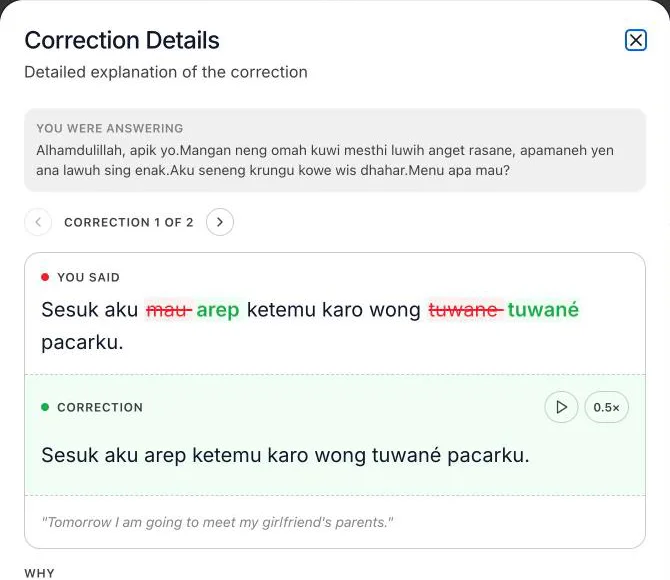
Why?Mau is Indonesian. In Javanese, for something you’re going to do, it’s arep: aku arep ketemu, I’m going to meet.
An illustration of the conversation screen, rebuilt for this page with Javanese text.
The short answer
Javanese sits in the middle of our difficulty ranking: 48th of the 67 for English speakers, harder than Indonesian. The tricky part is the speech levels: different words for friends and for your partner’s parents. And almost no AI speaking apps teach it. Speak, Langua, Praktika, Babbel and Busuu don’t, and Duolingo has no Javanese course at all. Talkpal lists it, and Ling and uTalk have beginner courses.
Here’s our honest take. Pick Teacher AI if you want to get fluent, not just practice. You get lots of real conversation with two teachers from Java, who talk ngoko and switch to krama when you ask, and a Why? on every correction, like an Indonesian word that slipped in. Plus Javanese videos and stories at your level, and we track every word you learn. Pick Talkpal for a cheaper AI chat, though its pages say nothing about the speech levels.
Starting from zero? Teacher AI works best for Javanese from about A2. Learn the basics with Ling or uTalk first, which both have Javanese courses.
Best for getting fluent: input, speaking and trackingTeacher AITalk about anything, for as long as you like, with teachers from Java, and every mistake explained, speech levels included. Grow your Javanese with videos and stories at your level, and watch your active and passive words climb. Web, iPhone and Android, $149 a year.
Cheaper, with open AI chatTalkpalJavanese is one of its 130+ languages, with chat, calls and roleplays. $119.99 a year, or 10 minutes a day for free. Its pages don’t mention ngoko or krama.
A step-by-step Javanese courseLingA Javanese course with dialogues and native audio, on iPhone and Android. $89.99 a year, and some lessons are free.
Your first Javanese wordsuTalkOver 2,500 words and phrases, to about A1 to A2. Record yourself and compare with a native speaker. Free starter words.
A fluency system, built by polyglots
Teacher AI isn’t a chatbot with a language menu. It’s a fluency system, built by some of the most accomplished polyglots and language teachers around. People who learned many languages themselves, and know what actually gets you speaking.
Arieh Smith
Xiaoma · the world’s most viral polyglot
Lucas Bighetti
One of the world’s best polyglots · speaks 20+ languages
Olly Richards
Author · 2M+ books sold · StoryLearning founder
Jan van der Aa
Runs the leading network for online language entrepreneurs
“I’ve tried lots of this type of app. This is the best one. It feels like it’s created by someone who understands language learning.”
Jcalebmi, App Store review, October 2026
What you need to practice speaking Javanese
Javanese sits in the middle. In our ranking of 67 languages, it’s the 48th hardest for English speakers, at 4,553 effort points. That’s a bit more than German (4,255), and about 1,200 points more than Indonesian (3,327). Most of those points are vocabulary.
No tenses, no genders, and you read it in Latin letters. What makes Javanese harder than it looks is who you’re talking to. The same question takes different words with a friend and with your partner’s mother.
Ngoko, krama and krama inggilJavanese has speech levels. “Have you eaten?” is Kowé wis mangan? to a friend, in ngoko. To someone you don’t know well, in krama: Sampeyan sampun nedha? And to your partner’s father, in krama inggil: Panjenengan sampun dhahar? The rule that trips learners up: krama inggil words honor the other person, so you never use them about yourself. Meeting the in-laws? That’s krama, and you want to have practiced it before the visit, not during it.
Not just a dialect of IndonesianIf you speak Indonesian, the grammar feels familiar. The words often don’t. Tidak is ora, rumah is omah, makan is mangan, pergi is lunga. Endings change too: rumahnya, his house, is omahé. So Aku ora ngerti, I don’t understand, is a sentence an Indonesian speaker from Jakarta may not follow.
Spelled a, said oIn Yogyakarta and Solo, an a at the end of a word usually sounds like an o, and often the one before it too. Apa, what, is said “opo”. Jawa is “Jowo”, mangga is “monggo”. And dh and th are sounds of their own: wedi is afraid, wedhi is sand. In Surabaya you’ll also hear a blunter East Java style, with koen for you and rek at the end of a sentence.
Javanese and Indonesian, in one sentenceIn Java, most people speak both, and switch all the time. Javanese at home and with old friends, Indonesian at work, at school and on TV. A mother might say Ayo mangan sik, nanti telat lho: come and eat first, or you’ll be late. It starts in Javanese and ends in Indonesian. And the moment they hear a foreigner, most people switch to Indonesian, kindly meant. So the Javanese practice has to come from somewhere.
Lots of Javanese you understandSpeaking activates the words you have. New words come from input: Javanese videos, podcasts and texts where you already understand most of it. That’s also where you hear how people at home really talk.
Lots of speaking timeJavanese sits in the middle of the difficulty ranking, and many everyday words come in two or three forms. That takes hours of talking. A few minutes a day won’t get you there.
A complete fluency system, not just a speaking app
Our speaking practice is the heart of Teacher AI. But speaking alone won’t make you fluent, and neither will input alone. You need both, and you need to see it working.
So Teacher AI is a complete fluency system. Input grows your Javanese. Speaking activates it. And we track every word along the way, to get you to real fluency as fast as we can.
Step 1Input grows your vocabularyWatch Javanese YouTube videos and podcasts, and read stories written at your level. You always see how much you already understand, and every word you tap becomes a flashcard. How Watch and Read work.
Step 2Speaking activates itKnowing a word isn’t the same as using it, at the right speech level, without an Indonesian word slipping in. Talking with your teacher, for as long as you like, is how words move from “I know that one” to “I just said it”. Every mistake gets fixed, with a Why?.
Step 3We track every wordYour passive words are the ones you understand when you read or hear them. Your active words are the ones you’ve used yourself. You see both grow, how your time splits between input and output, and how many words to your next level.
Brand new to Javanese? Start somewhere else first. Teacher AI works best from about A2, once you can handle simple everyday sentences. Before that, you just don’t have enough words yet for open conversation. So learn the basics with the Ling app or uTalk, which both have Javanese courses, and come back when you want to talk. Speak Indonesian already? You’ll get to A2 faster, but you still need the basic words first.
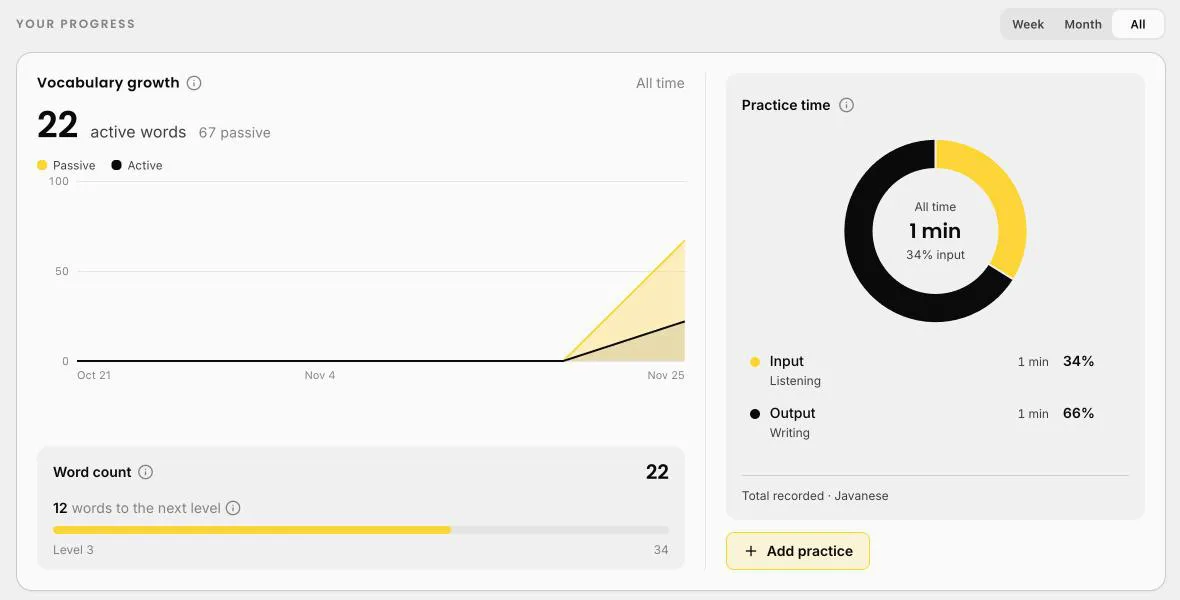
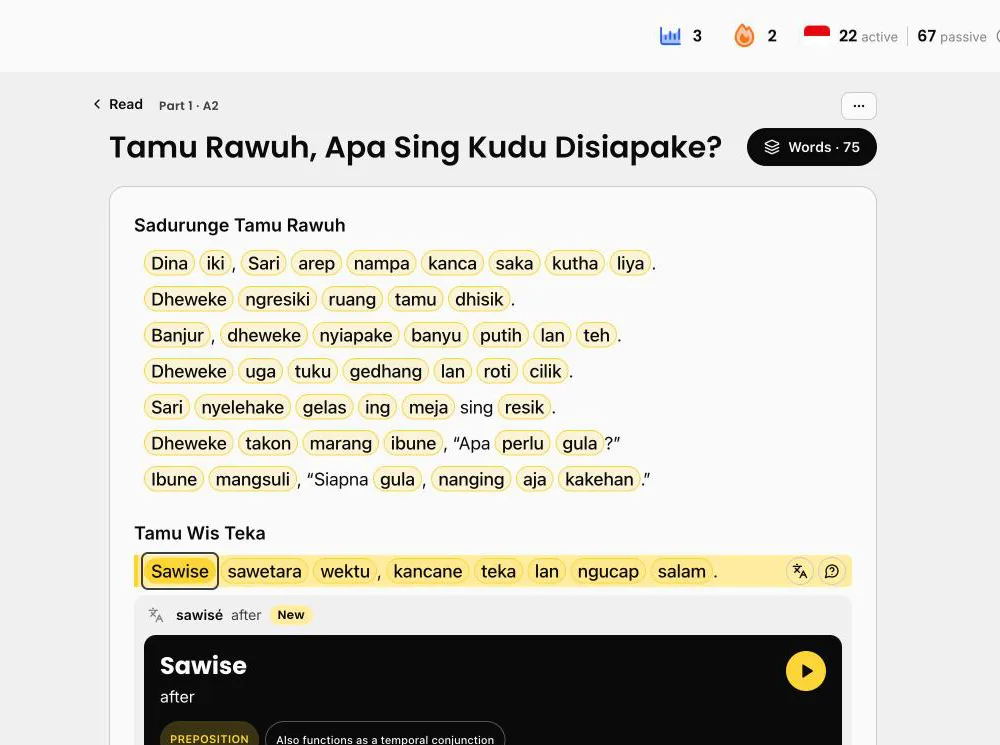
Your progress, in words22 Javanese words used, 67 understood, after one chat and a story. You see your active and passive words grow, the words to your next level, and your practice time split into input and output.
What it looks like in Javanese
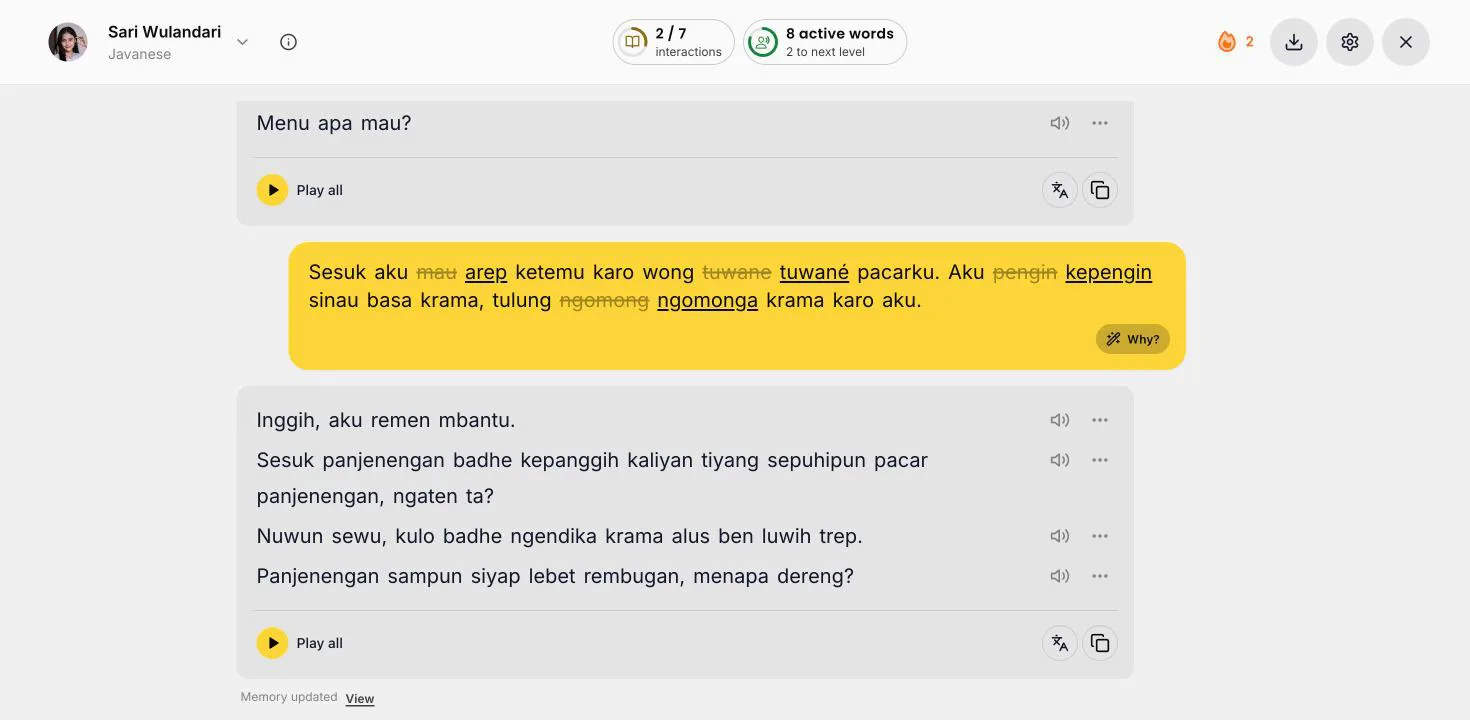
Here’s what a moment of practice looks like. You answer, your teacher replies, and if you made a mistake, your sentence gets fixed right there.
A card for every word you tap
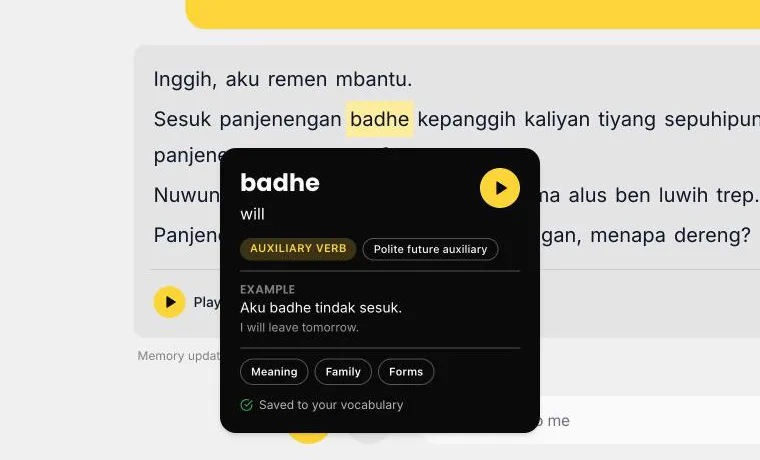
Tap any word, in a conversation, a video or a story, and you get its card: what it means, what kind of word it is, and an example with a translation. Tap play to hear it.
mangga
please, go ahead (polite)
EXPRESSION
ExampleMangga pinarak. Please, come in and sit down.
Good to knowSaid “monggo”. A false friend if you speak Indonesian, where mangga is a mango. In Javanese, a mango is pelem.
inggih
yes (polite)
EXPRESSION
ExampleInggih, Bu. Yes, ma’am.
Good to knowUsually shortened to nggih. It’s the krama yes. With friends, it’s iya. And a polite nggih can mean “I hear you” rather than “I agree”.
ewuh pakewuh
feeling too awkward to say no, out of respect
EXPRESSION
ExampleAku ewuh pakewuh nolak tawarané. I feel too awkward to turn down his offer.
Good to knowThere’s no one English word for it. It’s why a Javanese “yes” to an elder or a boss isn’t always a yes.
An illustration of three word cards, rebuilt for this page. On the real card, the wording depends on the word. Below: real screenshots of the web app.
Corrected while you talkYou tell Sari you’re meeting your partner’s parents tomorrow and ask her to talk krama. The Indonesian mau becomes arep, and she switches to krama.Tap Why?You see what you said, the fixed sentence, a translation and why: arep for mau, and the é in tuwané. You can save it as a flashcard.Tap any wordTap badhe in Sari’s krama and you get will, marked as the polite future word, with an example and a translation.
Meet your Javanese teachers
Two teachers from Java: Agus from Yogyakarta, the city of the sultan’s palace and the gamelan, and Sari. Each has their own voice. They talk everyday ngoko, like friends do. Ask for krama and they switch, so you can practice for your partner’s parents too.
Agus Santoso
Yogyakarta · Indonesian
Sari Wulandari
Java · Indonesian
Input: Javanese to watch and read, at your level
Here’s the input side up close. New words come from lots of Javanese you hear and read, where you already understand most of it.
Watch and Read are on the web app for now. Words you read along with, without tapping, count toward your passive words. Every word you tap lands in your flashcards. And when you’re done, you talk about it with your teacher.
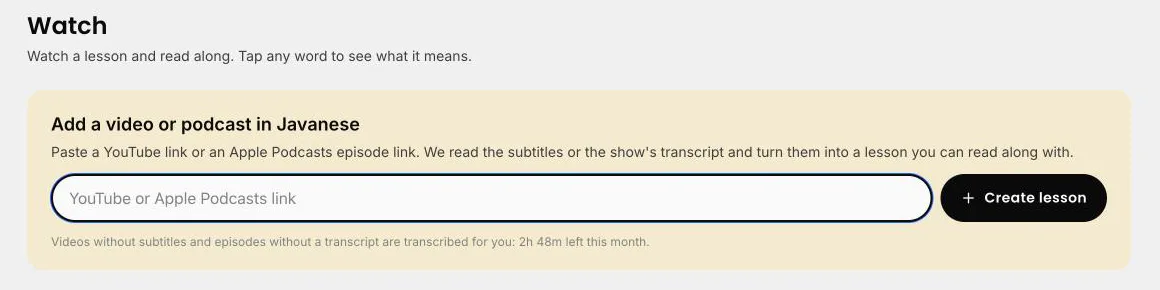
Any YouTube videoPaste a link to a Javanese YouTube video, or an Apple Podcasts episode. We turn it into a page you read along with, new words in yellow. No subtitles? On a paid plan we transcribe it for you, within a monthly allowance. Vlogs and comedy sketches from Yogyakarta, Solo or Surabaya are where you hear Javanese the way the family talks, Indonesian words and all. One catch: YouTube labels many Javanese videos as Indonesian, and Watch won’t take those, so finding one can take a few tries.
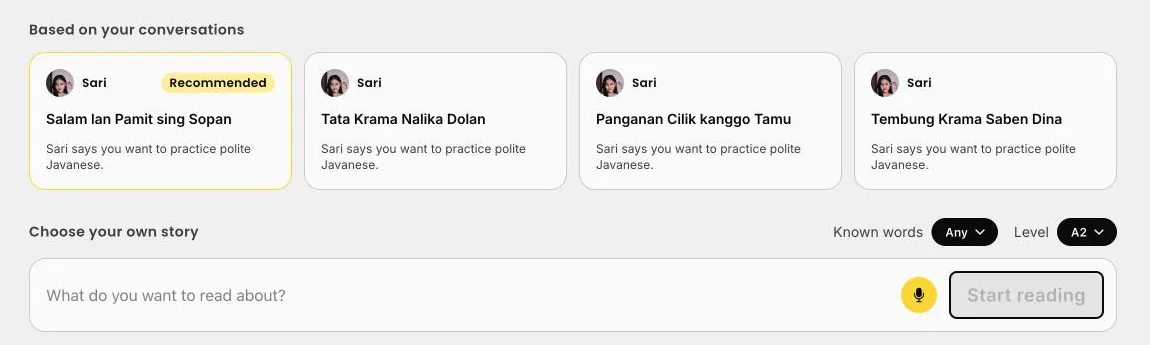
Stories written for youRead writes Javanese texts at your level, from A1 to Native, about anything you like, and suggests ideas from what you talk about with your teacher.
How much you know, before you startTeacher AI keeps a list of every Javanese word you’ve met: the ones you use when you talk, the ones you read or hear, the ones you tap. It checks every word of a video or text against that list and shows you the share you already know.
The 80% rulePick videos and texts where you know 80% or more of the words. Then your brain fills in the rest from context. Under 70% is too much for now. 90% and up is easy and fun.
Then talk about itOne tap on Talk about this starts a conversation about what you just watched or read. Retelling it is how new words become words you can say.
Paste a Javanese videoPaste a link to a Javanese YouTube video or podcast and it becomes a lesson. No subtitles? On a paid plan we transcribe it, within a monthly allowance. Videos YouTube labels as Indonesian won’t go in.Ideas to read aboutRead suggests things to read about: polite greetings and goodbyes, manners when you visit, snacks for guests and everyday krama words. Or type your own topic.A story at your levelTamu Rawuh, Apa Sing Kudu Disiapake?, guests are coming, what do we get ready?, at A2. New words are in yellow, and one tap shows what a word means. The story itself is in everyday ngoko.
Teacher AI or Duolingo?
Lots of people look for Javanese on Duolingo first. It isn’t there: Duolingo has no Javanese course, from English or from any other language. It does teach Indonesian. Here’s how the two compare for Javanese, from Duolingo’s own pages.
Duolingo
Teacher AI
Javanese course
None, from any language.
Yes, from about A2, with two teachers from Java.
Open conversation
No Javanese, so no Video Call or Roleplay in Javanese.
Unlimited on a paid plan, by voice or text, or hands-free in a call.
Speech levels
Not taught.
Your teacher talks ngoko, or krama when you ask, and fixes the Indonesian words that slip into your sentences.
Starting from zero
Not in Javanese. Its free Indonesian course starts at the beginning.
No. For Javanese, Teacher AI works best from about A2.
Where it works
iPhone, Android and web. Video Call and Roleplay only in the app.
iPhone, Android and web, conversations included.
Price (US)
Every course is free, with ads. Super Duolingo: $9.99 to $119.99 on the US App Store.
Start free on the website. Unlimited conversation: $149 a year on the web.
Need Indonesian in Java too? Duolingo’s free Indonesian course is a good way to start that, and our Indonesian guide covers the rest. For Javanese, once you reach about A2 and want to talk, that’s what Teacher AI is built for.
The apps side by side
Feature
Teacher AI
Talkpal
Ling
uTalk
Duolingo
Teaches this language
Yes, from about A2, with 2 teachers from Java.
Yes, one of its 130+ languages.
Yes, a Javanese course.
Yes, 2,500+ words and phrases in 60+ topics, to about A1 to A2.
No course for English speakers. No Javanese course from any language.
Open conversation
Unlimited on a paid plan, by voice or text, or hands-free in a call. Free plan: one conversation.
Chat, audio-only Call Mode and roleplays. Unlimited on Premium.
Dialogues and role-play scenarios in the app. Its AI Tutor is Thai only.
No AI conversation on its pages. Games with native-speaker audio.
No Javanese course, so no Video Call or Roleplay in Javanese.
Corrections
During the conversation: your message is marked up, and Why? explains each fix.
“Personalized feedback”, its Javanese page says. Nothing on ngoko or krama.
Not stated for Javanese.
Not stated.
No Javanese course.
Pronunciation help
Replay your recording next to a native speaker saying the same line. No pronunciation score.
Says it gives feedback on pronunciation, intonation and rhythm. Its Sentence Mode score is for selected languages, and doesn’t say if Javanese is one.
Native audio. Whether Javanese has its voice-recognition speaking game: not stated.
Record yourself copying a native speaker and compare the two.
No Javanese course.
Reading aid for the script
Not needed. Everyday Javanese is written in Latin letters, and é or è are optional, so any keyboard works.
€34.99/year or €5.99/month on its Javanese plans page. US App Store: $10.99 a month.
Super Duolingo: $9.99 to $119.99 on the US App Store, which doesn’t say which is monthly or yearly.
Free option
Start free on the website, no credit card.
10 minutes a day, free. 14-day trial, no payment up front.
Some lessons. 7-day trial on the yearly plan.
Free starter words. A 28-day money-back guarantee.
Every course is free, with ads. None in Javanese.
Scroll the table sideways to see every app.
The apps, one by one
Teacher AI
Best for getting fluent: input, speaking and tracking
Speaking
Unlimited on a paid plan. Pick a conversation starter at your level, talk about anything in Free Talk, try a roleplay, like meeting your partner’s parents, or switch to hands-free and just talk.
Teachers
Two for Javanese: Agus from Yogyakarta, and Sari, both from Java.
Speech levels
Your teacher talks ngoko by default and switches to krama when you ask. Its krama isn’t always pure, and in our test a krama inggil word used about yourself slipped through.
Corrections
Your own sentence is fixed while you talk, and Why? explains it: an Indonesian word that slipped in, like mau for arep or di for wonten.
Progress
Your active and passive words, your practice time split into input and output, and 100 levels with the matching CEFR level.
Watch and Read
Turn a Javanese YouTube video or podcast into a lesson (no subtitles? we transcribe it on a paid plan), and read stories at your level. Both show the share of words you already know. On the web app.
Not so good
Not for complete beginners: for Javanese, it works best from about A2, so learn the basics with Ling or uTalk first. And there’s no pronunciation score.
Talkpal
Cheaper, with open AI chat
Javanese
One of its 130+ languages, with its own Learn Javanese page. Chat, audio-only Call Mode and roleplays with an AI tutor.
Strengths
Feedback on your pronunciation, intonation and rhythm, its Javanese page says. On the web and on your phone. 10 minutes a day for free.
Not stated
Anything Javanese-specific: its Javanese page doesn’t mention ngoko or krama. Nor whether its pronunciation score (Sentence Mode, “available for selected languages”) covers Javanese.
Price
$119.99 a year or $19.99 a month on the US App Store, with a 14-day trial.
Ling
A step-by-step Javanese course
Javanese
One of the 80 languages in the Ling app, with lessons that start from pronunciation, essential words and greetings, built by native speakers, its Javanese page says.
Speaking
Dialogues and role-play scenarios with native audio. Its pages don’t say whether Javanese has its speaking game with voice recognition, and its AI Tutor is Thai only.
Not stated
Ngoko or krama: its Javanese page doesn’t mention the speech levels.
Price
$89.99 a year, $64.99 for 6 months or $16.99 a month on its website. Some lessons are free.
uTalk
Your first Javanese words
Course
Over 2,500 Javanese words and phrases in 60+ topics, from First Words up, to about A1 to A2, its Javanese page says.
Speaking
Listen to native Javanese speakers, record yourself copying them and compare the two. No AI conversation on its pages.
Good to know
Its page says different words are used with older and younger people, but doesn’t name ngoko or krama.
Price
€34.99 a year or €5.99 a month on its Javanese plans page. $10.99 a month on the US App Store. Free starter words.
Duolingo
No Javanese course
Course
None. Duolingo has no Javanese course at all, not even for Indonesian speakers.
Speaking
No course, so no Video Call or Roleplay in Javanese.
Good to know
Its Indonesian course (1.26 million learners) is a good start if you’ll need both languages in Java. Then see our Indonesian guide.
Where another app might suit you better
Speak Indonesian, and want the speech levels and the script explained in Indonesian? PBJ Komplit, a small app on the US App Store with no ratings yet ($2.99), covers ngoko, madya and krama inggil, an introduction to aksara Jawa, and an AI chat tutor called Joko that runs on your phone. Its interface is in Indonesian and Javanese, not English, and it doesn’t describe any speaking practice.
Living in Yogyakarta? Look at what’s on your doorstep. Wisma Bahasa, a language school there, lists Javanese among its programs. Its pages don’t give levels, prices or whether Javanese is taught online too, so ask. A human teacher is a great way to get krama ready for a family visit, and we love that.
Memrise has no official Javanese course, only word lists made by other users.
And if you’re looking at Speak, Langua, Praktika, Babbel, Busuu, Pimsleur or Mondly: none of them teaches Javanese.
What’s the best app to practice speaking Javanese?
For getting fluent, Teacher AI: talk about anything for as long as you like, with two teachers from Java, and a Why? on every correction, speech levels included. Plus Javanese videos and stories at your level, and every word you learn tracked. Very few AI speaking apps teach Javanese at all. Talkpal does, and it’s cheaper.
Is Javanese hard to learn?
It’s in the middle. In our ranking of 67 languages, Javanese is the 48th hardest for English speakers, at 4,553 effort points: a bit more than German (4,255), and well above Indonesian (3,327). There are no tenses and no genders, and you read it in Latin letters. The work is the vocabulary, the speech levels, and the sounds, like the a that’s said as an o.
Should I learn ngoko or krama first?
It depends on who you’ll talk to. Ngoko is for friends, people your age and younger, and inside a close family. Krama is for people you don’t know well and for older people, and krama inggil for words about the person you honor. Meeting a partner’s parents? Learn the krama basics early: nggih, sampun, matur nuwun, nyuwun pangapunten. Don’t panic about getting it all right. Plenty of younger Javanese aren’t sure of every krama inggil word either, and a learner who tries is usually welcomed warmly.
I speak Indonesian. How much does that help?
A lot with the grammar, less with the words. Sentences are built in a similar way, and you’ll recognize some words. But many everyday words are different: ora for tidak, omah for rumah, lunga for pergi. And some look the same and aren’t: in Javanese, mangga means please, not mango. The good news: in Java people mix the two all the time, so your Indonesian is never wasted.
Do I need to learn the Javanese script?
Not to talk. Everyday Javanese, in messages, newspapers and song lyrics, is written in Latin letters, and that’s what you’ll see in Teacher AI. The Javanese script, aksara Jawa or hanacaraka, is taught in school and you’ll see it on street signs in Yogyakarta and Solo. Learning it is fun, and great for gamelan and wayang fans, but you can start speaking without it.
Can I learn Javanese on Duolingo?
No. Duolingo has no Javanese course, from English or from any other language. It does teach Indonesian, which is useful in Java too. On Teacher AI you can practice spoken Javanese from English.
Can a complete beginner use Teacher AI for Javanese?
Not really. For Javanese, Teacher AI works best from about A2, once you can handle simple everyday sentences. Before that, you just don’t have enough words yet for open conversation. Starting from zero? Learn the basics with Ling or uTalk, which both have Javanese courses, then come here to talk. (Spanish and French are different: they have a beginner track from zero.)
Is Teacher AI only for speaking?
No. It’s a complete fluency system. Speaking is how you activate your Javanese. On the web app you also grow it: turn a Javanese YouTube video or podcast into a lesson, and read stories at your level. And Teacher AI tracks the words you understand and the words you use, so you see your progress in real numbers.
Is Teacher AI better than Duolingo for speaking Javanese?
Duolingo doesn’t teach Javanese at all, so for Javanese, yes. Teacher AI is built around conversation, unlimited on a paid plan, on the web and on your phone. If you’ll need Indonesian in Java too, Duolingo’s free Indonesian course is a good place to start that one.