Latvian · With teachers from Riga, and every long vowel and case ending fixed
The best AI apps to practice speaking Latvian
Updated November 15, 2026. We checked every other app on its own website, help pages and app store page. See the sources.
We built Teacher AI, so of course we’re biased. That’s why we link every claim we make about another app, and tell you plainly when another app suits you better.
Ko tu darīji nedēļas nogalē?What did you do at the weekend?
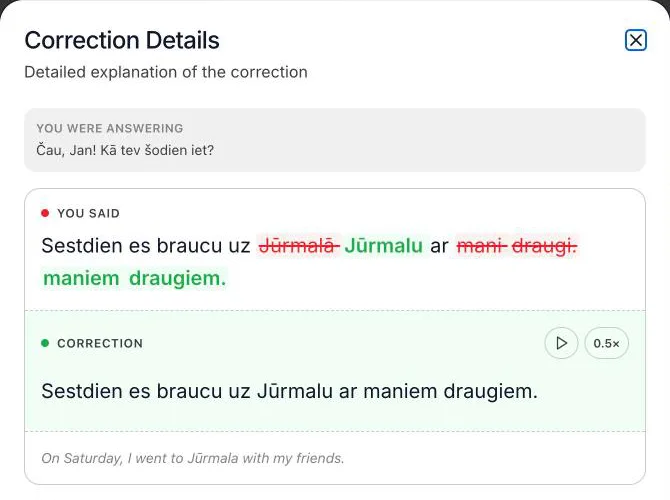
Sestdien es braucu uz Jūrmalā Jūrmalu ar mani draugi maniem draugiem.On Saturday I went to Jūrmala with my friends.
2 small fixesWhy?
Why?Uz, meaning “to”, takes the accusative in the singular: uz Jūrmalu. Jūrmalā means “in Jūrmala”. And in the plural, every preposition takes the dative, so “with my friends” is ar maniem draugiem.
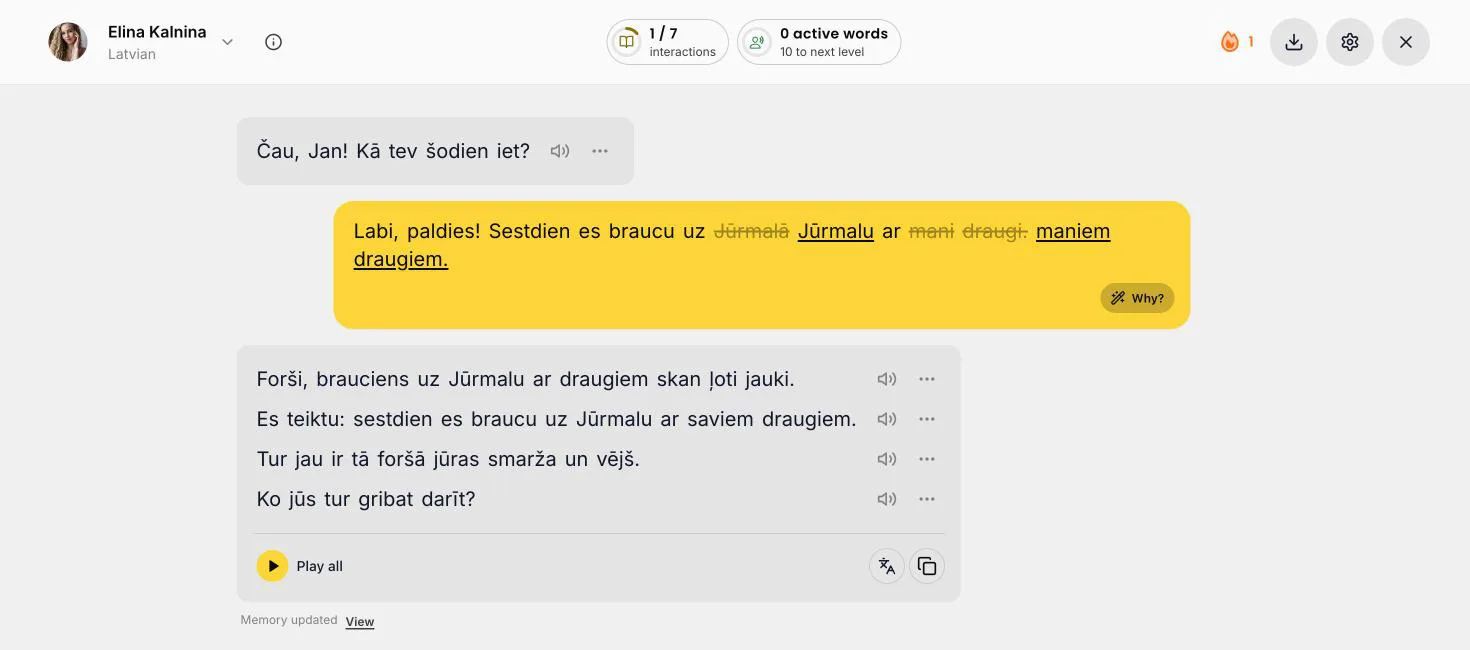
An illustration of the conversation screen, rebuilt for this page with Latvian text.
The short answer
Latvian is in the middle of our difficulty ranking: 35th of 67 for English speakers, a bit easier than Lithuanian, its only living cousin. But very few AI speaking apps teach it. Speak, Langua, Praktika, Babbel and Busuu don’t, and Duolingo and Pimsleur have no Latvian course for English speakers. Talkpal has open AI chat in Latvian. Ling and Mondly have courses.
Here’s our honest take. Pick Teacher AI if you want to get fluent, not just practice. You get lots of real conversation with Andris or Elina, both from Riga, and a Why? on every correction, from uz Jūrmalu to ar maniem draugiem. Plus Latvian videos and stories at your level, and we track every word you learn. Pick Talkpal for a cheaper AI chat, and Ling for game-style lessons.
Starting from zero? Teacher AI works best for Latvian from about A2. Learn the basics with Ling first.
Best for getting fluent: input, speaking and trackingTeacher AITalk about anything, for as long as you like, with teachers from Riga, and every mistake explained. Grow your Latvian with videos and stories at your level, and watch your active and passive words climb. Web, iPhone and Android, $149 a year.
Cheaper, with open AI chatTalkpalLatvian is one of its 130+ languages, with chat, calls and roleplays. $119.99 a year, or 10 minutes a day for free. Its pages don’t say anything Latvian-specific.
Best for game-style lessons from zeroLingA Latvian course with dialogues and role-play scenarios, and speaking lessons on Android and the web, not on iPhone. $89.99 a year, and the first 2 units are free.
A fluency system, built by polyglots
Teacher AI isn’t a chatbot with a language menu. It’s a fluency system, built by some of the most accomplished polyglots and language teachers around. People who learned many languages themselves, and know what actually gets you speaking.
Arieh Smith
Xiaoma · the world’s most viral polyglot
Lucas Bighetti
One of the world’s best polyglots · speaks 20+ languages
Olly Richards
Author · 2M+ books sold · StoryLearning founder
Jan van der Aa
Runs the leading network for online language entrepreneurs
“I’ve tried lots of this type of app. This is the best one. It feels like it’s created by someone who understands language learning.”
Jcalebmi, App Store review, October 2026
What you need to practice speaking Latvian
Most people learning Latvian have a reason. They live in Riga, or they’re moving there. They married into a Latvian family. Or their grandparents spoke it at home, and they want it back.
Latvian sits in the middle of our ranking of 67 languages: the 35th hardest for English speakers, at 5,275 effort points. That’s nearly twice what Spanish takes (2,941), more than German (4,255), and less than Lithuanian (6,037) or Russian (6,067).
Latvian and Lithuanian are the last two living Baltic languages. They’re cousins, not twins: lots of shared roots, but you can’t just listen to one and follow the other. Latvian changed more: shorter endings, and the stress up front. What makes it hard is the long vowels, the endings and a few constructions English has nothing like, at full speed, in a real conversation.
Long vowels that change the wordThe line over a vowel, in ā, ē, ī and ū, makes it long, and a long vowel is a different word. Kazas are goats. Kāzas is a wedding. A lapa is a leaf, a lāpa is a torch. So you need to hear the difference, say it, and type it.
Stress on the first syllableAlmost every Latvian word is stressed on its first syllable: Latvija is LAT-vi-ja, Jūrmala is JŪR-ma-la. English speakers tend to put it on the second. And a long vowel stays long even without the stress, like the last ā in Rīgā, in Riga.
Seven cases, your name includedEndings change with the job of the word. You live Rīgā, go uz Rīgu and come no Rīgas. In the plural, every preposition takes the dative: ar draugu, with a friend, but ar draugiem, with friends. Even foreign names get Latvian endings. John Smith is Džons Smits, and if you’re with him, you’re ar Džonu Smitu.
“To me must-go”Latvian says “I have to go” with a special form, the debitive: man jāiet, literally “to me must-go”. The person goes in the dative, the verb gets jā-, and it doesn’t change with the person: man jāiet, tev jāiet, mums jāiet. And the thing you must do stays in its basic form: man jāpērk maize, I have to buy bread, not maizi. Having and liking work the same way: man ir, I have, and man patīk, I like.
Lots of Latvian you understandSpeaking activates the words you have. New words come from input: Latvian videos, podcasts and texts where you already understand most of it.
Lots of speaking timeLatvian takes more hours than the easiest languages, and most of them should be spent talking. In Riga, lots of people switch to English the moment you hesitate. So you need somewhere you can keep going in Latvian.
A complete fluency system, not just a speaking app
Our speaking practice is the heart of Teacher AI. But speaking alone won’t make you fluent, and neither will input alone. You need both, and you need to see it working.
So Teacher AI is a complete fluency system. Input grows your Latvian. Speaking activates it. And we track every word along the way, to get you to real fluency as fast as we can.
Step 1Input grows your vocabularyWatch Latvian YouTube videos and podcasts, and read stories written at your level. You always see how much you already understand, and every word you tap becomes a flashcard. How Watch and Read work.
Step 2Speaking activates itKnowing a word isn’t the same as using it, with the long vowel in the right place, the right case ending, and man where English says “I”. Talking with your teacher, for as long as you like, is how words move from “I know that one” to “I just said it”. Every mistake gets fixed, with a Why?.
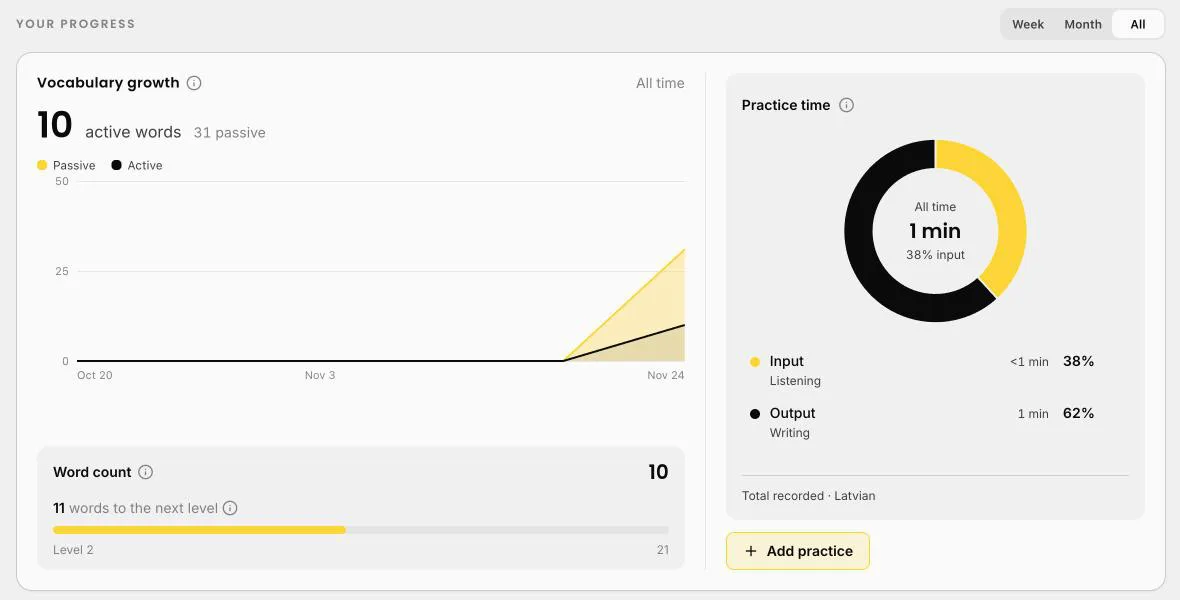
Step 3We track every wordYour passive words are the ones you understand when you read or hear them. Your active words are the ones you’ve used yourself. You see both grow, how your time splits between input and output, and how many words to your next level.
Brand new to Latvian? Start somewhere else first. Teacher AI works best from about A2, once you can handle simple everyday sentences. Before that, you just don’t have enough words yet for open conversation. Duolingo and Pimsleur don’t teach Latvian, so learn the basics with the Ling app, or the A1 self-study course from the Latvian Language Agency, and come back when you want to talk.
Your progress, in words10 Latvian words used, 31 understood, after one chat, a one-minute video and a story. You see your active and passive words grow, the words to your next level, and your practice time split into input and output.
What it looks like in Latvian
Here’s what a moment of practice looks like. You answer, your teacher replies, and if you made a mistake, your sentence gets fixed right there.
A card for every word you tap
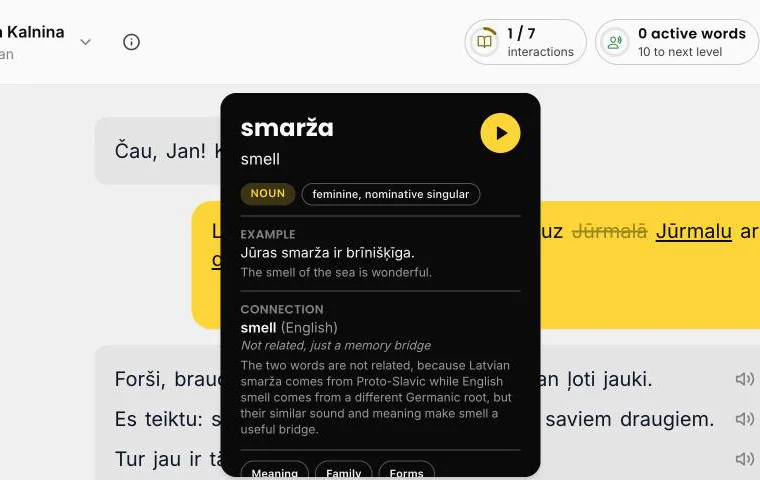
Tap any word, in a conversation, a video or a story, and you get its card: what it means, what kind of word it is, and an example with a translation. Its family and its forms are one tap away. Tap play to hear it.
kāzas
wedding
NOUN
ExampleSestdien mēs ejam uz kāzām. On Saturday we’re going to a wedding.
Good to knowAlways plural, like “scissors”. And mind the line over the ā: without it, kazas are goats.
Jāņi
Midsummer, the festival on June 23 and 24
NOUN
ExampleKo tu dari Jāņos? What are you doing for Midsummer?
Good to knowLatvia’s biggest holiday, named after Jānis, John. Every Jānis celebrates his name day on June 24. The night before is Līgo, with bonfires, songs, and wreaths of oak leaves and flowers.
sveiks
hi, bye
INTERJECTION
ExampleSveika, Anna! Kā iet? Hi, Anna! How’s it going?
Good to knowIt means “healthy”, so it changes like an adjective: sveiks to a man, sveika to a woman, sveiki to a group.
An illustration of three word cards, rebuilt for this page. On the real card, the wording depends on the word. Below: real screenshots of the web app.
Corrected while you talkYou tell Elina you’re driving to Jūrmala with friends on Saturday. Uz Jūrmalā becomes uz Jūrmalu, and ar mani draugi becomes ar maniem draugiem. Then she asks what you’ll do there.Tap Why?Going somewhere takes uz with the accusative, uz Jūrmalu, and “with my friends” is ar maniem draugiem. You see what you said, the fixed sentence, a translation and why, and you can save it as a flashcard.Tap any wordTap smarža and you get smell, its gender and case, an example, and a memory bridge to English smell, marked as not related.Two Latvian teachersElina and Andris, both from Riga, each with their own voice. Your chat history stays when you switch.
Meet your Latvian teachers
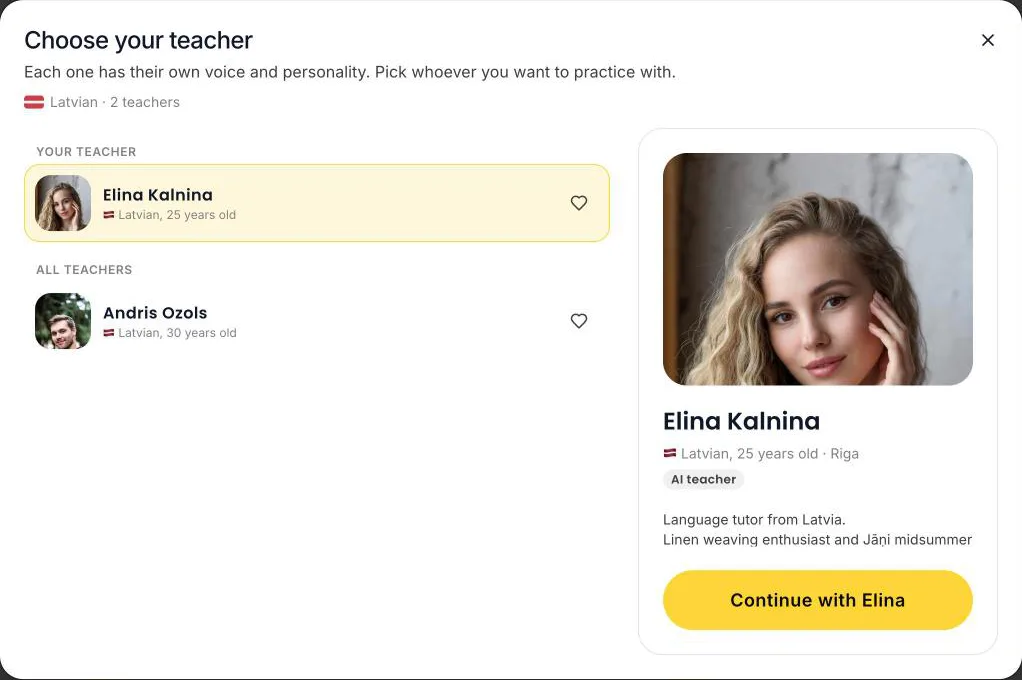
Two teachers, both from Riga: Andris and Elina. Each has their own voice. Pick the one you like, and switch whenever you want.
Andris Ozols
Riga · Latvian
Elina Kalnina
Riga · Latvian
Input: Latvian to watch and read, at your level
Here’s the input side up close. New words come from lots of Latvian you hear and read, where you already understand most of it.
Watch and Read are on the web app for now. Words you read along with, without tapping, count toward your passive words. Every word you tap lands in your flashcards. And when you’re done, you talk about it with your teacher.
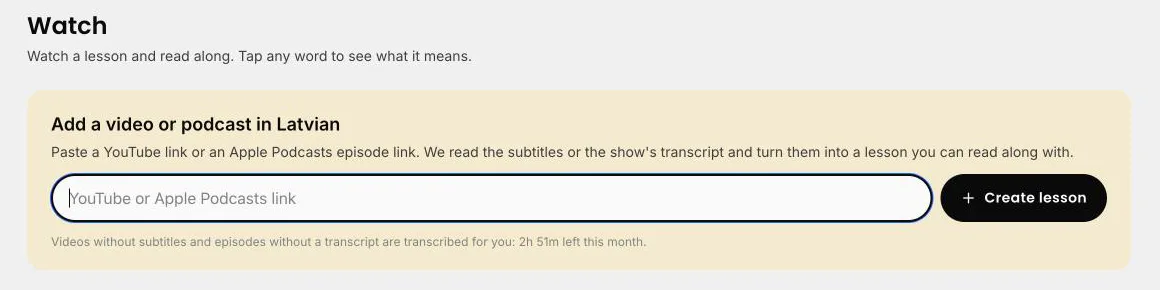
Any YouTube videoPaste a link to a Latvian YouTube video, or an Apple Podcasts episode. We turn it into a page you read along with, new words in yellow. No subtitles? On a paid plan we transcribe it for you, within a monthly allowance.
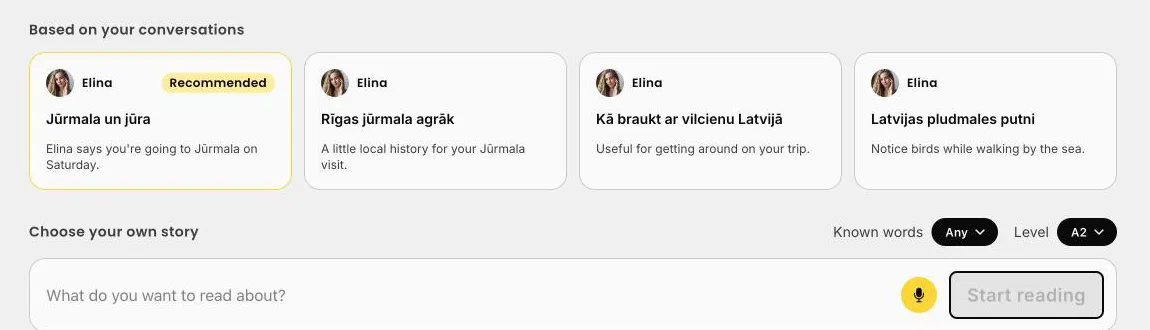
Stories written for youRead writes Latvian texts at your level, from A1 to Native, about anything you like, and suggests ideas from what you talk about with your teacher.
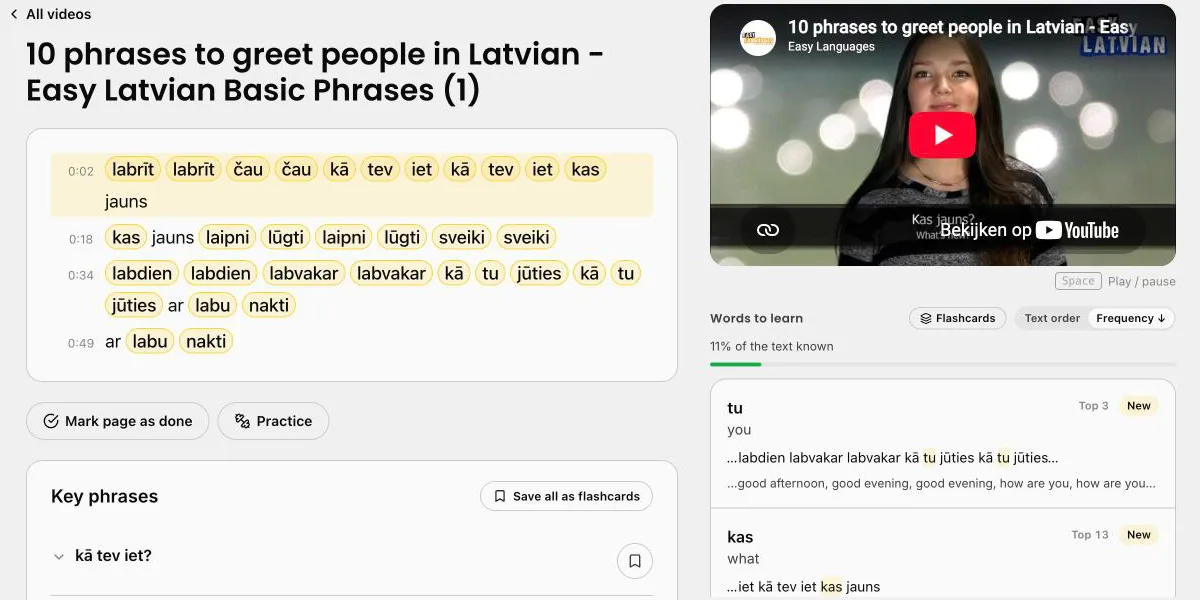
How much you know, before you startTeacher AI keeps a list of every Latvian word you’ve met: the ones you use when you talk, the ones you read or hear, the ones you tap. It checks every word of a video or text against that list and shows you the share you already know.
The 80% rulePick videos and texts where you know 80% or more of the words. Then your brain fills in the rest from context. Under 70% is too much for now. 90% and up is easy and fun.
Then talk about itOne tap on Talk about this starts a conversation about what you just watched or read. Retelling it is how new words become words you can say.
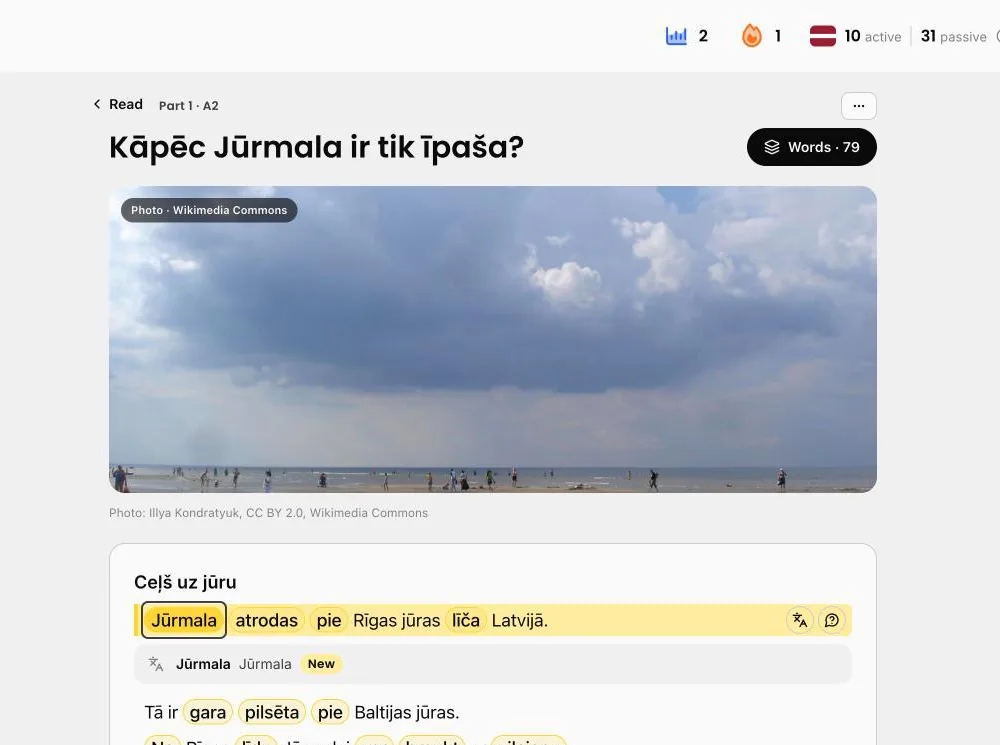
Paste any Latvian videoPaste a link to a Latvian YouTube video or podcast and it becomes a lesson. No subtitles? On a paid plan we transcribe it, within a monthly allowance.Any video becomes a lessonTen ways to say hello, from Easy Latvian, as a lesson. The transcript follows the video, new words in yellow, the words worth learning come with an example, and the key phrases save as flashcards in one tap.Ideas from your conversationsYou told Elina about your trip to Jūrmala. So Read suggests Jūrmala and the sea, a little history of the Riga seaside, taking the train in Latvia and the birds on its beaches.A story at your levelKāpēc Jūrmala ir tik īpaša?, why is Jūrmala so special?, at A2, with a photo of the beach. New words are in yellow, and one tap shows what a word means.
Teacher AI or Duolingo?
Lots of people look for Latvian on Duolingo first. It isn’t there. Duolingo’s list of courses for English speakers has no Latvian, and no Lithuanian either. Here’s how the two compare, from Duolingo’s own pages.
Duolingo
Teacher AI
Teaches Latvian
No course for English speakers.
Yes, from about A2. Your teacher can explain in English, or switch to your own language.
Open conversation
No Latvian course, so no Video Call or Roleplay in Latvian.
Unlimited on a paid plan, by voice or text, or hands-free in a call.
Teachers
Duolingo’s own characters, in its other courses.
Two from Riga, each with their own voice: Andris and Elina.
Starting from zero
Not in Latvian.
No. For Latvian, Teacher AI works best from about A2. Start with the Ling app.
Where it works
iPhone, Android and web. Video Call and Roleplay only in the app.
iPhone, Android and web, conversations included.
Price (US)
Every course is free, with ads. Super Duolingo: $9.99 to $119.99 on the US App Store.
Start free on the website. Unlimited conversation: $149 a year on the web.
Love your Duolingo streak? Keep it, in another language. For Latvian, learn the basics with the Ling app or the A1 course on valoda.lv. Once you reach about A2 and want to talk, that’s what Teacher AI is built for.
The apps side by side
Feature
Teacher AI
Talkpal
Ling
Duolingo
Teaches this language
Yes, from about A2, with 2 teachers, both from Riga.
Yes, one of its 130+ languages.
Yes, a Latvian course, from the basics to advanced topics.
No course for English speakers.
Open conversation
Unlimited on a paid plan, by voice or text, or hands-free in a call. Free plan: one conversation.
Chat by writing or speaking, Call Mode and roleplays. Unlimited on Premium.
Dialogues and role-play scenarios in the app. Its AI Tutor is Thai only.
No Latvian course, so no Video Call or Roleplay in Latvian.
Corrections
During the conversation: your message is marked up, and Why? explains each fix.
Personalized feedback, its Latvian page says.
Its speaking lessons check your answers with speech recognition.
No Latvian course.
Pronunciation help
Replay your recording next to a native speaker saying the same line. No pronunciation score.
Says it analyzes pronunciation, intonation and rhythm. Its Sentence Mode score is for selected languages, and doesn’t say if Latvian is one.
Google’s voice recognition in speaking lessons, on Android and the web, not on iPhone. No score on its own pages.
No Latvian course.
Reading aid for the script
Not needed: Latin letters, plus ā, č, ē, ģ, ī, ķ, ļ, ņ, š, ū and ž. Add a Latvian keyboard, or just speak.
Not needed.
Not needed. No writing lessons for Latvian, its help center says.
Super Duolingo: $9.99 to $119.99 on the US App Store, which doesn’t say which is monthly or yearly.
Free option
Start free on the website, no credit card.
10 minutes a day, free. 14-day trial, no payment up front.
The first 2 units. 7-day trial on the yearly plan only.
Every course is free, with ads.
Scroll the table sideways to see every app.
The apps, one by one
Teacher AI
Best for getting fluent: input, speaking and tracking
Speaking
Unlimited on a paid plan. Pick a conversation starter at your level, talk about anything in Free Talk, try a roleplay, or switch to hands-free and just talk.
Teachers
Two for Latvian: Andris Ozols and Elina Kalnina, both from Riga.
Corrections
Your own sentence is fixed while you talk: Jūrmalā where you meant uz Jūrmalu, ar mani draugi where Latvian says ar maniem draugiem. Tap Why? for the explanation.
Progress
Your active and passive words, your practice time split into input and output, and 100 levels with the matching CEFR level.
Watch and Read
Turn a Latvian YouTube video or podcast into a lesson (no subtitles? we transcribe it on a paid plan), and read stories at your level. Both show the share of words you already know. On the web app.
Not so good
Not for complete beginners: for Latvian, it works best from about A2, so learn the basics with the Ling app first. Only two teachers so far. And there’s no pronunciation score.
Talkpal
Cheaper, with open AI chat
Latvian
One of its 130+ languages, with its own Learn Latvian page. Chat about any topic by writing or speaking, plus Call Mode and roleplays with an AI tutor.
Strengths
Its Latvian page says it analyzes your pronunciation, intonation and rhythm, and gives personalized feedback. On the web and on your phone, with 10 minutes a day for free.
Not stated
Anything Latvian-specific, like the long vowels or the cases. Which levels it covers. And whether its pronunciation score (Sentence Mode, “available for selected languages”) covers Latvian.
Price
$119.99 a year or $19.99 a month on the US App Store, with a 14-day trial.
Ling
Best for game-style lessons from zero
Course
A Latvian course built by native speakers, from pronunciation and greetings up to advanced topics, its Latvian page says, with dialogues and role-play scenarios.
Speaking
Speaking lessons that check you with Google’s voice recognition, on Android and the web. Not on iPhone, its help center says. Its AI Tutor covers Thai only.
Not so good
No writing lessons for Latvian, its help center says, so you don’t practice typing the long vowels.
Price
$89.99 a year or $16.99 a month on its website. The first 2 units are free.
Duolingo
No Latvian course
Course
Duolingo has no Latvian course for English speakers. Its list of courses for English speakers doesn’t include either Baltic language.
Speaking
No Latvian course, so no Video Call, Roleplay or speaking exercises in Latvian.
Not so good
If you want Latvian, it isn’t an option. Keep your streak in another language if you like.
Where another app might suit you better
Want a course from zero? The Latvian Language Agency’s site, valoda.lv, has an A1 self-study course in English, made for adults with no Latvian, in Latvia or abroad. It’s a course, not conversation practice.
Mondly lists Latvian too. Its conversations have you repeat sentences the app gives you: practice, but not open conversation.
And if you’re looking at Speak, Langua, Praktika, Babbel, Busuu or Pimsleur: none of them teaches Latvian. (Pimsleur has Lithuanian, not Latvian.) Memrise has no official Latvian course.
For getting fluent, Teacher AI: talk about anything for as long as you like, with Andris or Elina from Riga, and a Why? on every correction. Plus Latvian videos and stories at your level, and every word you learn tracked. Very few AI speaking apps teach Latvian at all. Talkpal does, and it’s cheaper.
Can I learn Latvian on Duolingo?
Not from English. Duolingo’s list of courses for English speakers has no Latvian, and no Lithuanian either. To learn Latvian from zero, try the Ling app, or the A1 self-study course on valoda.lv, from the Latvian Language Agency. To practice speaking it, Teacher AI or Talkpal.
Is Latvian hard to learn?
Medium. In our ranking of 67 languages, Latvian is the 35th hardest for English speakers, at 5,275 effort points: nearly twice Spanish, more than German, and a bit less than Lithuanian or Russian. The alphabet is Latin, and there’s no word for “the”. The work is in the long vowels, the seven cases and constructions like man jāiet, out loud and at full speed.
How close are Latvian and Lithuanian?
Close cousins. They’re the only two Baltic languages still spoken, and many words share a root: roka and ranka, hand, sirds and širdis, heart. But Latvian cut its endings shorter and put the stress on the first syllable, so the two don’t understand each other by ear. Knowing one helps you learn the other, not skip it. (We have two Lithuanian teachers too, Rasa and Tomas from Vilnius: see our Lithuanian guide.)
I grew up hearing Latvian at home. Is Teacher AI for me?
Very likely. Lots of people grew up with Latvian in the US, Canada, Australia, the UK or Ireland, and understand much more than they can say. That’s exactly the gap conversation closes. Talk about anything, for as long as you like, and your teacher fixes the endings and long vowels you never had to think about. If you can follow simple everyday Latvian, you’re probably ready.
Why does my name change in Latvian?
Because Latvian nouns need an ending to work in a sentence, names included. Foreign names are spelled the way they sound, with a Latvian ending: John Smith becomes Džons Smits, Shakespeare Šekspīrs. Then the ending changes with the case: Es runāju ar Džonu, I’m talking with John.
Can a complete beginner use Teacher AI for Latvian?
Not really. For Latvian, Teacher AI works best from about A2, once you can handle simple everyday sentences. Before that, you just don’t have enough words yet for open conversation. Starting from zero? Learn the basics with the Ling app, or the A1 self-study course on valoda.lv, first, then come here to talk. (Spanish and French are different: they have a beginner track from zero.)
Is Teacher AI only for speaking?
No. It’s a complete fluency system. Speaking is how you activate your Latvian. On the web app you also grow it: turn a Latvian YouTube video or podcast into a lesson, and read stories at your level. And Teacher AI tracks the words you understand and the words you use, so you see your progress in real numbers.
Is Teacher AI better than Duolingo for speaking Latvian?
Duolingo has no Latvian course for English speakers, so there’s nothing to compare there. Teacher AI is built around conversation, unlimited on a paid plan, on the web and on your phone. If you love your Duolingo streak, keep it for another language, and practice Latvian here.